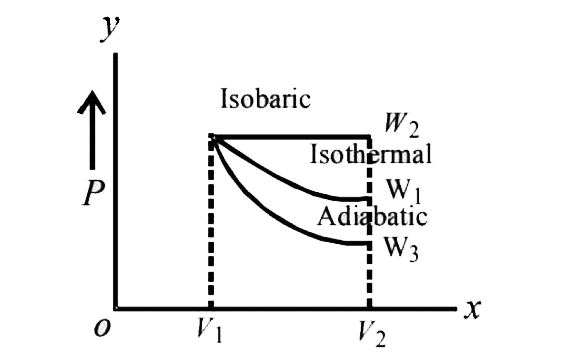
Starting with the same initial conditions, an ideal gas expands from volume `V_1 to V_2` in three different ways. The work done by the gas is W_1 if the process is purely isothermal, `W_2`if purely isobaric and `W_3` if purely adiabatic. Then
A
`W_(2)gt W_(1)gtW_(3)`
B
`W_(2)gt W_(3)gtW_(1)`
C
`W_(1)gt W_(2)gtW_(3)`
D
`W_(1)gt W_(3)gtW_(2)`
Text Solution
Verified by Experts
The correct Answer is:
a
Topper's Solved these Questions
IIT QUESTIONS 1
D MUKHERJEE|Exercise Assertion- Reason Type|2 Videos
IIT QUESTIONS 1
D MUKHERJEE|Exercise Linked- Comprehension Type|3 Videos
HEAT AND THERMODYNAMICS
D MUKHERJEE|Exercise All Questions|85 Videos
IIT QUESTIONS 2
D MUKHERJEE|Exercise Matrix matching type|1 Videos
Similar Questions
Explore conceptually related problems
With same initial conditions , an ideal gas expands from volume V_(1)" to "V_(2) in three different ways . The work done by the gas is W_(1) if the process is isothermal , W_(2) if isobaric and W_(3) if adiabatic , then
Starting with the same initial conditions, an ideal gas expands from volume V_(1) to V_(2) . The amount of work done by the gas is greatest when the expansion is
A sample of gas expands from volume V_(1) to V_(2) . The amount of work done by the gas is greatest when the expansion is
A gas expands under constant pressure P from volume V_(1) to V_(2) The work done by the gas is
An ideal gas expands from an intial volume V into vacuume under isothermal conditions. For this process,
Entrolpy change in isothermal expansion work of one mole of an ideal gas from volume V_(1) and V_(2) is given by
Let Q and W denote the amount of heat given to an ideal gas the work done by it in an isothermal process.