Home
Class 12
CHEMISTRY
Consider a reaction A(g)overset(k=0.1 M ...

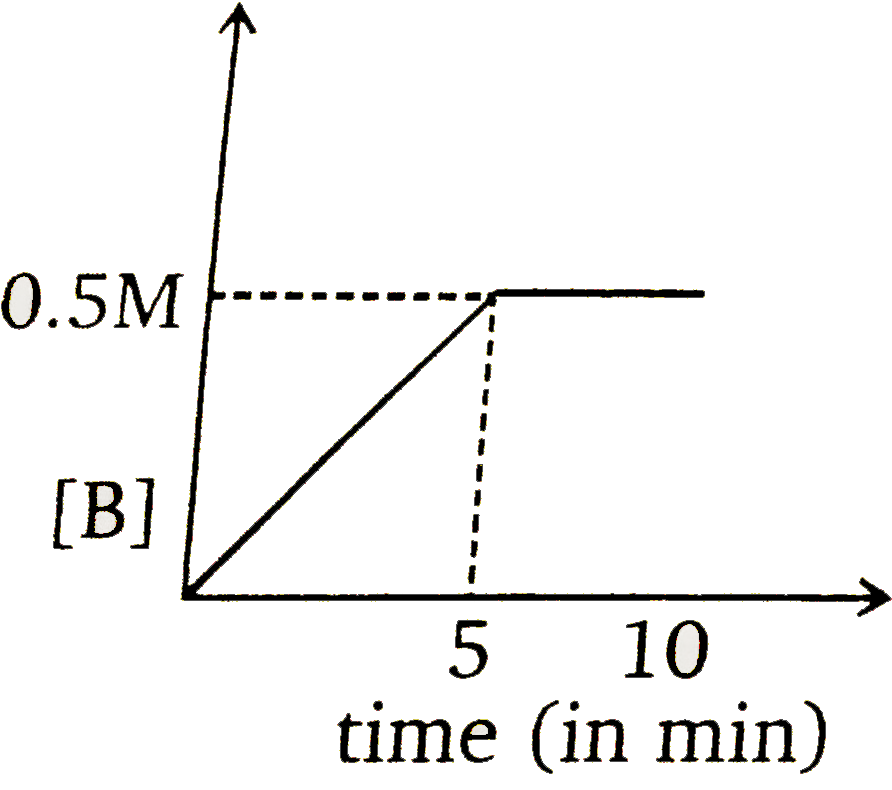
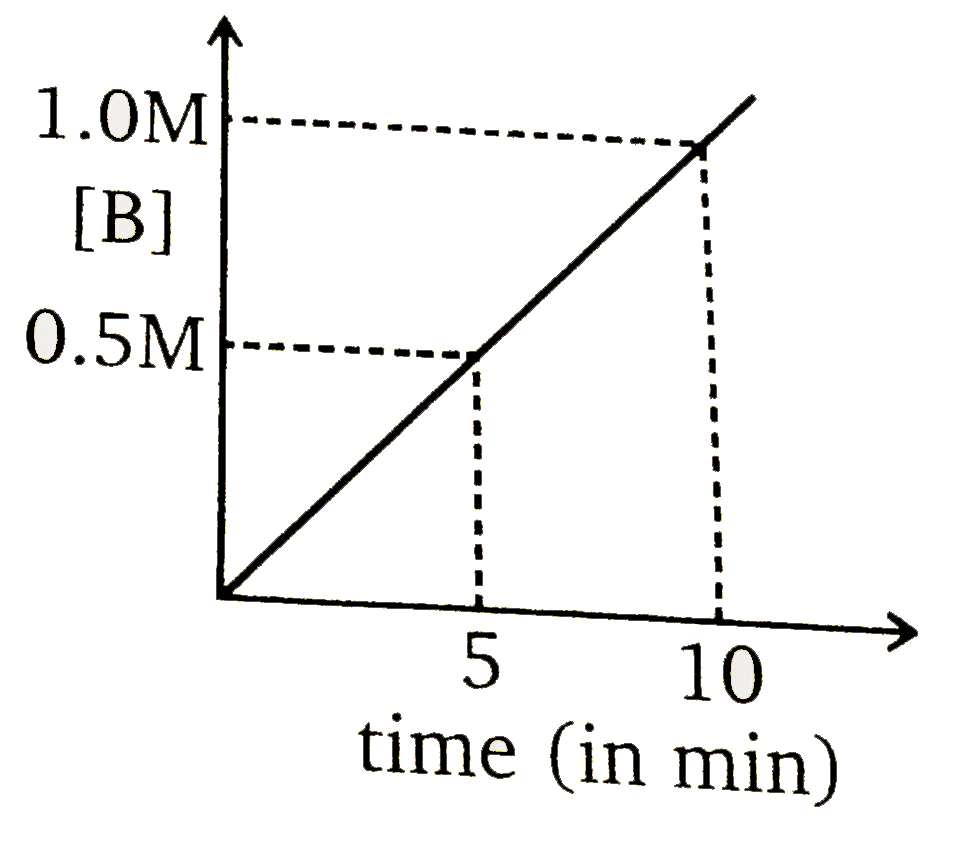
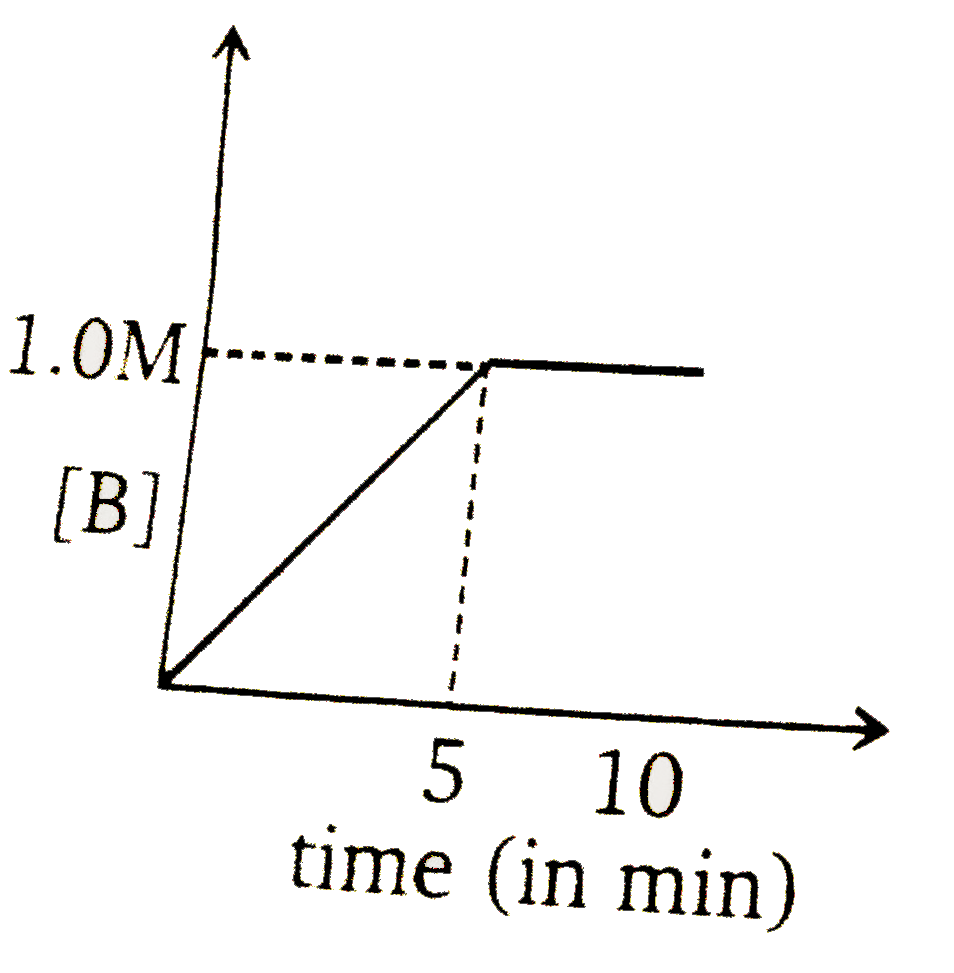
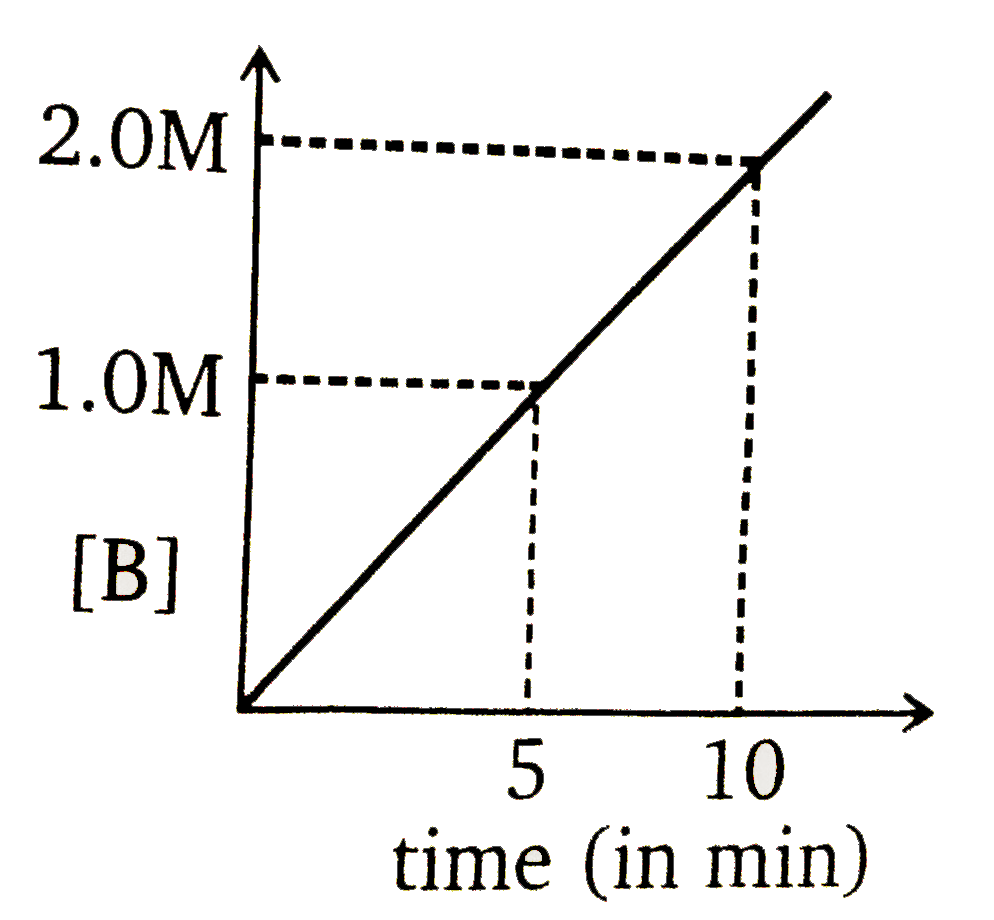
Consider a reaction `A(g)overset(k=0.1 M min^(-1))to2B(g)`. If initial concentration of A is 0.5 M then select correct graph.

A

B

C

D

Text Solution

AI Generated Solution

The correct Answer is:

To solve the problem, we need to analyze the reaction and its kinetics step by step. ### Step 1: Identify the Reaction Order The reaction given is: \[ A(g) \overset{k=0.1 \, \text{M min}^{-1}}{\rightarrow} 2B(g) \] The rate constant \( k \) has units of \( \text{M min}^{-1} \). This suggests that the reaction is a zero-order reaction because the unit of the rate constant for a zero-order reaction is \( \text{M} \cdot \text{time}^{-1} \). ### Step 2: Write the Rate Law Expression For a zero-order reaction, the rate law can be expressed as: \[ \text{Rate} = k \] And the concentration of the reactant \( A \) over time can be described by the equation: \[ [A] = [A_0] - kt \] Where: - \( [A_0] \) is the initial concentration of \( A \) - \( k \) is the rate constant - \( t \) is time ### Step 3: Substitute Known Values Given: - \( [A_0] = 0.5 \, \text{M} \) - \( k = 0.1 \, \text{M min}^{-1} \) Substituting these values into the equation gives: \[ [A] = 0.5 - (0.1 \cdot t) \] ### Step 4: Calculate Concentration of A at Different Times 1. **At \( t = 0 \) min:** \[ [A] = 0.5 - (0.1 \cdot 0) = 0.5 \, \text{M} \] 2. **At \( t = 5 \) min:** \[ [A] = 0.5 - (0.1 \cdot 5) = 0.5 - 0.5 = 0 \, \text{M} \] 3. **At \( t = 10 \) min:** \[ [A] = 0.5 - (0.1 \cdot 10) = 0.5 - 1 = -0.5 \, \text{M} \] (This is not possible, indicating that the reaction will stop before reaching this time.) ### Step 5: Determine Concentration of B Since the stoichiometry of the reaction shows that 1 mole of \( A \) produces 2 moles of \( B \): - At \( t = 5 \) min, when \( [A] = 0 \): \[ [B] = 2 \times (0.5) = 1 \, \text{M} \] ### Step 6: Analyze the Graphs We need to select the correct graph based on the concentration of \( B \): - At \( t = 0 \): \( [B] = 0 \, \text{M} \) - At \( t = 5 \): \( [B] = 1 \, \text{M} \) - At \( t > 5 \): \( [B] \) remains constant at \( 1 \, \text{M} \) because \( A \) is fully consumed. ### Conclusion The correct graph should show: - An increase in the concentration of \( B \) from \( 0 \) to \( 1 \, \text{M} \) at \( t = 5 \) minutes. - A plateau at \( 1 \, \text{M} \) for \( t > 5 \) minutes.
Promotional Banner

Topper's Solved these Questions

  • CHEMICAL KINETIC & NUCLEAR CHEMISTRY

    NARENDRA AWASTHI|Exercise Level 1 (Q.3 To Q.32)|2 Videos
  • CHEMICAL KINETIC & NUCLEAR CHEMISTRY

    NARENDRA AWASTHI|Exercise Level 1 (Q.33 To Q.62)|3 Videos
  • SURFACE CHEMISTRY

    NARENDRA AWASTHI|Exercise Level 3 - Assertion - Reason Type Questions|1 Videos

Similar Questions

Explore conceptually related problems

For a reaction Aoverset(k_(r)=0.6M min^(-1))to2B starting with 1 M of 'A' only, concentration of B (in M) after 100 sec. and 200 sec. is respectively?

The rate law expresses the relationship of the rate of a reaction to the rate constant and the concentration of the reactants raised to some powers for the general reaction. aA+bBtocC+dD Rate law takes the form r=k[A]^(x)[B]^(y) where x and y are number that must be determined experimentely k is the rate constant and [A] and [B] are concentration of A & B respectively. The initial rate of zero order reaction of the gaseous equation A(g)to2B (g) is 10^(-2) M min^(-1) If the initial concentration of A is 0.1 M what would be concentration of B after 60 seconds ?

The rate constant for a first order reaction was found to be 0.082 min^(-1) . If initial concentration of reactant is 0.15M , how long would it take: (a) to reduce the concentration of A to 0.03 M ? (b) to reduce the concentration of A by 0.03 M ?

For a zero order reaction : A rarr 2B, initial rate of a reaction is 10^(-1)"M min"^(-1) . If concentration of 'A' is 0.1 after 120 sec then what would be concentration of B after 60 sec.

For any reaction A(g) rarr B(g) , rate constant k = 8.21 xx 10^(-2) atm/min at 300 K. If initial concentration of A is 2M then what is the half life (in hr.)?

Consider the reaction : {:(,P(g)+,2Q(g)overset(K_(C )=10^(12))hArr,R(g)+,S(g)),("Initial conc.",2M,4M,0,0):} then select correct statement(s)
