Home
Class 12
CHEMISTRY
Decomposition of NH(4)NO(2)(aq into N(2)...

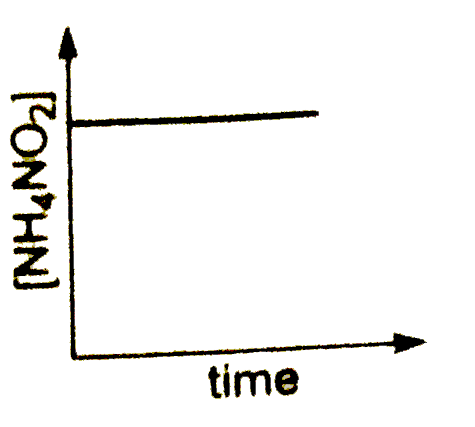
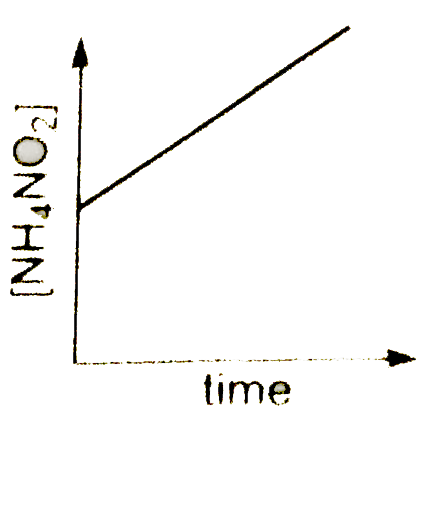
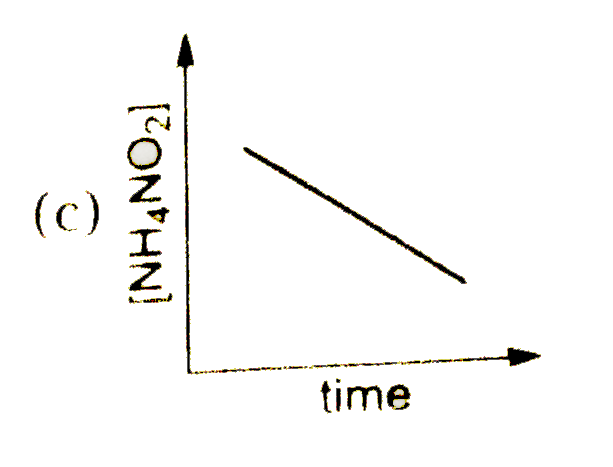
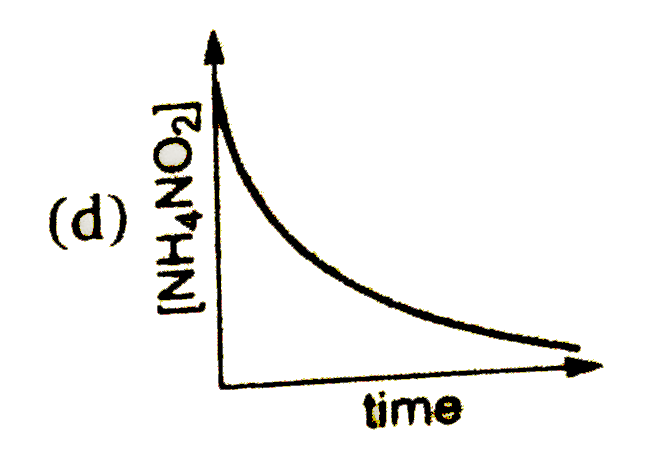
Decomposition of `NH_(4)NO_(2)(aq` into `N_(2)(g)` and `2H_(2)O(l)` is first order reaction.

A

B

C

D

Text Solution

AI Generated Solution

The correct Answer is:

To solve the problem regarding the decomposition of ammonium nitrite (NH₄NO₂) into nitrogen gas (N₂) and water (H₂O), we need to analyze the reaction and its characteristics as a first-order reaction. Here’s a step-by-step solution: ### Step 1: Write the Reaction The decomposition reaction can be represented as: \[ \text{NH}_4\text{NO}_2(aq) \rightarrow \text{N}_2(g) + 2\text{H}_2\text{O}(l) \] ### Step 2: Identify the Order of the Reaction The problem states that this is a first-order reaction. In a first-order reaction, the rate of reaction is directly proportional to the concentration of one reactant. ### Step 3: Write the Rate Law For a first-order reaction, the rate law can be expressed as: \[ \text{Rate} = -\frac{d[\text{NH}_4\text{NO}_2]}{dt} = k[\text{NH}_4\text{NO}_2] \] where \( k \) is the rate constant. ### Step 4: Integrate the Rate Law To find the relationship between concentration and time, we need to integrate the rate law. Rearranging gives: \[ \frac{d[\text{NH}_4\text{NO}_2]}{[\text{NH}_4\text{NO}_2]} = -k dt \] Integrating both sides: \[ \int \frac{d[\text{NH}_4\text{NO}_2]}{[\text{NH}_4\text{NO}_2]} = -k \int dt \] This results in: \[ \ln[\text{NH}_4\text{NO}_2] = -kt + C \] Where \( C \) is the integration constant. At \( t = 0 \), let \( [\text{NH}_4\text{NO}_2] = [\text{NH}_4\text{NO}_2]_0 \): \[ \ln[\text{NH}_4\text{NO}_2]_0 = C \] Substituting back gives: \[ \ln[\text{NH}_4\text{NO}_2] = -kt + \ln[\text{NH}_4\text{NO}_2]_0 \] ### Step 5: Exponential Form Exponentiating both sides to eliminate the natural logarithm yields: \[ [\text{NH}_4\text{NO}_2] = [\text{NH}_4\text{NO}_2]_0 e^{-kt} \] ### Step 6: Graphical Representation The concentration of NH₄NO₂ decreases exponentially over time. The graph of concentration vs. time for a first-order reaction will show a downward curve, indicating that as time increases, the concentration of NH₄NO₂ decreases. ### Step 7: Identify the Correct Graph Based on the characteristics of a first-order reaction, the graph will be an exponential decay curve. Among the options provided, the correct graph will be the one that shows a decreasing exponential trend. ### Conclusion The correct answer is the graph that represents an exponential decrease in concentration over time. ---
Promotional Banner

Topper's Solved these Questions

  • CHEMICAL KINETIC & NUCLEAR CHEMISTRY

    NARENDRA AWASTHI|Exercise Level 1 (Q.3 To Q.32)|2 Videos
  • CHEMICAL KINETIC & NUCLEAR CHEMISTRY

    NARENDRA AWASTHI|Exercise Level 1 (Q.33 To Q.62)|3 Videos
  • SURFACE CHEMISTRY

    NARENDRA AWASTHI|Exercise Level 3 - Assertion - Reason Type Questions|1 Videos

Similar Questions

Explore conceptually related problems

The gas phase reaction 2NO_(2)(g) rarr N_(2)O_(4)(g) is an exothermic reaction. The decomposition of N_(2)O_(4) in equilibrium mixture of NO_(2)(g) and N_(2)O_(4) can be increased by :

NH_(4)NO_(3) overset(Delta) to N_(2)O+H_(2)O

The molar heat of formation of NH_(4)NO_(3)(s) is -360.0kJ and those of N_(2)O(g) and H_(2)O(l) are +80.00kJ and -285.00kJ , respectively, at 25^(@)C and 1atm . Calculate DeltaH and DeltaU for the reaction. NH_(4)NO_(3)(s) rarr N_(2)O(g) +2H_(2)O(l)

The molar heat of formation of NH_(4)NO_(3)(s) is -367.5kJ and those of N_(2)O(g) and H_(2)O(l) are +81.46kJ and -285.78kJ respectively at 25^(@)C and 1 atmospheric pressure. Calculate the DeltaH and DeltaU for the reaction, NH_(4)NO_(3)(s)toN_(2)O(g)+2H_(2)O(l)

In the reaction NH_(4)NO_(2)(aq.) rarr N_(2)(g) + 2H_(2)O(l) the volume of N_(2) after 20 min and after a long time is 40 ml and 70 ml respectively, The value of rate constant is :
