Home
Class 12
PHYSICS
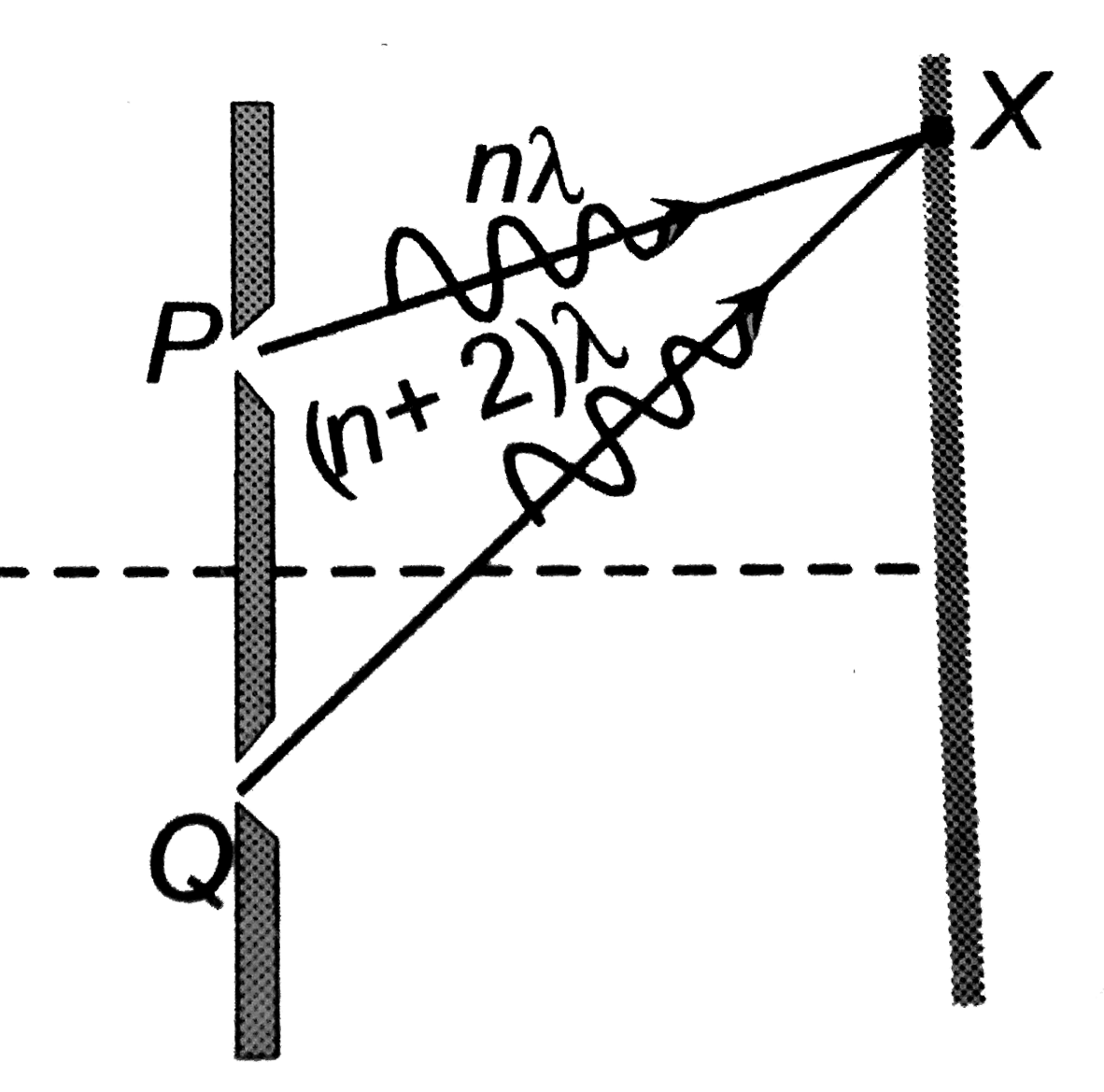
The figure shows a double slit experimen...

The figure shows a double slit experiment with P and Q as the slits. The path lengths PX and QX are `nlambda` and `(n+2)lambda` respectively, where n is a whole number and `lambda` is the wavelength. Taking the central fringe as zero, what is formed at X?

A

first bright

B

first dark

C

second bright

D

second dark

Text Solution

Verified by Experts

The correct Answer is:

C
Promotional Banner

Similar Questions

Explore conceptually related problems

Fig show a double slit experiment, P and Q are the two coherent source. The path lengths PY and QY are n lambda and (n+4)lambda respectively where n is whole number and lambda is wavelength. Taking the central bright fringe as zero, what is fromed at Y ?

In a Young's double slit experiment, let S_(1) and S_(2) be the two slits, and C be the centre of the screen. If angle S_(1)CS_(2)=theta and lambda is the wavelength, the fringe width will be

In a Young's double slit experiment using red and blue lights of wavelengths 600 nm and 480 nm respectively, the value of n for which the nth red fringe coincides with (n+1) th blue fringe is

In Young's double slit experiment, wavelength lambda=5000Å the distance between, the slits is 0.2mm and the screen is at 200cm from the slits. The central maximum is at x=0 The third maximum (Taking the central maximum as zeroth maximum) will be at x equal to

In a double slit experiment, the separation between the slits is d and distance of the screen from slits is D. If the wavelength of light used is lambda and I is theintensity of central bright fringe, then intensity at distance from central maximum is

In Young's double slit experiment the intensity of light at a point on the screen where the path difference lambda is K. The intensity of light at a point where the path difference is (lambda)/(6) [ lambda is the wavelength of light used] is

In a Young's double slit experiment (slit distance d) monochromatic light of wavelength lambda is used and the figure pattern observed at a distance L from the slits. The angular position of the bright fringes are

In a Young's double slit experiment, one of the slits is covered by a thin film of thickness t=0.04 mm, and refractive index mu=1.2+(9xx10^(-14)m^(2))/(lambda^(2)) , where lambda is the wavelength in meter. A beam of light consisting of two wavelength lambda_(1)=400nm and lambda_(2)=600 nm falls normally on the plane of the slits. Find the distance between two central maxima in milimeter. Distance of screen from slits is 400 times the the separation between the slits.
