Home
Class 12
PHYSICS
Two ideal slits S(1) and S(2) are at a d...

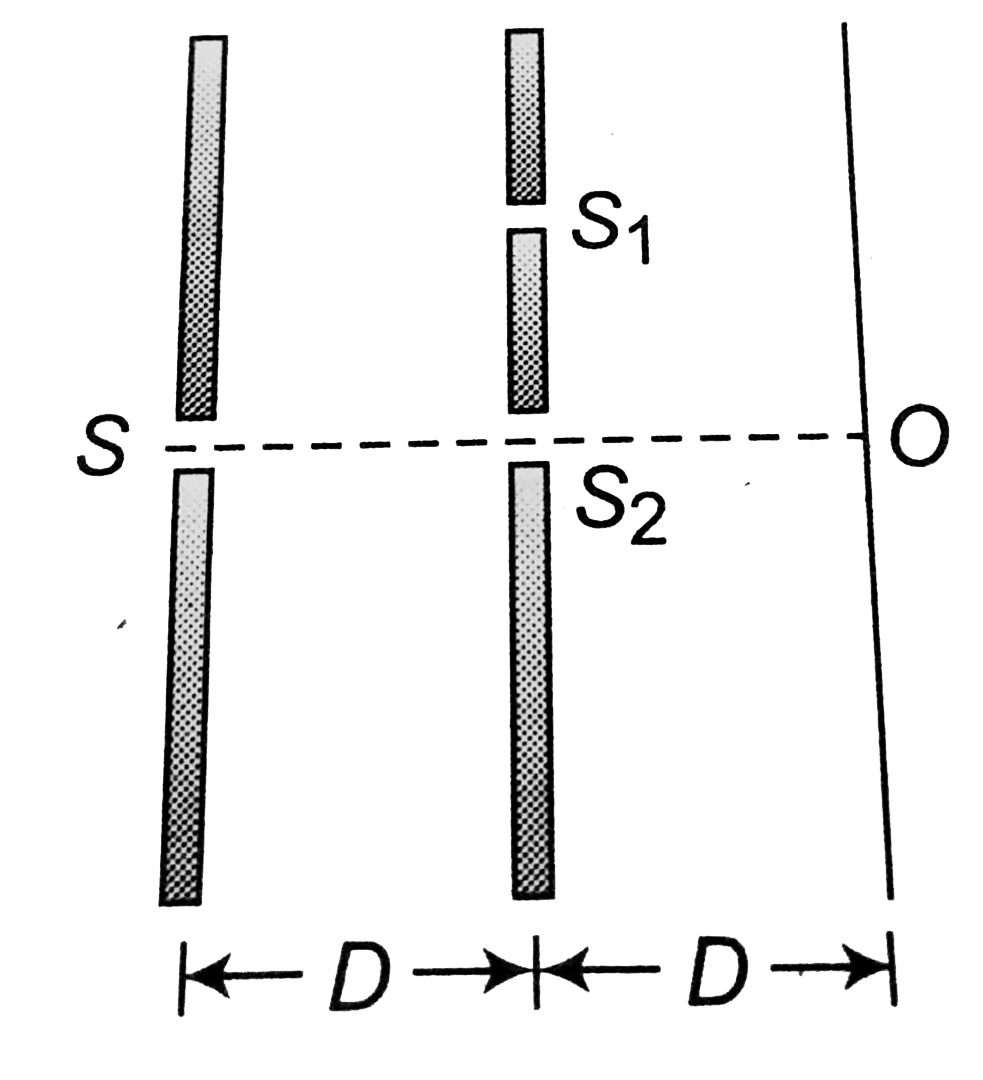
Two ideal slits `S_(1)` and `S_(2)` are at a distance `d` apart, and illuninated by light of wavelength `lambda` passing through an ideal source slit `S` placed on the line through `S_(2)` as shown. The distance between the planes of slits and the source slit is `D.A` screen is held at a distance `D` from the plane of the slits. The minimum value of `d` for which there is darkness at `O` is `(dlt lt D)`

A

`sqrt((3lamdaD)/(2))`

B

`sqrt(lamdaD)`

C

`(sqrt((lamdaD)/(2)))`

D

`sqrt(3lamdaD)`

Text Solution

Verified by Experts

The correct Answer is:

C
Promotional Banner

Similar Questions

Explore conceptually related problems

A parallel beam of light of wavelength lambda passes through a slit of width d. The transmitted light is collected on a screen D aways (D gt gt d) . Find the distance between the two second order minima.

In a double slit experiment, the distance between the slits is d. The screen is at a distance D from the slits. If a bright fringe is formed opposite to one of the slits, its order is

White light of wavelength in range 400 nm to 700 nm is incident normaly on a young's double slit experiment apparatus. The distance betweenn slits is d=1 mm and distance between plane of the slits and screen in 0.8 m. At a point on the screen just in front of one of the slits the missing wavelength is (are)

In a Young's double slit experiment, bi-chromatic light of wavelengths 400 nm and 560 nm are used. The distance between the slits is 0.1 mm and the distance between the plane of the slits and the screen is 1m. The minimum distance between two successive regions of complete darkness is

Consider the situation shown in fig. The two slits S_(1) and S_(2) placed symmetrically around the central line are illuminated by monochromatic light of wavelength lambda . The separation between the slit is d. The ligth transmitted by the slits falls on a screen S_(0) placed at a distance D form the slits. The slit S_(3) is at the central line and the slit S_(4) is at a distance z from S_(3) Another screen S_(c) is placed a further distance D away from S_(c) Find the ratio of the maximum to minimum intensity observed on S_(c) If z = (lambda D)/(2 d)

Consider the situation shown in fig. The two slits S_(1) and S_(2) placed symmetrically around the central line are illuminated by monochromatic light of wavelength lambda . The separation between the slit is d. The ligth transmitted by the slits falls on a screen S_(0) placed at a distance D form the slits. The slit S_(3) is at the central line and the slit S_(4) is at a distance z from S_(3) Another screen S_(c) is placed a further distance D away from S_(c) Find the ratio of the maximum to minimum intensity observed on S_(c) If z = (lambda D)/(4 d)

Consider the situation shown in fig. The two slits S_(1) and S_(2) placed symmetrically around the central line are illuminated by monochromatic light of wavelength lambda . The separation between the slit is d. The ligth transmitted by the slits falls on a screen S_(0) placed at a distance D form the slits. The slit S_(3) is at the central line and the slit S_(4) is at a distance z from S_(3) Another screen S_(c) is placed a further distance D away from S_(c) Find the ratio of the maximum to minimum intensity observed on S_(c) If z = (lambda D)/(d)

In a YDSE arrangement, the distance of screen from the slits is half the distance between the slits. If 'lambda' is the wavelength of then the value of D such that first minima on the screen falls at a distance D from then centre 'O' is

In a Young's double-slit experiment, if the incident light consists of two wavelengths lambda_(1) and lambda_(2) , the slit separation is d, and the distance between the slit and the screen is D, the maxima due to each wavelength will coincide at a distance from the central maxima, given by

Young's double slit experiment is carried out using microwaves of wavelength lambda=3cm . Distance between the slits is d= 5cm and the distance between the plane of slits and the screen is D=100cm . (a) Find total number of maxima and (b) their positions on the screen.
