

Home
Class 11
PHYSICS
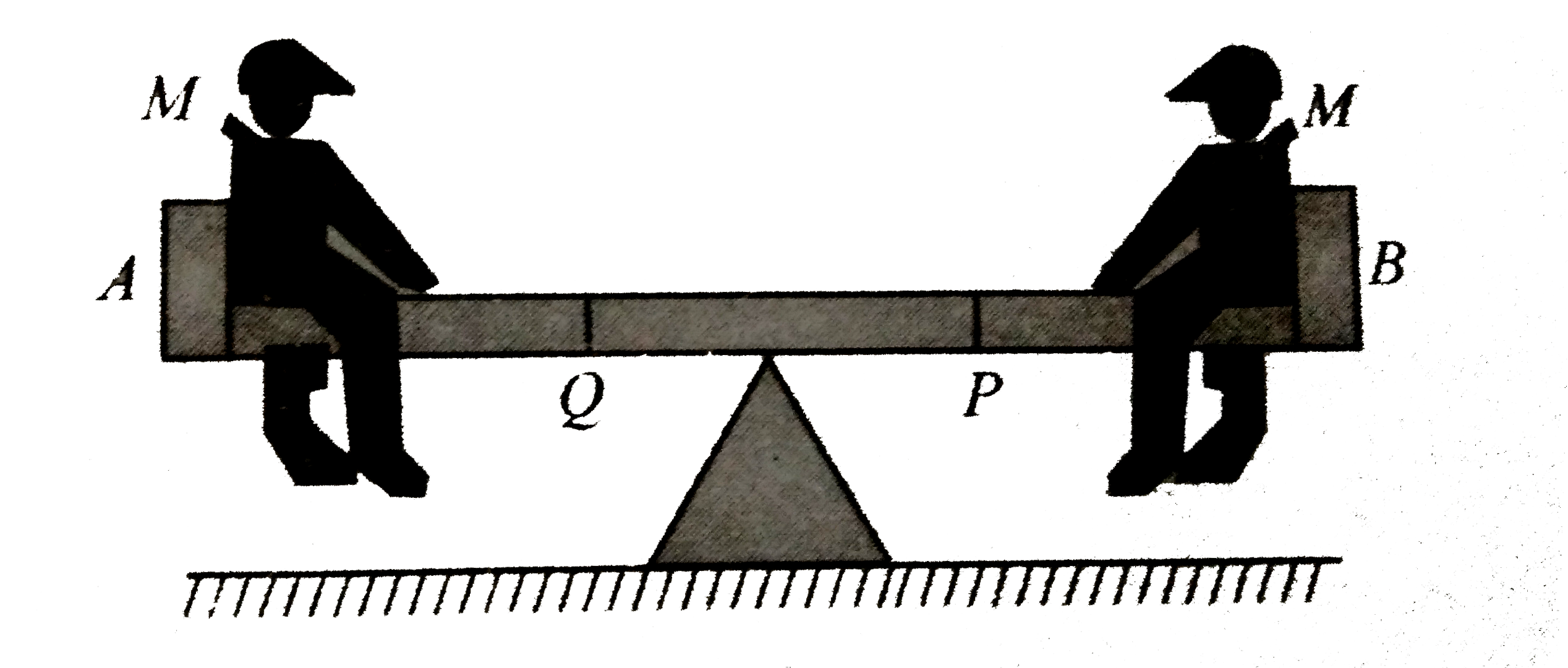
Two children A and B of same mass (inclu...

Two children `A` and `B` of same mass (including their caps) `M` are sitting On a see-saw as shown in Fig. Initially, the beam is horizontal. At once, child `B` throws away his cap (mass `M/25`) which falls at point `Q`, midpoint of the left half of the beam, due to this the balance of beam is disturbed. To balance it again what is the mass in required to be put at point `P` on the right half of the beam?

Promotional Banner

Topper's Solved these Questions

  • LINEAR MOMENTUM & ITS CONSERVATION

    PHYSICS GALAXY - ASHISH ARORA|Exercise Practive Exercise|28 Videos
  • LINEAR MOMENTUM & ITS CONSERVATION

    PHYSICS GALAXY - ASHISH ARORA|Exercise Discussio Q|28 Videos
  • KINEMATICS

    PHYSICS GALAXY - ASHISH ARORA|Exercise Unsolved Numerical Pro.|83 Videos
  • NEWTONS LAWS OF MOTION

    PHYSICS GALAXY - ASHISH ARORA|Exercise Unsolved Numerical Problem|81 Videos

Similar Questions

Explore conceptually related problems

A faulty balance with unequal arms has its beam horizontal. Are the weights of the two pans equal ?

The radius of plant A is half the radius of planet B . If the mass of A is M_(A) , what must be the mass of B so that the value of g on B is half of its value on A ?

A proton beam is fired from west to east and an electron beam is fired parallel to it in the same direction. Force on the electron beam will be

When slightly different weights are placed on the two pans of a beam balance, the beam comes to rest at an angle with the horizontal. The beam is supported at a single point P by a pivot.

A rigid massless beam is balanced by a particle of mass 4m in left hand side and a pulley particle system in right hand side. The value of x/y is

If the weighing is done by a physical beam balance, the buyer will have the same mass of sugar per kg both at the pole and at the equator.

Find the reading of spring balance as shown in fig. Assume that mass M in equilibrium. (All surfaces are smooth).

If parallel beam of light falls on a convex lens. The path of the rays is shown in fig. It follows that