

Home
Class 11
PHYSICS
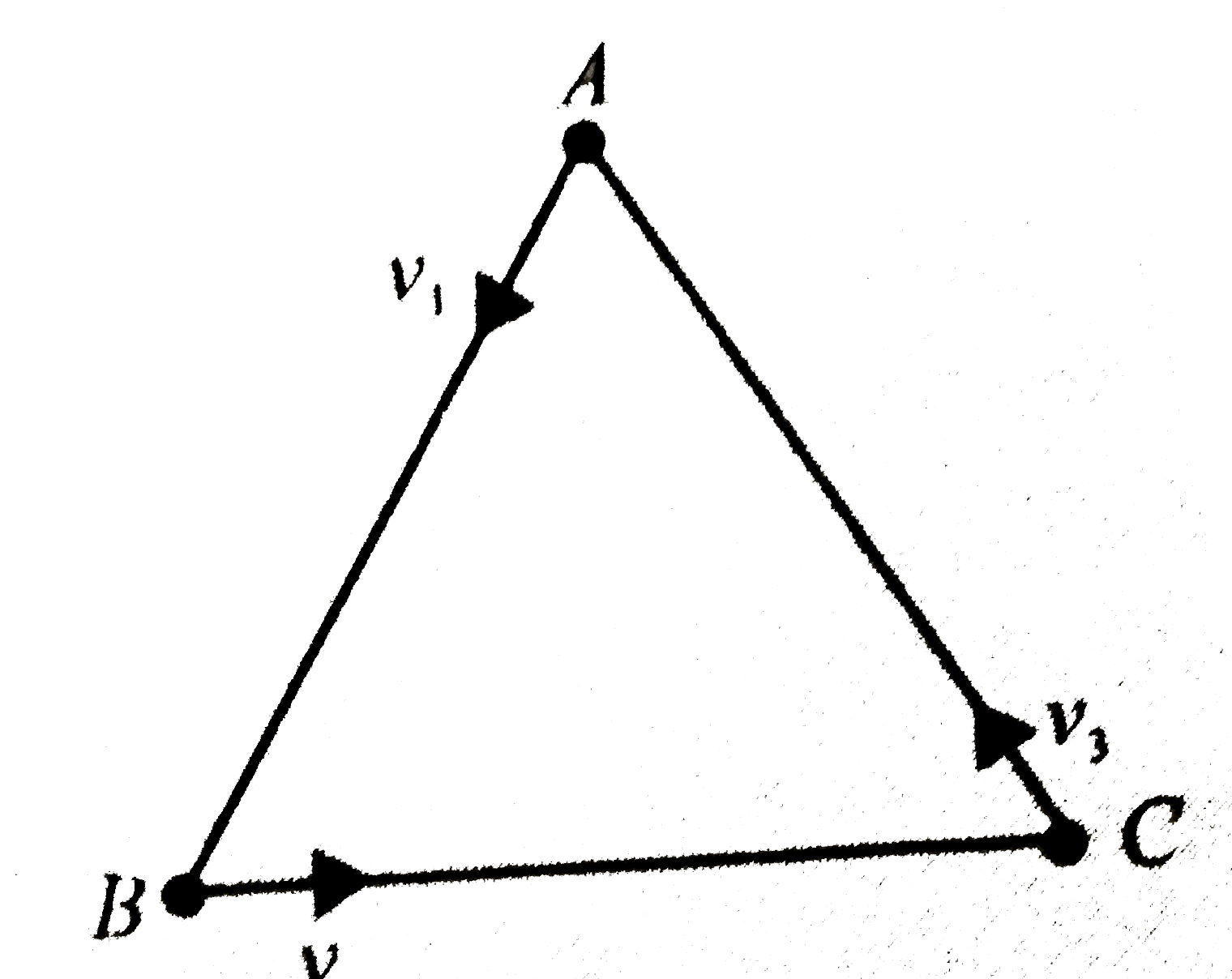
Let there are three equal masses situate...

Let there are three equal masses situated at the vertices of an equilateral triangle, as shown in Fig. Now particle `A` starts with a velocity `v_(1)` towards line `AB`, particle `B` starts with the velocity `v_(2)`, towards line `BC` and particle `C` starts with velocity `v_(3)` towards line `CA`. Find the displacement of the centre of mass of the three particles `A, B` and `C` after time `t`. What would it be if `v_(1)=v_(2)=v_(3)`?

Promotional Banner

Topper's Solved these Questions

  • LINEAR MOMENTUM & ITS CONSERVATION

    PHYSICS GALAXY - ASHISH ARORA|Exercise Practive Exercise|28 Videos
  • LINEAR MOMENTUM & ITS CONSERVATION

    PHYSICS GALAXY - ASHISH ARORA|Exercise Discussio Q|28 Videos
  • KINEMATICS

    PHYSICS GALAXY - ASHISH ARORA|Exercise Unsolved Numerical Pro.|83 Videos
  • NEWTONS LAWS OF MOTION

    PHYSICS GALAXY - ASHISH ARORA|Exercise Unsolved Numerical Problem|81 Videos

Similar Questions

Explore conceptually related problems

Three particles of equal masses are placed at the corners of an equilateral triangle as shown in the figure. Now particle A starts with a velocity v_(1) towards line AB , particle B starts with a velocity v_(2) towards line BC and particle C starts with velocity v_(3) towards line CA . The displacement of CM of three particle A, B and C after time t will be (given if v_(1)=v_(2)=v_(3))

Three particles A, B, Care located at the comers of an equilateral triangle as shown in figure. Each of the particle is moving with velocity v. Then at the instant shown, the relative angular velocity of

A particle moves with a velocity v(t)= (1/2)kt^(2) along a straight line . Find the average speed of the particle in a time t.

Two identical particles move towards each other with velocity 2v and v respectively. The velocity of centre of mass is

A particle of mass m has a velocity -v_(0) i , while a second particle of same mass has a velocity v_(0) j . After the particles collide, first particle is found to have a velocity (-1)/(2) v_(0) overline i then the velocity of othe particle is

Three particles A,B and C and situated at the vertices of an equilateral triangle ABC of side of length l at time t=0 ,Each of the particles move with constant speed u . A always has its velocity along AB, B along BC and C along CA .

Three particles A, B and C are situated at the vertices of an equilateral triangle ABC of side d at time t=0. Each of the particles moves with constant speed v. A always has its velocity along AB, B along BC and C along CA. At what time will the particles meet each other?

The acceleration of a particle varies with time t as a=t^(2)+t+2 where t is in seconds. The particle starts with an initial velocity v-3m/s at t=0. find the velocity of the particle at the end of 5s.