

Home
Class 11
PHYSICS
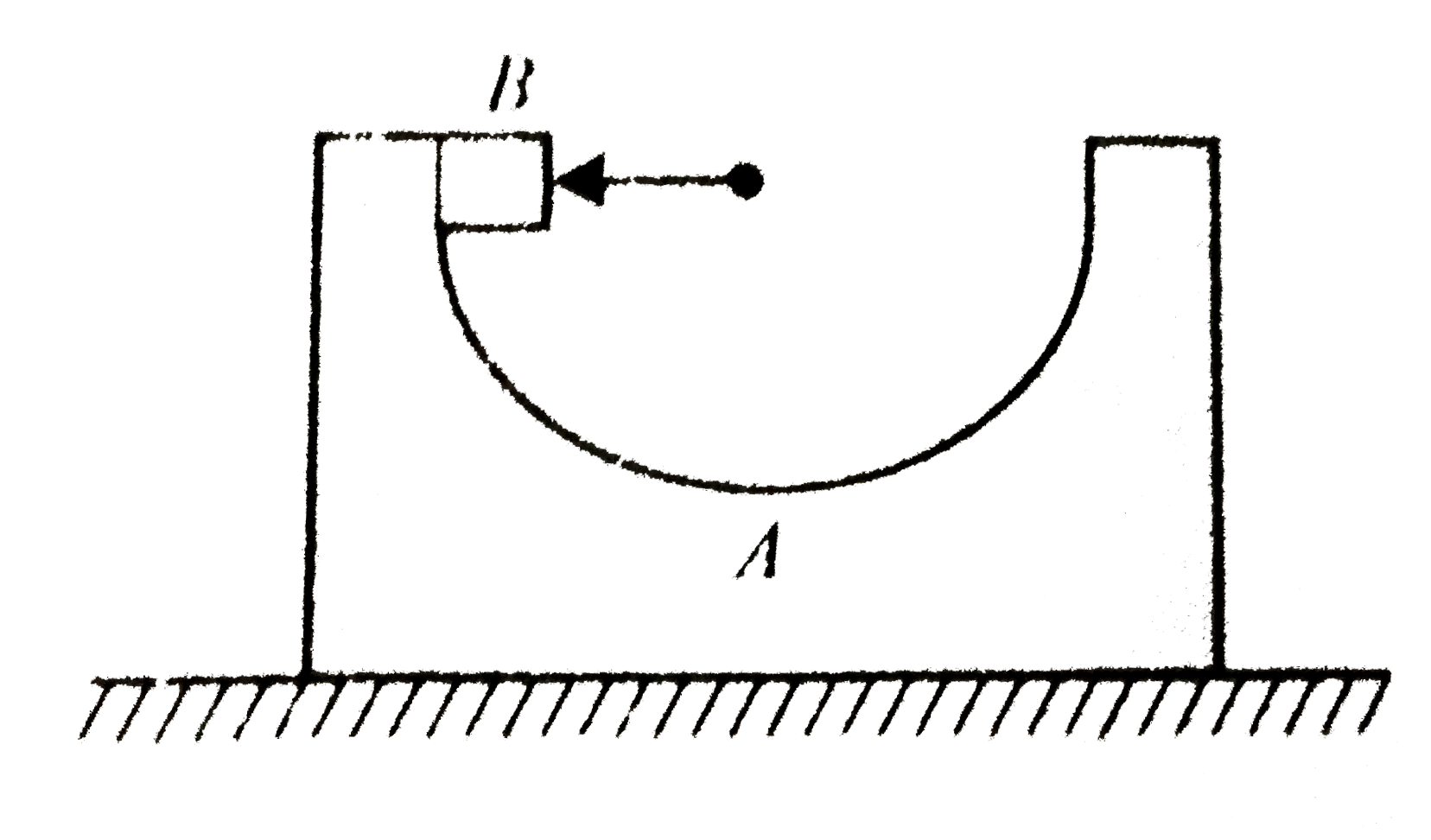
Figure shows a block A of mass 6 m havin...

Figure shows a block `A` of mass `6 m` having a smooth semicircular groove of radius a placed on a smooth horizontal surface. A block `B` of mass `m` is released from a position in groove where its radius is horizontal. Find the speed of the bigger block when the smaller block reaches its bottom most position.

Promotional Banner

Topper's Solved these Questions

  • LINEAR MOMENTUM & ITS CONSERVATION

    PHYSICS GALAXY - ASHISH ARORA|Exercise Practive Exercise|28 Videos
  • LINEAR MOMENTUM & ITS CONSERVATION

    PHYSICS GALAXY - ASHISH ARORA|Exercise Discussio Q|28 Videos
  • KINEMATICS

    PHYSICS GALAXY - ASHISH ARORA|Exercise Unsolved Numerical Pro.|83 Videos
  • NEWTONS LAWS OF MOTION

    PHYSICS GALAXY - ASHISH ARORA|Exercise Unsolved Numerical Problem|81 Videos

Similar Questions

Explore conceptually related problems

Figure shows a wedge A of mass 6 m smooth semicircular groove of radius a= 8.4 m placed on a smooth horizontal surface. A small block B of mass m is released from a position in groove where its radius is horizontal. Find the speed (in ms^(-1) ) of bigger block when smaller block reaches its bottommost position.

A block of mass m is placed at rest on a smooth wedge of mass M placed at rest on a smooth horizontal surface. As the system is released

Figure shows a small block of mass m which is started with a speed v on the horizontal part of the bigger block of mas m placed on a horizontal floor. The curved part of the surface shown is semicircular. All the surfaces are frictionless. Find the speed of the bigger block when the smaller block reaches the point A of the surface.

A smooth wedge of mass M rests on a smooth horizontal surface. A block of mass m is projected from its lowermost point with velocity v_(0) . What is the maximum height reached by the block?

A block is released from position A in the following figure. Find the speed of the block in position B. Assume the surface as frictionless.

A block of mas m is placed on a triangular block of mas m, which in tunis placed on a horizontal surface as shown in figure. Assuming frictionless surfaces find the velocity of the triangular block when the smaller block reaches the bottom end.

A block of mass m is placed on a triangular block of mass M(M = 2m) , as shown. All surfaces are smooth. Calculate the velocity of triangular block when the smaller block reaches at bottom.

A block of mass m is released from the top of a wedge of mass M as shown in figure. Find the displacement of wedges on the horizontal ground when the block reaches the bottom of the wedges. Neglect friction everywhere.

A small block of mass m is released from rest from position A inside a smooth hemispherical bowl of radius R as shown in figure Choose the wrong option.