

Home
Class 11
PHYSICS
A non-viscous liquid of constant density...

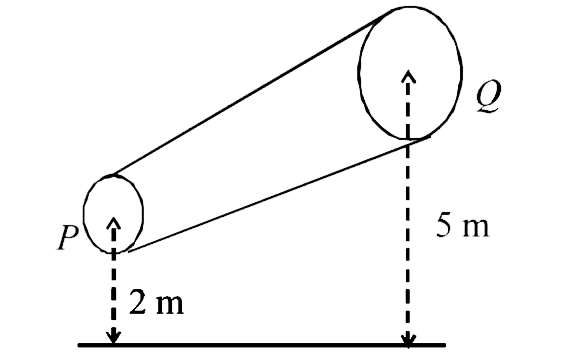
A non-viscous liquid of constant density `1000kg//m^3` flows in a streamline motion along a tube of variable cross section. The tube is kept inclined in the vertical plane as shown in Figure. The area of cross section of the tube two point P and Q at heights of 2 metres and 5 metres are respectively `4xx10^-3m^2` and `8xx10^-3m^2`. The velocity of the liquid at point P is `1m//s`. Find the work done per unit volume by the pressure and the gravity forces as the fluid flows from point P to Q.

Promotional Banner

Topper's Solved these Questions

  • FLUID MECHANICS

    PHYSICS GALAXY - ASHISH ARORA|Exercise practice Exercise 7.1|10 Videos
  • FLUID MECHANICS

    PHYSICS GALAXY - ASHISH ARORA|Exercise Practice Exercise 7.2|8 Videos
  • GRAVITATION

    PHYSICS GALAXY - ASHISH ARORA|Exercise Unsolved Numerical|94 Videos

Similar Questions

Explore conceptually related problems

(i) Air (density= rho ) flows through a horizontal venturi tube that discharges to the atmosphere. The area of cross section of the tube is A_(1) and at the constriction it is A_(2) . The constriction is connected to a water (density =rho_(0) ) tank through a vertical pipe of lenght H. Find the volume flow rate (Q) of the air through tube that is needed to just draw the water into the tube. (ii) A non viscous liquid of constant density rho flows in a stremline motion along a tube of variable cross section. The tube is kept inclined in the vertical plane as shown in the figure. The area of cross section of the tube at two points P and Q at heights of h_(1) and h_(2) are respectively A_(1) and A_(2) . The velocity of the liquid at point P is v. Find the work done on a small volume DeltaV of fluid by the neighbouring fluid as the small volume moves from P to Q.

A non-viscous liquid of constant density 500 kg//m^(3) flows in a variable cross-sectional tube. The area of cross section of the tube at two points P and Q at heights of 3 m and 6 m are 2 xx 10^(-3) m^(3) and 4 xx 10^(-3) m^(3) , respectively. Find the work done per unit volume by the forces of gravity as the fluid flows from point P to Q .

A non viscous liquid of constant density 10^(3) kg//m^(3) flows in stream line motion along a vertical tube PQ of variable cross-section. Height of P and Q are 2m and 2.5m respectively. Area of tube at Q is equal to 3 times the area of tube at 'P'. Then work done per unit volume by pressure as liquid flows from P and Q. Speed of liquid at 'P' is 3 m//s .

Water flows through the tube shown in figure. The areas of cross section of the wide and the narrow portions of the tube are 5cm^2 and 2cm^2 respectively. The rate of flow of water through the tube is 500 cm^3s^-1 . Find the difference of mercury levels in the U-tube.

A liquid of density rho comes out with a velocity v from a horizontal tube of area of cross-section A. The reaction force exerted by the liquid on the tube is F :

Water flows through the tubes shown in figure. The areas of cross-section of the wide and the narrow portions of the tube are 5 cm^(2) and 2 cm^(2) respectively. The rate of flow of water through the tube is 500 cm^(3)//s . Find the difference of mercury levels in the U-tube.

A V-shaped glass tube of uniform cross section is kept in a vertical plane as shown. A liquid is poured in the tube. In equilibrum the level of liquid in both limds of tube. Find the angular frequency of small oscillation of liquid.

Figure shows a liquid of densith 1200kgm^-3 flowing steadily in a tube of varying cross section. The cross section at a point A is 1.0cm^2 and that at B is 20mm^2 , the points A and B are in the same horizontal plane.The speed of the liquid at A is 10 cms^-1 . Calculate the difference in pressure at A and B.

PHYSICS GALAXY - ASHISH ARORA-FLUID MECHANICS-Unsolved Numerical Problems
  1. A non-viscous liquid of constant density 1000kg//m^3 flows in a stream...

    Text Solution

    |

  2. A block of wood floats in water two-thirds of its volume submerged. In...

    Text Solution

    |

  3. A balloon filled with hydrogen has a volume of 1m^(3) and its mass is ...

    Text Solution

    |

  4. A horizontal pipeline carries water in a streamline flow. At a point a...

    Text Solution

    |

  5. A glass tube of radius 0.8 cm floats vertical in water, as shown in fi...

    Text Solution

    |

  6. When equal volumes of two substances are mixed together, the specific ...

    Text Solution

    |

  7. Water from a tap emerges vertically downwards with an initial spped of...

    Text Solution

    |

  8. A piece of metal floats on mercury. The coefficient of volume expansio...

    Text Solution

    |

  9. A large open tank has two holes in the wall. One is a square hole of s...

    Text Solution

    |

  10. A tank 5 m high is half filled with water and then is filled to top wi...

    Text Solution

    |

  11. A stone of density 2.5 g//cm^(3) completely immersed in sea water is a...

    Text Solution

    |

  12. A cube of wood supporting 200gm mass just floats in water. When the ma...

    Text Solution

    |

  13. Water is flowing continuously from a tap having an internal diameter 8...

    Text Solution

    |

  14. A certain block weighs 15 N in air. But is weighs only 12 N when compl...

    Text Solution

    |

  15. A cylindrical tank 1 m in radius rests on a platform 5 m high. Initial...

    Text Solution

    |

  16. A vertical uniform U tube open at both ends contains mercury. Water is...

    Text Solution

    |

  17. A piece of copper having an internal cavity weights 264 g in air and 2...

    Text Solution

    |

  18. A beaker of mass 1 kg contains 2 kg of water and rests on a scale. A 2...

    Text Solution

    |

  19. A Piece of brass (alloy of zinc and copper) weighs 12.9 g in air. When...

    Text Solution

    |

  20. Shows a hydraulic press with the larger piston of diameter 35cm at a h...

    Text Solution

    |

  21. Two identical cyclindrical vessels (area of cross section 3.5 xx 10^(-...

    Text Solution

    |