Home
Class 11
PHYSICS
A vessel full of water has a bottom of a...

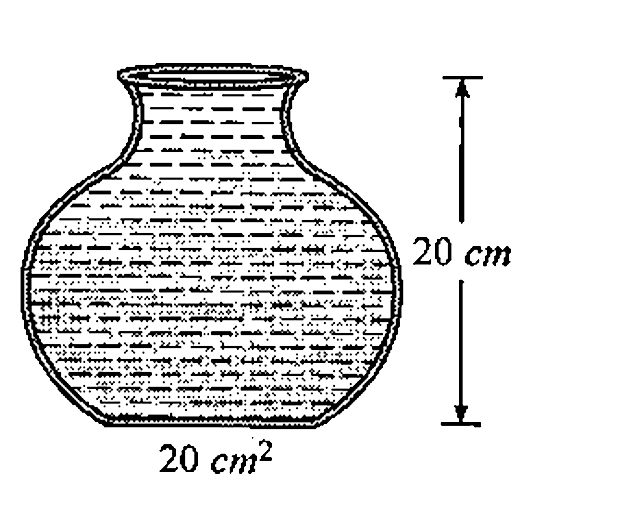
A vessel full of water has a bottom of area `20 cm^(2)`, top of area `20 cm^(2)`, height 20 cm and volume half a litre as shown in figure.
(a) find the force exerted by the water on the bottom.

(b) considering the equilibrium of the water, find the resultant force exerted by the sides of the glass vessel on the water. atmospheric pressure `=1.0xx10^(5) N//m^(2)`. density of water `=1000 kg//m^(3)` and `g=10m//s^(2)`

Text Solution

Verified by Experts

The correct Answer is:

(a) 204 N ; (b) 1N upwards
Promotional Banner

Topper's Solved these Questions

  • FLUID MECHANICS

    PHYSICS GALAXY - ASHISH ARORA|Exercise Practice Exercise 7.2|8 Videos
  • FLUID MECHANICS

    PHYSICS GALAXY - ASHISH ARORA|Exercise Practice exercise 7.3|9 Videos
  • FLUID MECHANICS

    PHYSICS GALAXY - ASHISH ARORA|Exercise Unsolved Numerical Problems|86 Videos
  • GRAVITATION

    PHYSICS GALAXY - ASHISH ARORA|Exercise Unsolved Numerical|94 Videos

Similar Questions

Explore conceptually related problems

A glass full of water has a bottom of area 20 cm^(2) , top of area 20 cm , height 20 cm and volume half a litre. a. Find the force exerted by the water on the bottom. b. Considering the equilibrium of the v , after. find the resultant force exerted by the side, of the glass on the water. Atmospheric pressure = 1.0 xx 10^(5) N//m^(2) . Density of water = 1000 kg//m^(-3) and g = 10 m//s^(2)

A glass full of water upto a height of 10 cm has a bottom of are 10 cm^(2) , top of area 30cm^(2) and volume 1 litre. (a) Find the force exerted by the water on the bottom. (b) Find the resultant force exerted by the sides of the glass on the water. (c ) If the glass is convered by a jar and the air inside the jar is completely pumped out, what will be the answer to parts (a) and (b). (d) If a glass of different shape is used, provided the height, the bottom area, the top area and the volume are unchanged, will the answer to parts (a) and (b) change. Take g=10m//s^(3) , density of water =10^(3) kg//m^(3) and atmospheric pressure =1.01xx10^(5)N//m^(2) .

A glass of water upto a height of 10 cm has a bottom of area 10 cm^(2) , top of area 30 cm^(2) and volume 1 litre. The downward force exerted by water on the bottom is…(Taking g=10 m//s^(2) ,density of water =10^(3) kg//m^(3) , atmosphereic pressure =1.01xx10^(5) N//m^(2) )

Prove that the pressure exerted by water at the bottom of the container depends on the height of its column.

A water container has water upto a height of 20 cm, volume 2 litres. Top of container has area 60 cm ""^(2) and bottom has area of 20 cm ""^(2) . The downward force exerted by water at the bottom will be.

A container of filled with water to a height of 10 m. The pressure exerted by the water at the bottom of the container is _________ .

A cylindrical vessel of height 500mm has an orifice (small hole) at its bottom. The orifice is initially closed and water is filled in it up to height H. Now the top is completely sealed with a cap and the orifice at the bottom is opened. Some water comes out from the orifice and the water level in the vessel becomes steady with height of water column being 200mm. Find the fall in height(in mm) of water level due to opening of the orifice. [Take atmospheric pressure =1.0xx10^5N//m^2 , density of water=1000kg//m^3 and g=10m//s^2 . Neglect any effect of surface tension.]

Water is filled in a flask upto a height of 20cm . The bottom of the flask is circular with radius 10 cm . If the atmospheric pressure is 1.013xx10^(5) Pa, find the force exerted by the water on the bottom . Take g=10 "ms"^(-2) and density of water =1000 "kgm"^(-3).
