Home
Class 11
PHYSICS
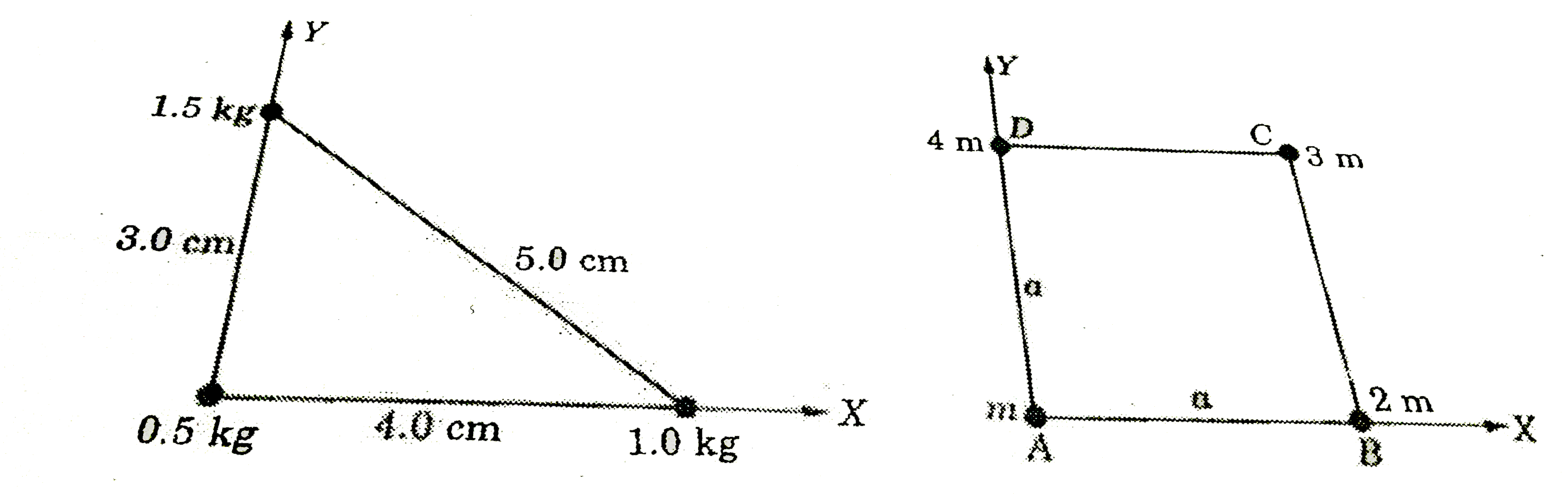
Three particles of masses 0.50 kg, 1.0 k...

Three particles of masses 0.50 kg, 1.0 kg and are placed at the corners of a right angle triangle, as shown in fig. Locate the centre of mass of the system.

Text Solution

Verified by Experts

The correct Answer is:

1.33 cm, 1.5 cm
Promotional Banner

Topper's Solved these Questions

  • ROTATIONAL MOTION

    SL ARORA|Exercise Problem|24 Videos
  • PROPERTIES OF SOLIDS

    SL ARORA|Exercise All Questions|97 Videos
  • System of particles & rotational Motion

    SL ARORA|Exercise EXERCISE|353 Videos

Similar Questions

Explore conceptually related problems

Three point particles of masses 1.0 kg, 1.5 kg and 2.5 kg are placed at three corners of a right angle triangle as shown in figure. The centre of mass of the system is at a point :

Four particles of masses m, m, 2m and 2m are placed at the corners of a square of side a, as shown in fig. Locate the centre of mass.

Three particles , each of mass m, are placed at the vertices of a right angled triangle as shown in figure. The position vector of the center of mass of the system is (O is the origin and hat(i), hat(j), hat(k) are unit vectors)

Particle of masses 2 kg, 2 kg, 1 kg and 1 kg are placed at the corners A, B, C, D of a square of side L as shown in Fig. Find the centre of mass of the system.

Three particles of masses 0.5 kg, 1.0 kg and 1.5 kg are placed at the three corners of a right angled triangle of sides 3.0 cm, 4.0 cm and 5.0 cm as shown in figure. Locate the centre of mass of the system.

Three masses 3,4 and 5 kg are located at the corners of an equilateral triangle of side 1m. Locate to centre of mass of the system.

Three point particles of masses 1.0 kg 2 kg and 3 kg are placed at three comers of a right angle triangle of sides 4.0 cm , 3.0 cm and 5.0 cm as shown in the figure . The centre of mass of the system is at point :

The point masses of 0.3 kg, 0.2 kg and 0.1 kg are placed at the corner of a right angles Delta ABC , as shown in Fig. 8.49. find the moment of inertia of the system (i) about an axis through A and perpendicular to the plane of the diagram and (ii) about an axis along BC.

Three point masses m1, m2, m3 are placed at the corners of an equilateral triangle of side 2 m. Locate the centre of mass of the system. m_(1)=2kg, m_(2)=3kg, m_(3)=4kg

SL ARORA-ROTATIONAL MOTION-Problem for self practice
  1. Two bodies of masses 10 kg and 2 kg are moving with velocities 2 hat(i...

    Text Solution

    |

  2. Four particles of masses m, m, 2m and 2m are placed at the four corner...

    Text Solution

    |

  3. Three particles of masses 0.50 kg, 1.0 kg and are placed at the corner...

    Text Solution

    |

  4. Four particles of masses m, m, 2m and 2m are placed at the corners of ...

    Text Solution

    |

  5. Two bodies of masses 2 kg and 1 kg are moving along the same line with...

    Text Solution

    |

  6. The mass per unit length (lambda) of a non-uniform rod varies linearly...

    Text Solution

    |

  7. The centre of mass of three particles of masses 1kg, 2 kg and 3kg lies...

    Text Solution

    |

  8. From a square sheet of uniform density , a portion a removed shown sha...

    Text Solution

    |

  9. A 100 g weight is tied at the end of a string and whirled around in ho...

    Text Solution

    |

  10. A gramophone disc rotates at 60 rpm. A coin of mass 18 g is placed at ...

    Text Solution

    |

  11. A string can withstand a tension of 25 N. What is the greatest speed ...

    Text Solution

    |

  12. A ball of mass 100 g is suspended by a string 40 cm long. Keeping the ...

    Text Solution

    |

  13. Find the maximum speed at which a car can take turn round a curve of 3...

    Text Solution

    |

  14. What should be the coefficient of friction between the tyres and the r...

    Text Solution

    |

  15. The mass of a bicycle rider along with the bicycle is 100 kg. he wants...

    Text Solution

    |

  16. A cyclist riding at a speed of 14sqrt(3) ms^(-1) takes a turn around a...

    Text Solution

    |

  17. A cyclist speeding at 6ms^(-1) in a circle of 18 m radius makes an ang...

    Text Solution

    |

  18. A motor cyclist goes round a circular race course of diameter 320 m at...

    Text Solution

    |

  19. An aeroplane travelling at a speed of 500 km h^(-1) tilts at an angle ...

    Text Solution

    |

  20. For traffic moving at 60 kmh^(-1), if the radius of the curve is 0.1 k...

    Text Solution

    |
