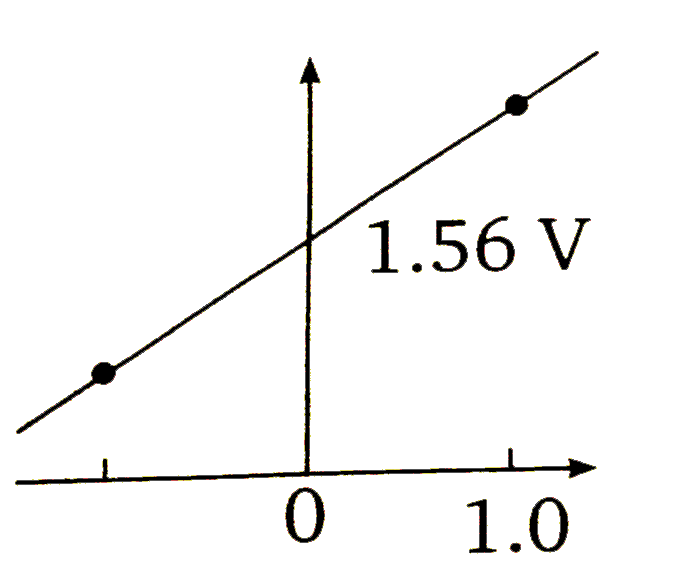
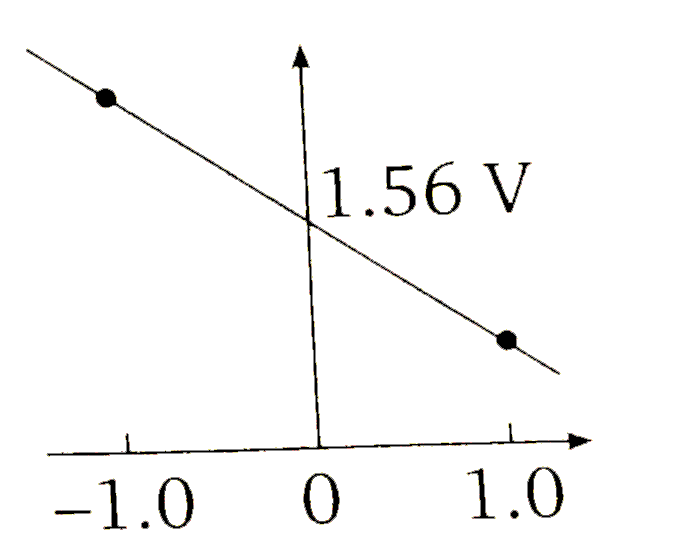
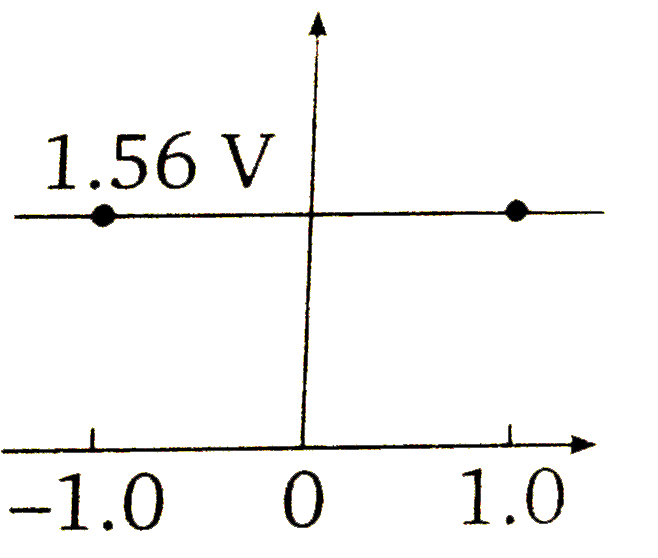
Which graph correctly correlates `E_(cell)` as a function of concentration for the cell `Zn(s)+2Ag^+(aq)toZn^(2+)(aq)+2Ag(s), E_(cell)^(@)=1.56V` y-axis: `E_(cell)`, X-axis: `log_(10)"([Zn^(2+)])/([Ag^+]^2)`
A
B
C
D
Text Solution
AI Generated Solution
The correct Answer is:
To solve the problem, we need to analyze the electrochemical cell reaction and how the cell potential \( E_{cell} \) varies with the concentrations of the reactants and products. The cell reaction given is:
\[
\text{Zn(s)} + 2 \text{Ag}^+(aq) \rightarrow \text{Zn}^{2+}(aq) + 2 \text{Ag(s)}
\]
### Step 1: Write the Nernst Equation
The Nernst equation relates the cell potential \( E_{cell} \) to the standard cell potential \( E_{cell}^\circ \) and the concentrations of the reactants and products. The equation is given by:
\[
E_{cell} = E_{cell}^\circ - \frac{RT}{nF} \ln Q
\]
Where:
- \( E_{cell}^\circ \) is the standard cell potential (1.56 V in this case).
- \( R \) is the universal gas constant (8.314 J/(mol·K)).
- \( T \) is the temperature in Kelvin (assume 298 K if not specified).
- \( n \) is the number of moles of electrons transferred (2 for this reaction).
- \( F \) is Faraday's constant (96485 C/mol).
- \( Q \) is the reaction quotient.
### Step 2: Determine the Reaction Quotient \( Q \)
For the given reaction, the reaction quotient \( Q \) is defined as:
\[
Q = \frac{[\text{Zn}^{2+}]}{[\text{Ag}^+]^2}
\]
### Step 3: Substitute \( Q \) into the Nernst Equation
Substituting \( Q \) into the Nernst equation, we get:
\[
E_{cell} = E_{cell}^\circ - \frac{RT}{nF} \ln \left( \frac{[\text{Zn}^{2+}]}{[\text{Ag}^+]^2} \right)
\]
### Step 4: Convert the Natural Logarithm to Logarithm Base 10
To express the equation in terms of logarithm base 10, we use the conversion:
\[
\ln x = 2.303 \log_{10} x
\]
Thus, the equation becomes:
\[
E_{cell} = E_{cell}^\circ - \frac{2.303RT}{nF} \log_{10} \left( \frac{[\text{Zn}^{2+}]}{[\text{Ag}^+]^2} \right)
\]
### Step 5: Rearranging the Equation
Rearranging the equation gives us:
\[
E_{cell} = E_{cell}^\circ - \frac{2.303RT}{nF} \log_{10} [\text{Zn}^{2+}] + \frac{2 \cdot 2.303RT}{nF} \log_{10} [\text{Ag}^+]
\]
### Step 6: Identify the Slope and Intercept
From the rearranged equation, we can identify:
- The y-intercept is \( E_{cell}^\circ = 1.56 \, V \).
- The slope is negative because of the negative sign in front of the concentration terms.
### Step 7: Conclusion about the Graph
The graph of \( E_{cell} \) vs. \( \log_{10} \left( \frac{[\text{Zn}^{2+}]}{[\text{Ag}^+]^2} \right) \) will have:
- A negative slope.
- A y-intercept at \( 1.56 \, V \).
Thus, the correct graph will show a downward trend starting from \( 1.56 \, V \) on the y-axis.
Topper's Solved these Questions
ELECTROCHEMISTRY
NARENDRA AWASTHI|Exercise Level 1 (Q.1 To Q.30)|1 Videos
ELECTROCHEMISTRY
NARENDRA AWASTHI|Exercise Level 1 (Q.91 To Q.120)|1 Videos
DILUTE SOLUTION
NARENDRA AWASTHI|Exercise Level 3 - Match The Column|1 Videos
Which graph correctly correlates E_("cell") as a function of concentration for the cell (for different values of M nad M' Zn(s)+Cu^(2+)(M)rarrZn^(2+(M')+Cu(s), E_("cell")^(@)=1.10V X - axis : log_(10).([Zn^(2+)])/([Cu^(2+)]), Y - axis : E_("cell")
Which graph correctly correlates E_(cell) as a funcation of concentrations for the cell (for different values of M and M' )? Zn(s) + Cu^(2+) (M) rarr Zn^(2+) (M') + Cu(s), E_(cell)^(@) = 1.10 V X -axis : (log_(10)[Zn^(2+)])/([Cu^(2+)]) Y-axis : E_("cell")
The equilibrium constant of the reaction : Zn(s)+2Ag^(+)(aq)toZn(aq)+2Ag(s),E^(@)=1.50V at 298 K is
Select the correct cell reaction of the cell Ag(s)|Ag^+(aq)"||"cu^(2+)(aq)"|"cu(s) :
The cell reaction Zn(s)+2Ag^(+)(aq)rarrZn^(2+)(aq)+Ag(s) is best represented by
The equilibrium constant (K) for the reaction Cu(s)+2Ag^(+) (aq) rarr Cu^(2+) (aq)+2Ag(s) , will be [Given, E_(cell)^(@)=0.46 V ]
Select the correct cell reaction of the cell Pt(s)|Cl_2(g)|Cl^(-)(aq)"||"Ag^+(aq)|Ag(s) :
Write cell representation for following cells Cd^(2+)(aq)+Zn(s)toZn^(2+)(aq)+Cd(s)