Home
Class 12
CHEMISTRY
Water ice exists in several different fo...

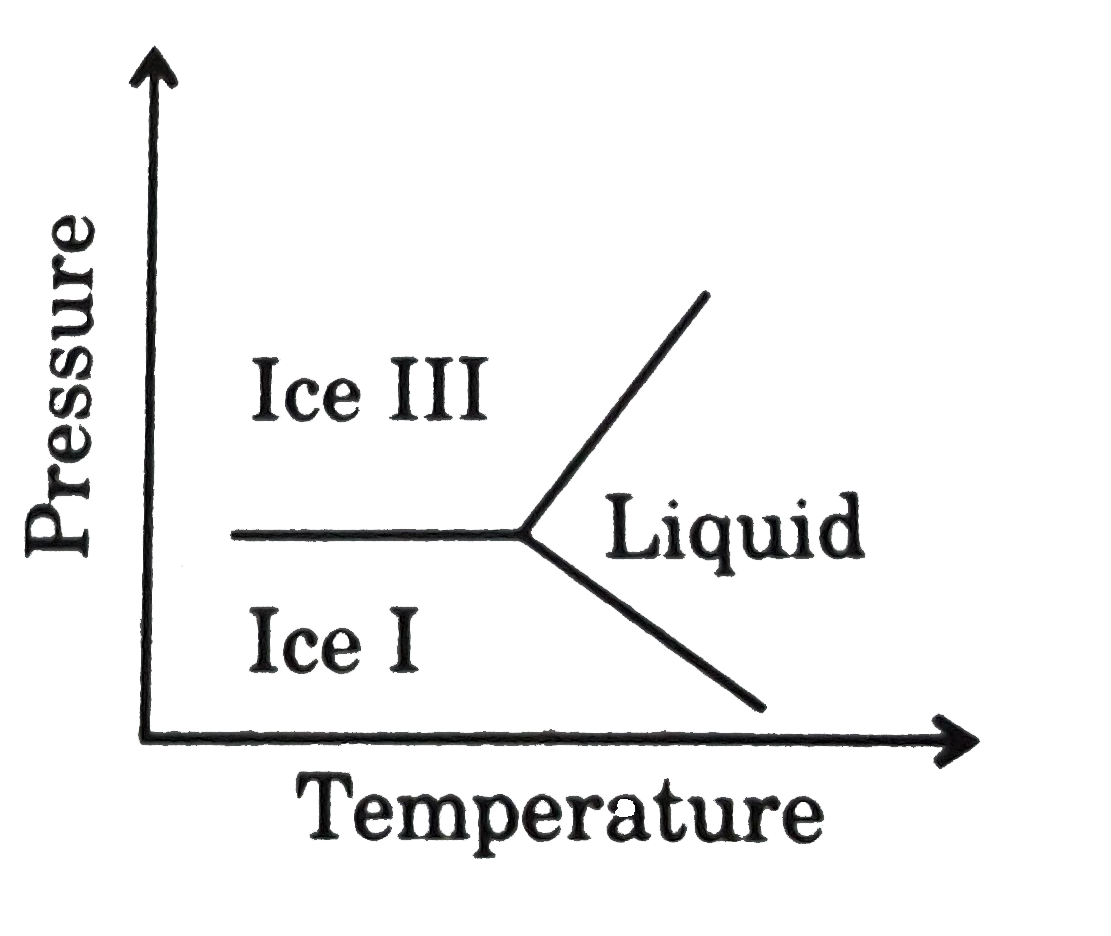
Water ice exists in several different form depending on the pressure and temperature. A proton of the phase diagram for ice I, ice III and liquid water is shown below. Which statement about the densities of these three phases is correct ?

A

The density of liquid water is greater than the densities of either ice I or ice III.

B

The density of ice I is greater than the densities of either ice III or liquid water.

C

The density of ice III is greater than the densities of either ice I or liquid water

D

The densities of ice I and ice III are equal and greater than the density of liquid water.

Text Solution

Verified by Experts

The correct Answer is:

C
Promotional Banner

Topper's Solved these Questions

  • GRAPHICAL INTERPRETATION

    GRB PUBLICATION|Exercise H. Chemical Kinetics|1 Videos
  • GRAPHICAL INTERPRETATION

    GRB PUBLICATION|Exercise Chemical Kinetics|80 Videos
  • GRAPHICAL INTERPRETATION

    GRB PUBLICATION|Exercise G. Chemical Equilibrium|1 Videos
  • F-BLOCK ELEMENTS

    GRB PUBLICATION|Exercise Subjective type|7 Videos
  • HYDROCARBON (ALIPHATIC)

    GRB PUBLICATION|Exercise Previous years jee questions|28 Videos

Similar Questions

Explore conceptually related problems

The phase diagram for sulphur is shown below. Which statement about this diagram is correct ?

According to the phase diagram of methanol shown below, which statement is correct ?

Each phase of a material can exits only in certain regions of pressure and temperature . P-T phase diagrams, in which pressure is plotted versus temperature, show the regions corresponding to various phases and phase transformations . P-V diagrams, on the other hand , can be used to study pressure volume relationship at a constant temperature. If the liquid and gaseous phases of a pure substances are heated together in a closed container, both the temperature and the vapor pressure will increase until a point is reached at which the two phases can no longer be distinguished from one another. The temperature and pressure at which this occurs are called the critical temperature and pressure. Exceeding either of these parameters, by itself ,will cause the "gas"//"liguid" phase transition to disappear. if the other variable is then changed as well, while the first variable is maintained above its critical point , a gradual transition will occur between the gaseous and liquid phases, with no clear boundary.(The liquid and solid phases, on the other hand , maintain a distinct boundary at all pressure above the triple point). Shown in figure is a combined P-T phase diagram for material A and B . Which is true about the substance in figure?

Each phase of a material can exits only in certain regions of pressure and temperature . P-T phase diagrams, in which pressure is plotted versus temperature, show the regions corresponding to various phases and phase transformations . P-V diagrams, on the other hand , can be used to study pressure volume relationship at a constant temperature. If the liquid and gaseous phases of a pure substances are heated together in a closed container, both the temperature and the vapor pressure will increase until a point is reached at which the two phases can no longer be distinguished from one another. The temperature and pressure at which this occurs are called the critical temperature and pressure. Exceeding either of these parameters, by itself ,will cause the "gas"//"liguid" phase transition to disappear. if the other variable is then changed as well, while the first variable is maintained above its critical point , a gradual transition will occur between the gaseous and liquid phases, with no clear boundary.(The liquid and solid phases, on the other hand , maintain a distinct boundary at all pressure above the triple point). Shown in figure is a combined P-T phase diagram for material A and B . If heat is added to solids A and B , each in a container that is open to the atmosphere :-

Assertion : In pressure-temperature ( P - T ) phase diagram of water, the slope of the melting curve is found to be negative. Reason : Ice contracts on melting to water

Assertion : In pressure-temperature (P-T) phase diagram of water, the slope of the melting curve is found to be negative. Reason : Ice contracts on melting to water.

At a particular temperature and atmospheric pressure, the solid and liquid phases of a pure substance can exist i equilibrium. Which of the following term defines this temperature ?

GRB PUBLICATION-GRAPHICAL INTERPRETATION-Chemical Equilibrium
  1. The phase diagram for sulphur is shown below. Which statement about th...

    Text Solution

    |

  2. What quantity is represented by the slope of the line in this graph of...

    Text Solution

    |

  3. Water ice exists in several different form depending on the pressure a...

    Text Solution

    |

  4. Under certain conditions, CO(2) melts rather than sublimes, CO(2) whic...

    Text Solution

    |

  5. Which of the following graphs is the correct phase diagram of a substa...

    Text Solution

    |

  6. What is the normal melting point of the substance represented by the p...

    Text Solution

    |

  7. Which points in this phase diagram represent conditions of temperature...

    Text Solution

    |

  8. The curve shown results when a liquid is cooled. What temperature is c...

    Text Solution

    |

  9. According to the solubility curve shown, how many grams of solute can ...

    Text Solution

    |

  10. According to the phase diagram, what would be the effect of increasing...

    Text Solution

    |

  11. According to the phase diagram shown, in what state does not represent...

    Text Solution

    |

  12. Which statement is correct about the substance represented by this pha...

    Text Solution

    |

  13. According to this phase diagram, which phases can exist at pressure lo...

    Text Solution

    |

  14. According to the phase diagram shown, where does a mixture of solid an...

    Text Solution

    |

  15. Supercritical carbon dioxide exists at which point on the accompanying...

    Text Solution

    |

  16. Which point on the phase diagram represents the normal boiling point?

    Text Solution

    |

  17. What can be concluded about the substance represented by this phase di...

    Text Solution

    |

  18. Which segment of the heating curve obtained at constant pressure corre...

    Text Solution

    |

  19. Which graph best represents the vapour pressure of water as a function...

    Text Solution

    |

  20. According to the graph (ln vapour pressure us 1//T) what can be conclu...

    Text Solution

    |
