Home
Class 12
CHEMISTRY
For a reversible factors in forward and ...

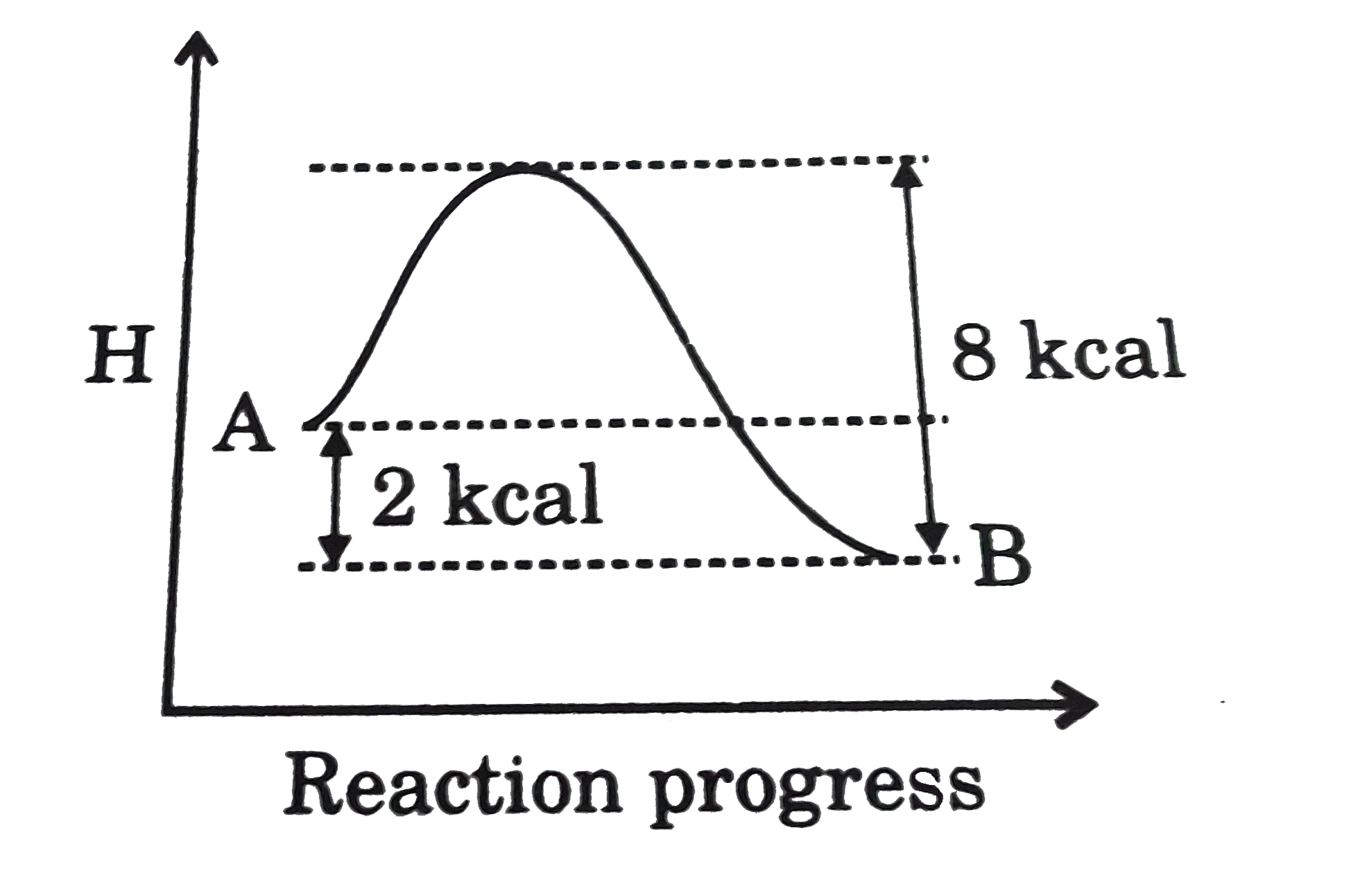
For a reversible factors in forward and backward direction are assumed to be equl. Select the incorrect option (s) on the basis of above graph. [take `R : =2 Cal//"mole"-K]`

A

`(E_(a))_("forward") = 6 Kcal//mol`

B

At 500K, fraction of molecules of A crossing energy barrier for backward reaction is `e^(-8)`.

C

At 500 K, fraction of molecules of B crossing energy barrier for backward reaction is `e^(-8)`.

D

Equilibrium constant for the reaction is `e^(-2)` at 500K temperature.

Text Solution

Verified by Experts

The correct Answer is:

D
Promotional Banner

Topper's Solved these Questions

  • GRAPHICAL INTERPRETATION

    GRB PUBLICATION|Exercise I.Electrochemistry|1 Videos
  • GRAPHICAL INTERPRETATION

    GRB PUBLICATION|Exercise Electrochemistry|9 Videos
  • GRAPHICAL INTERPRETATION

    GRB PUBLICATION|Exercise H. Chemical Kinetics|1 Videos
  • F-BLOCK ELEMENTS

    GRB PUBLICATION|Exercise Subjective type|7 Videos
  • HYDROCARBON (ALIPHATIC)

    GRB PUBLICATION|Exercise Previous years jee questions|28 Videos

Similar Questions

Explore conceptually related problems

Mass action ratio or reaction quotient Q for a reaction can be calculated using the law of mass actionl, A(g)+B(g)hArrC(g)+D(g) Q=([C][D])/([A][B]) The value of Q decides whether the reaction is at equilibrium or not. At equilibrium, Q=K For non-equilibrium process QneK When QgtK , reaction will be favoured in backward direction and when QltK , it will be favoured in forward direction. For the reaction : 2A+BhArr3C at 298 K, K_(c)=49 A 3 L vessel contains 2, 1 and 3 moles of A, B and C respectively. The reaction at the same temperature :

A drunkard moves on a straight road such that he takes 7 steps forward and 2 steps backward in each cycle. If the stride length of each step is 1 feet and the drunkard moves with a speed 2 feet/s in forward direction and 4 feet/s in backward direction, then the time after which the drunkard will fall into a pit 11 feet further from his starting point is

For a reaction, aA+bBhArrcC+dD , the reaction quotient Q=([C]_(0)^(c)[D]_(0)^(d))/([A]_(0)^(a)[B]_(0)^(b)) , where [A]_(0) , [B]_(0) , [C]_(0) , [D]_(0) are initial concentrations. Also K_(c)=([C]^(c)[D]^(d))/([A]^(a)[B]^(b)) where [A] , [B] , [C] , [D] are equilibrium concentrations. The reaction proceeds in forward direction if Q lt K_(c) and in backward direction if Q gt K_(c) . The variation of K_(c) with temperature is given by: 2303log(K_(C_(2)))/(K_(C_(1)))=(DeltaH)/(R)[(T_(2)-T_(1))/(T_(1)T_(2))] . For gaseous phase reactions K_(p)=K_(c)(RT)^(Deltan) where Deltan= moles of gaseous products - moles of gaseous reactants. Also -DeltaG^(@)=2.303RT log_(10)K_(c) . Which relation is correct?

For a reaction, aA+bBhArrcC+dD , the reaction quotient Q=([C]_(0)^(c)[D]_(0)^(d))/([A]_(0)^(a)[B]_(0)^(b)) , where [A]_(0) , [B]_(0) , [C]_(0) , [D]_(0) are initial concentrations. Also K_(c)=([C]^(c)[D]^(d))/([A]^(a)[B]^(b)) where [A] , [B] , [C] , [D] are equilibrium concentrations. The reaction proceeds in forward direction if Q lt K_(c) and in backward direction if Q gt K_(c) . The variation of K_(c) with temperature is given by: 2303log(K_(C_(2)))/(K_(C_(1)))=(DeltaH)/(R)[(T_(2)-T_(1))/(T_(1)T_(2))] . For gaseous phase reactions K_(p)=K_(c)(RT)^(Deltan) where Deltan= moles of gaseous products - moles of gaseous reactants. Also -DeltaG^(@)=2.303RT log_(10)K_(c) . The heat or reaction for an endothermic reaction, in equilibrium is 1200 cal , at constant volume is more than at constant pressure at 300 K . The ratio of K_(p)//K_(c) is:

For a reaction, aA+bBhArrcC+dD , the reaction quotient Q=([C]_(0)^(c)[D]_(0)^(d))/([A]_(0)^(a)[B]_(0)^(b)) , where [A]_(0) , [B]_(0) , [C]_(0) , [D]_(0) are initial concentrations. Also K_(c)=([C]^(c)[D]^(d))/([A]^(a)[B]^(b)) where [A] , [B] , [C] , [D] are equilibrium concentrations. The reaction proceeds in forward direction if Q lt K_(c) and in backward direction if Q gt K_(c) . The variation of K_(c) with temperature is given by: 2303log(K_(C_(2)))/(K_(C_(1)))=(DeltaH)/(R)[(T_(2)-T_(1))/(T_(1)T_(2))] . For gaseous phase reactions K_(p)=K_(c)(RT)^(Deltan) where Deltan= moles of gaseous products - moles of gaseous reactants. Also -DeltaG^(@)=2.303RT log_(10)K_(c) . ( B ) The moisture content of a gas is often expressed as dew point, the temperature at which if gas is cooled becomes saturted with vapour pressure of water at that temperture. Dew point of H_(2)O is 43^(@)C having vapour pressure 0.07 "torr" . CaCl_(2)*2H_(2)O_((s))hArrCaCl_(2(s))+2H_(2)O_((g)) , The equilibrium constant should not be more than..... (atm)^(2) if CaCl_(2) is to be used as desiccant.

GRB PUBLICATION-GRAPHICAL INTERPRETATION-Chemical Kinetics
  1. Which of the following graph is correct w.r.t half life for a zero ord...

    Text Solution

    |

  2. For a reaction A rarr Product, a graph plotted between (1)/([A]^(2)) v...

    Text Solution

    |

  3. For a reversible factors in forward and backward direction are assumed...

    Text Solution

    |

  4. Consider the reaction : A rarr B. The concentration of both reactant a...

    Text Solution

    |

  5. The following mechanism has been proposed for the exothermic catalyzed...

    Text Solution

    |

  6. For an elementary reaction: nA rarr Product Find the value of n: [wher...

    Text Solution

    |

  7. Which of the following graph is incorrect for variation of rate consta...

    Text Solution

    |

  8. For a reaction 3A rarr 2B, following graph is obtained, calculate rate...

    Text Solution

    |

  9. Consider the first order reaction: A rarr 2B. Which of the following f...

    Text Solution

    |

  10. Which of the folloing characteristics are correct for a reaction in wh...

    Text Solution

    |

  11. For a reaction A +B rarr C, it is observed that half life of A (when B...

    Text Solution

    |

  12. Rate constant vs temperature graph looks like: If the activation energ...

    Text Solution

    |

  13. Which of the following graph is incorrect for variation of rate consta...

    Text Solution

    |

  14. A reaction follows the given concentration (M) vs time graph. The rate...

    Text Solution

    |

  15. For a first order reaction, the reaction, the plot of log C against 't...

    Text Solution

    |

  16. The graph between concentration (X) of the Product and time of the rea...

    Text Solution

    |

  17. A graph plotted between log t(50%) vs log concentration is a straight ...

    Text Solution

    |

  18. What will be the order of reaction and rate constant for a chemical ch...

    Text Solution

    |

  19. A rarr Product and ((dx)/(dt)) = k [A]^(2). If log ((dx)/(dt)) is plot...

    Text Solution

    |

  20. In the different reactions, involving a angle reactant in each case, a...

    Text Solution

    |
