Home
Class 12
CHEMISTRY
Consider the first order reaction: A rar...

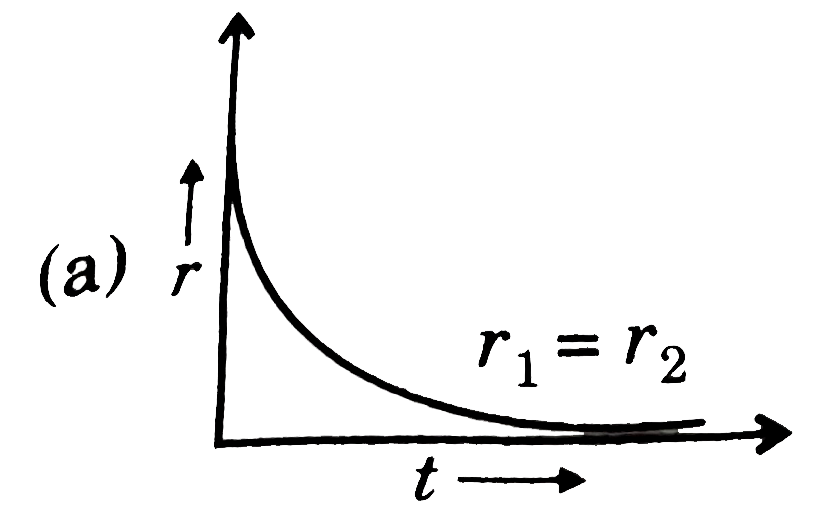
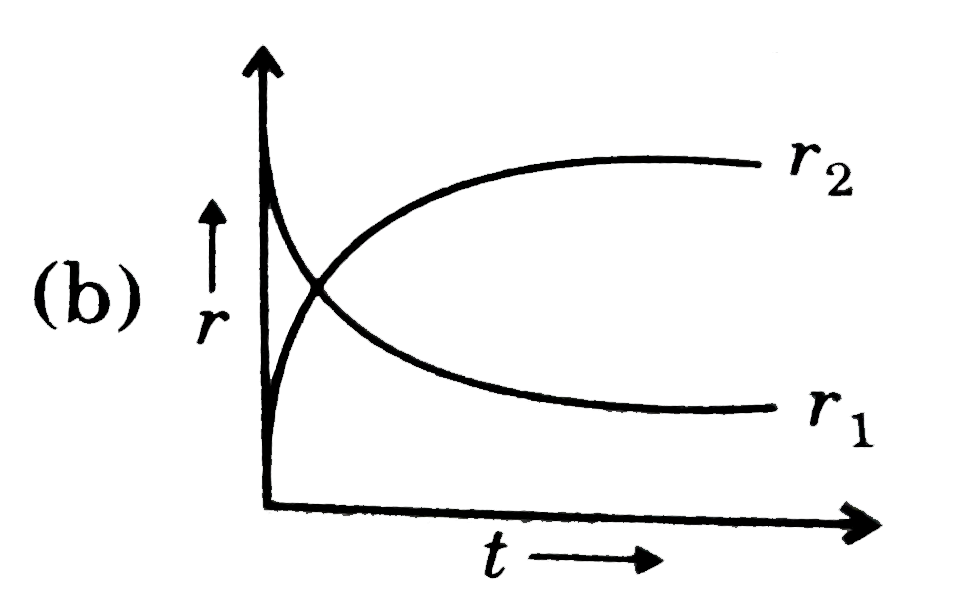
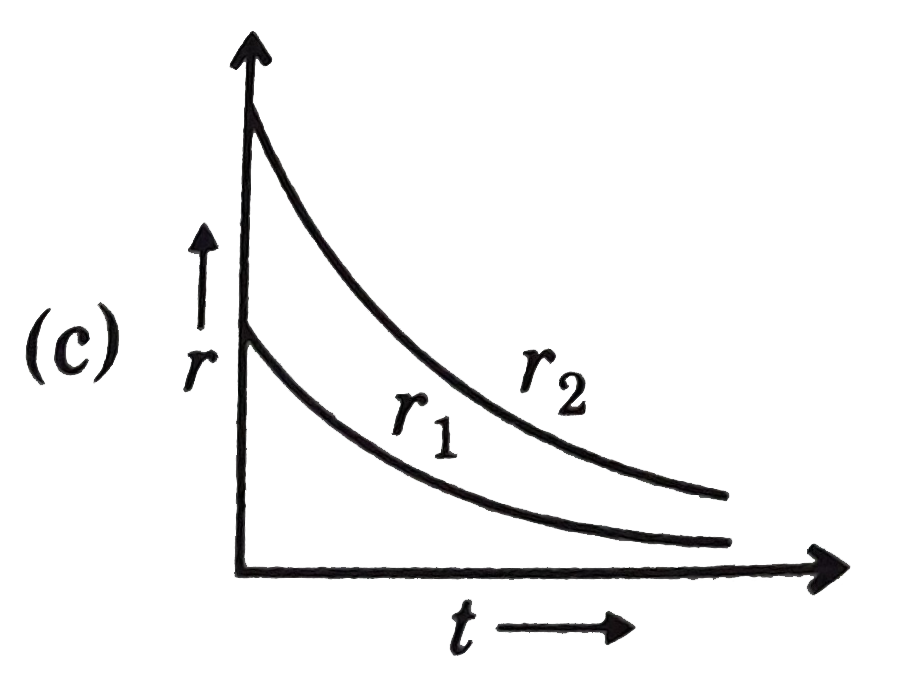
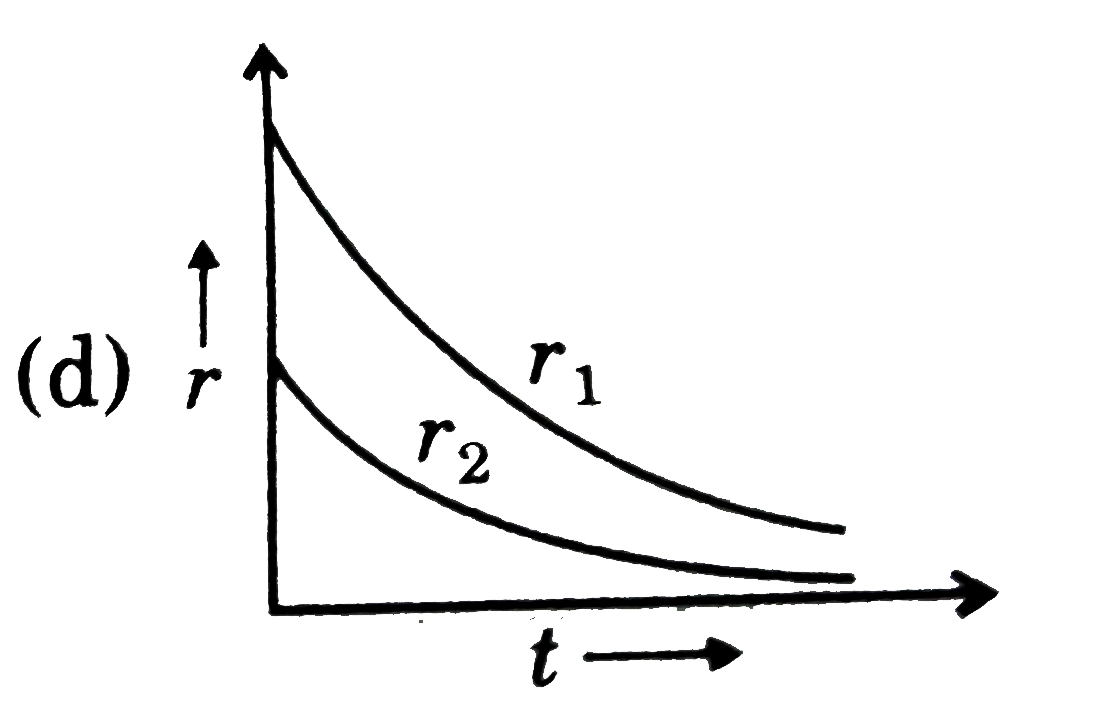
Consider the first order reaction: `A rarr 2B`. Which of the following figure correctly describes the rate of disappearance of `A(r_(1))` and rate of appearance of `B(r_(2))` with time ?

A

B

C

D

Text Solution

AI Generated Solution

The correct Answer is:

To solve the problem regarding the first-order reaction \( A \rightarrow 2B \), we need to analyze the rates of disappearance of \( A \) and the appearance of \( B \) over time. Here’s a step-by-step breakdown of the solution: ### Step 1: Understand the Reaction The reaction given is a first-order reaction where one mole of \( A \) produces two moles of \( B \). The stoichiometry indicates that for every mole of \( A \) that disappears, two moles of \( B \) appear. ### Step 2: Define the Rates - The rate of disappearance of \( A \) can be expressed as: \[ R_1 = -\frac{d[A]}{dt} \] - The rate of appearance of \( B \) can be expressed as: \[ R_2 = \frac{d[B]}{dt} \] From the stoichiometry of the reaction, we can relate these rates: \[ R_1 = -\frac{1}{2} R_2 \] This means that the rate at which \( A \) disappears is half the rate at which \( B \) appears. ### Step 3: Express Concentrations Over Time For a first-order reaction, the concentration of \( A \) at time \( t \) is given by: \[ [A] = [A]_0 e^{-kt} \] Where \( [A]_0 \) is the initial concentration of \( A \) and \( k \) is the rate constant. ### Step 4: Calculate the Rate Expressions Using the expression for \( [A] \): - The rate of disappearance of \( A \) becomes: \[ R_1 = k[A] = k[A]_0 e^{-kt} \] - The rate of appearance of \( B \) becomes: \[ R_2 = -\frac{d[A]}{dt} = k[A]_0 e^{-kt} \] However, since \( R_2 \) is related to the stoichiometry, we have: \[ R_2 = -\frac{d[A]}{dt} = 2k[A]_0 e^{-kt} \] ### Step 5: Analyze the Graphs - The graph of \( R_1 \) (rate of disappearance of \( A \)) will show an exponential decay since it is proportional to \( e^{-kt} \). - The graph of \( R_2 \) (rate of appearance of \( B \)) will also show an exponential decay, but it will be steeper because it is multiplied by 2. ### Step 6: Conclusion The correct graph will show: - \( R_1 \) decreasing gently over time. - \( R_2 \) decreasing more steeply over time, reflecting that \( B \) is produced at a rate that is double that of the disappearance of \( A \). ### Final Answer The figure that correctly describes the rates of disappearance of \( A \) and appearance of \( B \) with time is the one where \( R_1 \) decreases gently and \( R_2 \) decreases more steeply. ---
Promotional Banner

Topper's Solved these Questions

  • GRAPHICAL INTERPRETATION

    GRB PUBLICATION|Exercise I.Electrochemistry|1 Videos
  • GRAPHICAL INTERPRETATION

    GRB PUBLICATION|Exercise Electrochemistry|9 Videos
  • GRAPHICAL INTERPRETATION

    GRB PUBLICATION|Exercise H. Chemical Kinetics|1 Videos
  • F-BLOCK ELEMENTS

    GRB PUBLICATION|Exercise Subjective type|7 Videos
  • HYDROCARBON (ALIPHATIC)

    GRB PUBLICATION|Exercise Previous years jee questions|28 Videos

Similar Questions

Explore conceptually related problems

For a first order reaction, A rarr B , the rate = k xx…………. .

Consider the reaction A to B . The concentration of both the reactants and the products varies exponentially with time. Which of the following figure correctly describes the change in concentration of reactants and products with time ?

For the reaction, 4P+Q rarr 2R+2S , Which of the following statement(s) is /are true? Rate of appearance of S is doubled the rate of the disappearance of Q. Rate of disappearance of Q is one fourth the rate of disappearance of P. Rate of formation of R is equal to the rate of formation of S. Choose the correct ooption.

Consider the reaction : A rarr B . The concentration of both reactant and product varies exponentially with time. Which of the following figure correctly describes the rate of reactant and product with time ?

For a reaction 1//2A to 2B , rate of disappearance of A is related to the rate of appearance of B by the expression:

For an imaginary reaction 2X+3Y to "products" Given: rate of disappearance of X = r_1 rate of disappearance of Y = r_(2) r_1 and r_2 are related as:-

2Aoverset(K)rarr3B+4C Rate of disappearance of A is 4xx10^(-2)Ms^(-1) . Find the rate of appearance of B at the same instant.

GRB PUBLICATION-GRAPHICAL INTERPRETATION-Chemical Kinetics
  1. Which of the following graph is incorrect for variation of rate consta...

    Text Solution

    |

  2. For a reaction 3A rarr 2B, following graph is obtained, calculate rate...

    Text Solution

    |

  3. Consider the first order reaction: A rarr 2B. Which of the following f...

    Text Solution

    |

  4. Which of the folloing characteristics are correct for a reaction in wh...

    Text Solution

    |

  5. For a reaction A +B rarr C, it is observed that half life of A (when B...

    Text Solution

    |

  6. Rate constant vs temperature graph looks like: If the activation energ...

    Text Solution

    |

  7. Which of the following graph is incorrect for variation of rate consta...

    Text Solution

    |

  8. A reaction follows the given concentration (M) vs time graph. The rate...

    Text Solution

    |

  9. For a first order reaction, the reaction, the plot of log C against 't...

    Text Solution

    |

  10. The graph between concentration (X) of the Product and time of the rea...

    Text Solution

    |

  11. A graph plotted between log t(50%) vs log concentration is a straight ...

    Text Solution

    |

  12. What will be the order of reaction and rate constant for a chemical ch...

    Text Solution

    |

  13. A rarr Product and ((dx)/(dt)) = k [A]^(2). If log ((dx)/(dt)) is plot...

    Text Solution

    |

  14. In the different reactions, involving a angle reactant in each case, a...

    Text Solution

    |

  15. The Arrhenius relationship of two different reactions is shown below. ...

    Text Solution

    |

  16. If for a reaction in which A(g) converts to B(g) the reaction carried ...

    Text Solution

    |

  17. Rate of reaction A rarr B depends only on A and can be represented by ...

    Text Solution

    |

  18. Adjoining graph is for a reaction which have only single reactant (R) ...

    Text Solution

    |

  19. The conversion of vinyl allyl ether to pent-4-enol follows first-order...

    Text Solution

    |

  20. A simple mechanism for enzyme-catalysed reaction is given by the follo...

    Text Solution

    |
