Home
Class 12
CHEMISTRY
For a reaction A rarr B, E(a) = 10 kJ mo...

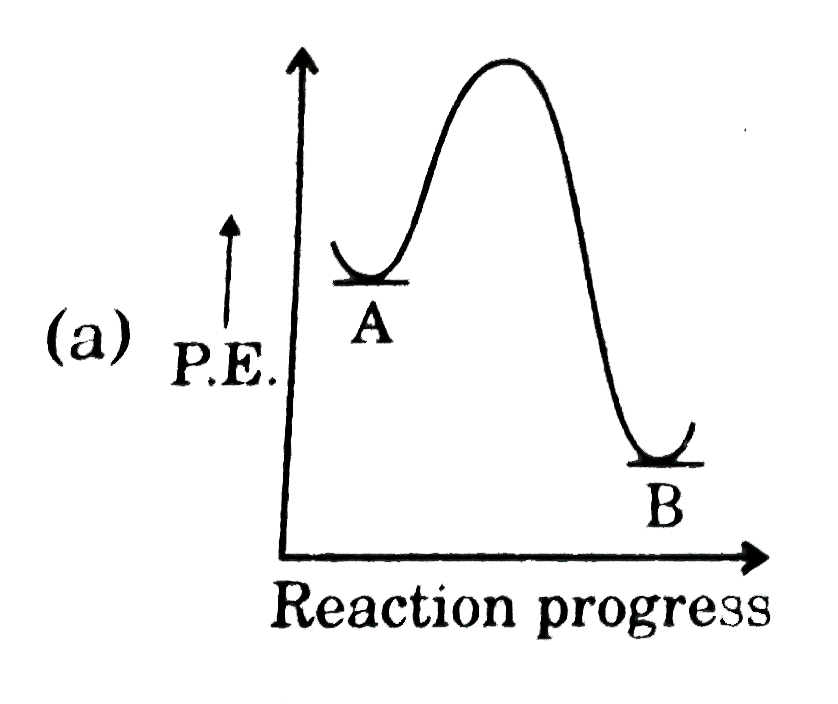
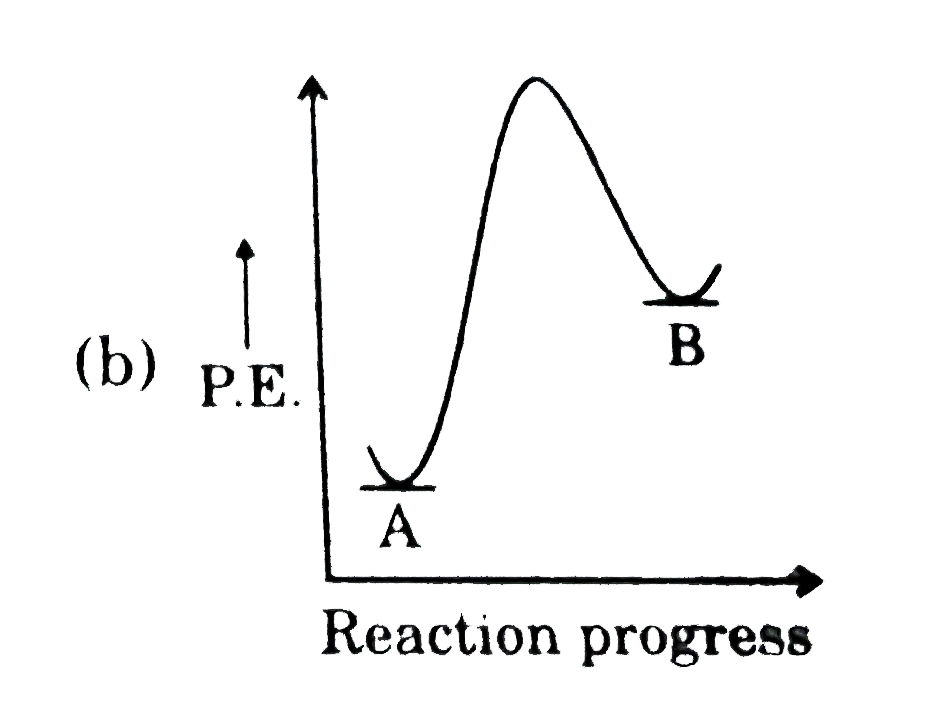
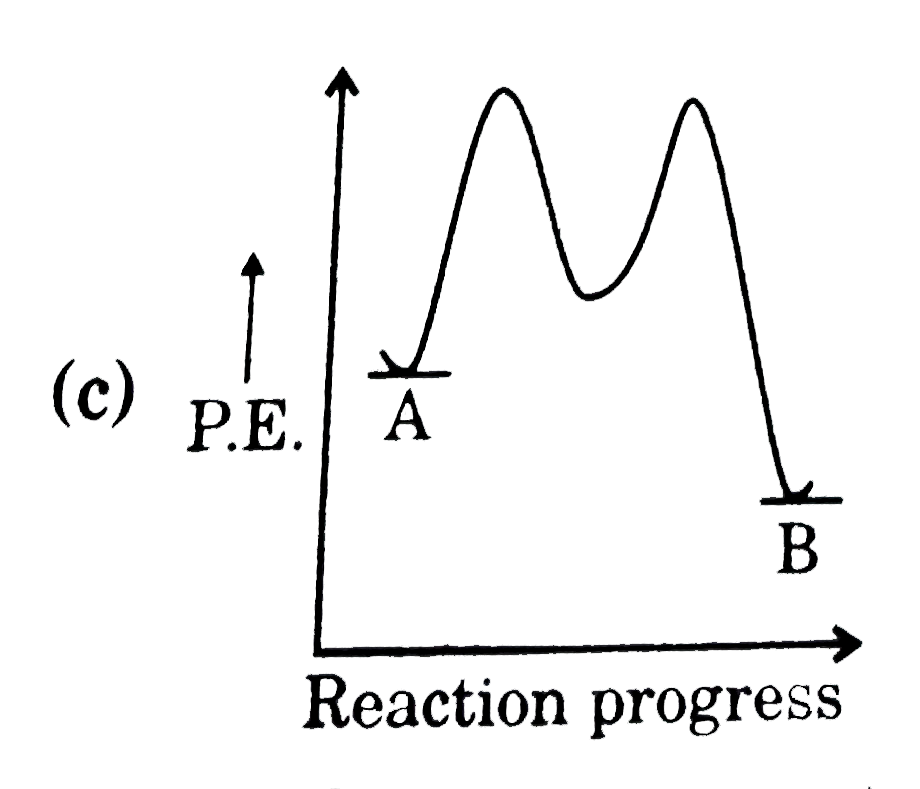
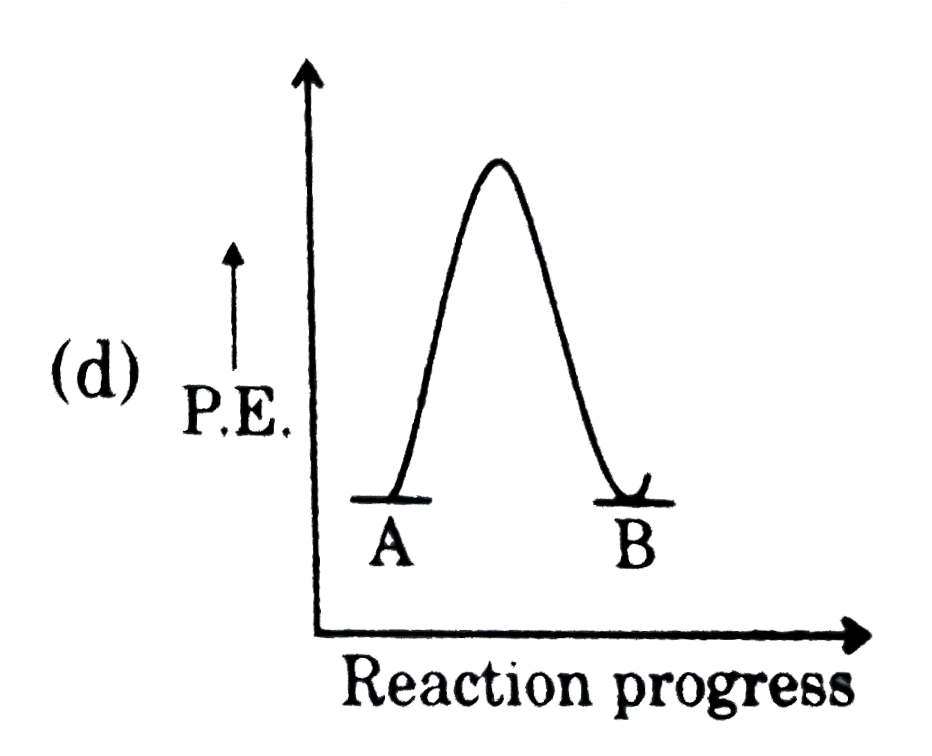
For a reaction `A rarr B, E_(a) = 10 kJ mol^(-1), DeltaH = 5 kJ mol^(-1)`. Thus, potential energy profile for this reaction is:

A

B

C

D

Text Solution

AI Generated Solution

The correct Answer is:

To solve the problem regarding the potential energy profile for the reaction \( A \rightarrow B \) with given values of activation energy (\( E_a = 10 \, \text{kJ mol}^{-1} \)) and enthalpy change (\( \Delta H = 5 \, \text{kJ mol}^{-1} \)), we can follow these steps: ### Step-by-Step Solution: 1. **Understand the Definitions**: - **Activation Energy (\( E_a \))**: This is the minimum energy required for a reaction to occur. The given \( E_a = 10 \, \text{kJ mol}^{-1} \) is for the forward reaction. - **Enthalpy Change (\( \Delta H \))**: This indicates whether a reaction is exothermic or endothermic. A positive \( \Delta H = 5 \, \text{kJ mol}^{-1} \) means the reaction is endothermic. 2. **Determine the Activation Energy for the Backward Reaction**: - We can use the relationship: \[ \Delta H = E_a^{\text{forward}} - E_a^{\text{backward}} \] - Plugging in the values: \[ 5 = 10 - E_a^{\text{backward}} \] - Rearranging gives: \[ E_a^{\text{backward}} = 10 - 5 = 5 \, \text{kJ mol}^{-1} \] 3. **Sketch the Potential Energy Profile**: - On the y-axis, represent potential energy. - Start with the potential energy of reactant \( A \) at a certain level. - Draw a peak at the activation energy for the forward reaction, which is \( 10 \, \text{kJ mol}^{-1} \) above the energy level of \( A \). - From the peak, drop down to the energy level of product \( B \). Since \( \Delta H = 5 \, \text{kJ mol}^{-1} \), the energy level of \( B \) will be \( 5 \, \text{kJ mol}^{-1} \) higher than that of \( A \). 4. **Label the Diagram**: - Label the starting point as \( A \), the peak as the transition state, and the endpoint as \( B \). - Indicate the activation energy for the forward reaction (\( E_a^{\text{forward}} = 10 \, \text{kJ mol}^{-1} \)) and the activation energy for the backward reaction (\( E_a^{\text{backward}} = 5 \, \text{kJ mol}^{-1} \)). 5. **Conclusion**: - The potential energy profile illustrates that the reaction is endothermic, as the products are at a higher energy level compared to the reactants.
Promotional Banner

Topper's Solved these Questions

  • GRAPHICAL INTERPRETATION

    GRB PUBLICATION|Exercise I.Electrochemistry|1 Videos
  • GRAPHICAL INTERPRETATION

    GRB PUBLICATION|Exercise Electrochemistry|9 Videos
  • GRAPHICAL INTERPRETATION

    GRB PUBLICATION|Exercise H. Chemical Kinetics|1 Videos
  • F-BLOCK ELEMENTS

    GRB PUBLICATION|Exercise Subjective type|7 Videos
  • HYDROCARBON (ALIPHATIC)

    GRB PUBLICATION|Exercise Previous years jee questions|28 Videos

Similar Questions

Explore conceptually related problems

For a reaction ArarrB,E_a=10kJ//mol,DeltaH=5kJ//mol . Thus potential energy profile for this reaction is

The activation energy for the forward reaction X rarr Y is 60 kJ mol^(-1) and Delta H is -20 kJ mol^(-1) . The activation energy for the reverse reaction is

The activation energy of exothermic reaction ArarrB is 80 kJ "mol"^(-1) . The heat of reaction is 200 kJ "mol"^(-1) . The activation energy for the reaction Brarra ( in kJ/mol) will be :

For a reaction, DeltaH=10000" kJ "mol^(-1) and DeltaS=25" kJ "k^(-1)mol^(-1) . The minimum temperature, above which the reaction would be spontaneous is

ArarrB, DeltaH= -10 KJ mol^(-1), E_(a(f))=50 KJ mol^(-1) , then E_(a) of BrarrA will be

For a reaction A rarr B, E_(a) for the forward reaction E_(a(f)) and backward reaction E_(a(b)) is 9kJ mol^(-1) and 9kJ mol^(-1) , respectively. Potential energy of A is 12 kJ mol^(-1) . Calculate (a) The heat of the reaction (b) The threshold energy of reaction (THE) ( c) The potential energy of Products (PE)

In an exothermic reaction A rarr B , the activation energy of the forward reaction is 200 kJ mol^(-1) . The enthalpy of the reaction is 280 kJ mol^(-1) . The activation energy of the reverse reaction B rarr A is

GRB PUBLICATION-GRAPHICAL INTERPRETATION-Chemical Kinetics
  1. Following reaction can take place in both direction A overset(k(1))und...

    Text Solution

    |

  2. Graph between log k and (1)/(T) (k is rate constant in s^(-1) and T is...

    Text Solution

    |

  3. For a reaction A rarr B, E(a) = 10 kJ mol^(-1), DeltaH = 5 kJ mol^(-1)...

    Text Solution

    |

  4. Match the graphical study with the order of the reaction: A: Firs...

    Text Solution

    |

  5. The potential energy diagram for a reaction R rarr P is given DeltaH^(...

    Text Solution

    |

  6. For the first order reaction Following observation is made: wher...

    Text Solution

    |

  7. When a graph between log K and 1//T is drawn a straight line is obtain...

    Text Solution

    |

  8. The slope of straight line graph between ln k us (1)/(T) is equal to 2...

    Text Solution

    |

  9. For a reaction represented by A rarr B, which of the following options...

    Text Solution

    |

  10. For a certain reaction, a plot of ([C(0)-C])/(C ) against time t, yiel...

    Text Solution

    |

  11. Consider the following chart. Now with the following, select the cor...

    Text Solution

    |

  12. Based on the following graph, mark the correct option for the reaction...

    Text Solution

    |

  13. For the reactions (i) A overset(K(I))rarr P and (ii) B overset(K(II))r...

    Text Solution

    |

  14. According to Arrhenius equation rate constant k is equal to Ae^(-E(a)/...

    Text Solution

    |

  15. Consider the figure and mark the correct option.

    Text Solution

    |

  16. A graph of volume of hydrogen released us. Time for the reaction betwe...

    Text Solution

    |

  17. Consider the graph given in the above questions. Which of the followin...

    Text Solution

    |

  18. For any first order reaction following observation is made. If at temp...

    Text Solution

    |

  19. Which of the following graphs is correct for a first order reaction ? ...

    Text Solution

    |

  20. 2NO(2)(g) rarr 2NO(g) +O(2)(g) For the reaction above, a straight line...

    Text Solution

    |
