Home
Class 12
CHEMISTRY
Titration are one of the methods we can ...

Titration are one of the methods we can use to discover the precise concentration of solutions. A typical titration involves adding a solution from a burette to another solution in a flask. The end point of the titration is found by watching a colour change taking place.However, a problem arises when a suitable indicator cannot be found, or when the colour change involved are unclear. In these cases, redox potential may sometimes come to the rescue.

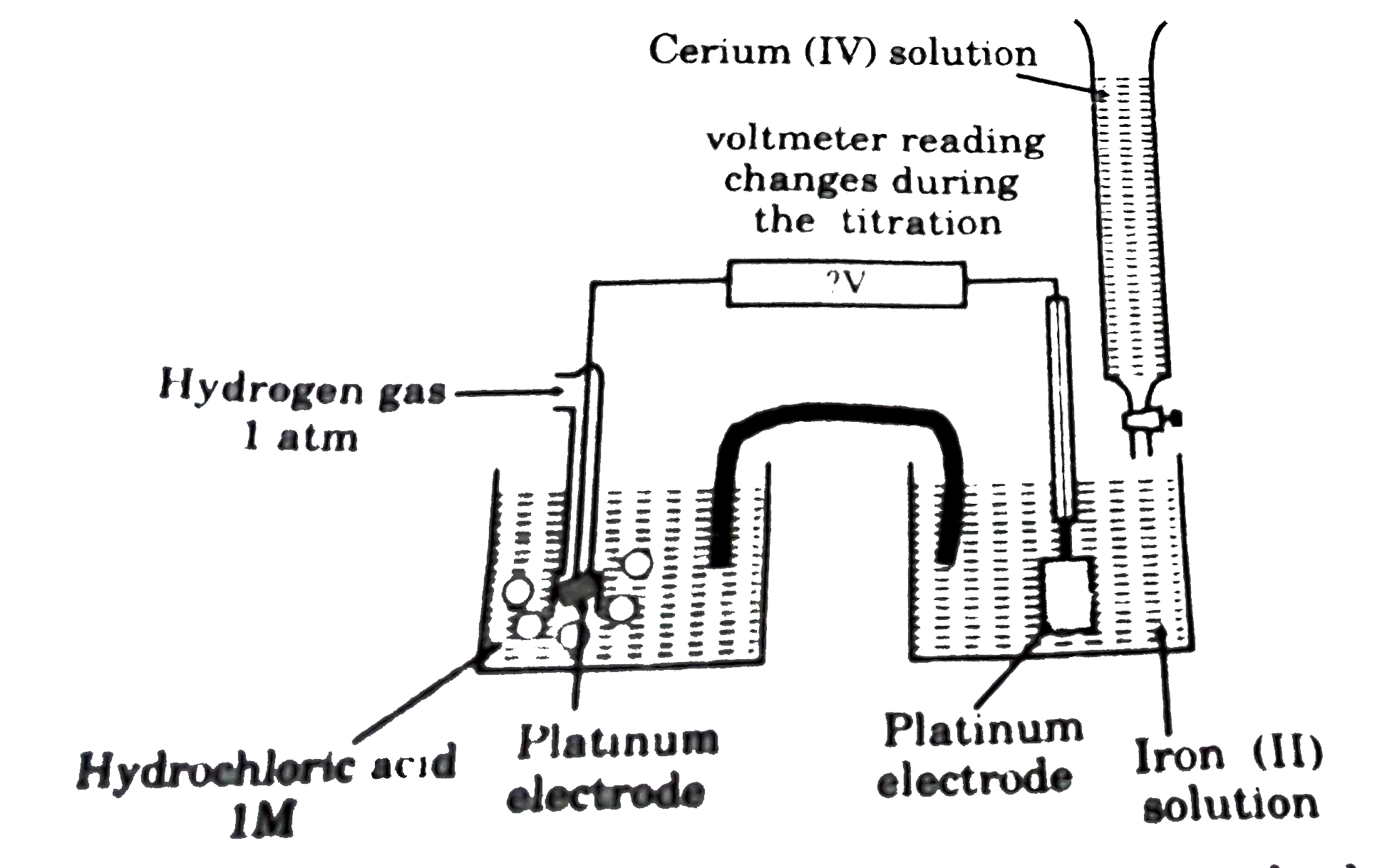
A perticularly well known example (Fig.) is a method of discovering then concentration of iron (II) ions in a solution by titrating them with a solution of cerium (IV). The redox potential that are of interest here are`E_(Fe^(3+)|Fe^(2+))^(@)=0.77 V "and"E_(Ce^(4+|Ce^(3+)))^(@)=1.61V.` These tell us that cerium (IV) ions are the oxidising agents. They should react according to the equation
`Fe^(2+) (aq) + Ce^(4+) (aq) to Fe^(3+) (aq) + Ce^(3+) (aq).`
Now imagine that we know the concentration of the cerium (IV) ions solution in the burette. We want to measure the concentration of the cerium (IV) solution from the burette, some of the iron (II) ions are will be oxidised. As a consequence the beaker would now contain large number of unreacted iron (II) ions , but also some iron (III) ions as well. All of the cerium (III). The solution in the beaker now represents an iron `(III)//iron(II)` half cell although not at standard conditions.Thus , the emf of the cell will be near, but not equal to `E_(Fe^(3+|Fe^(2+.)))^(@)`

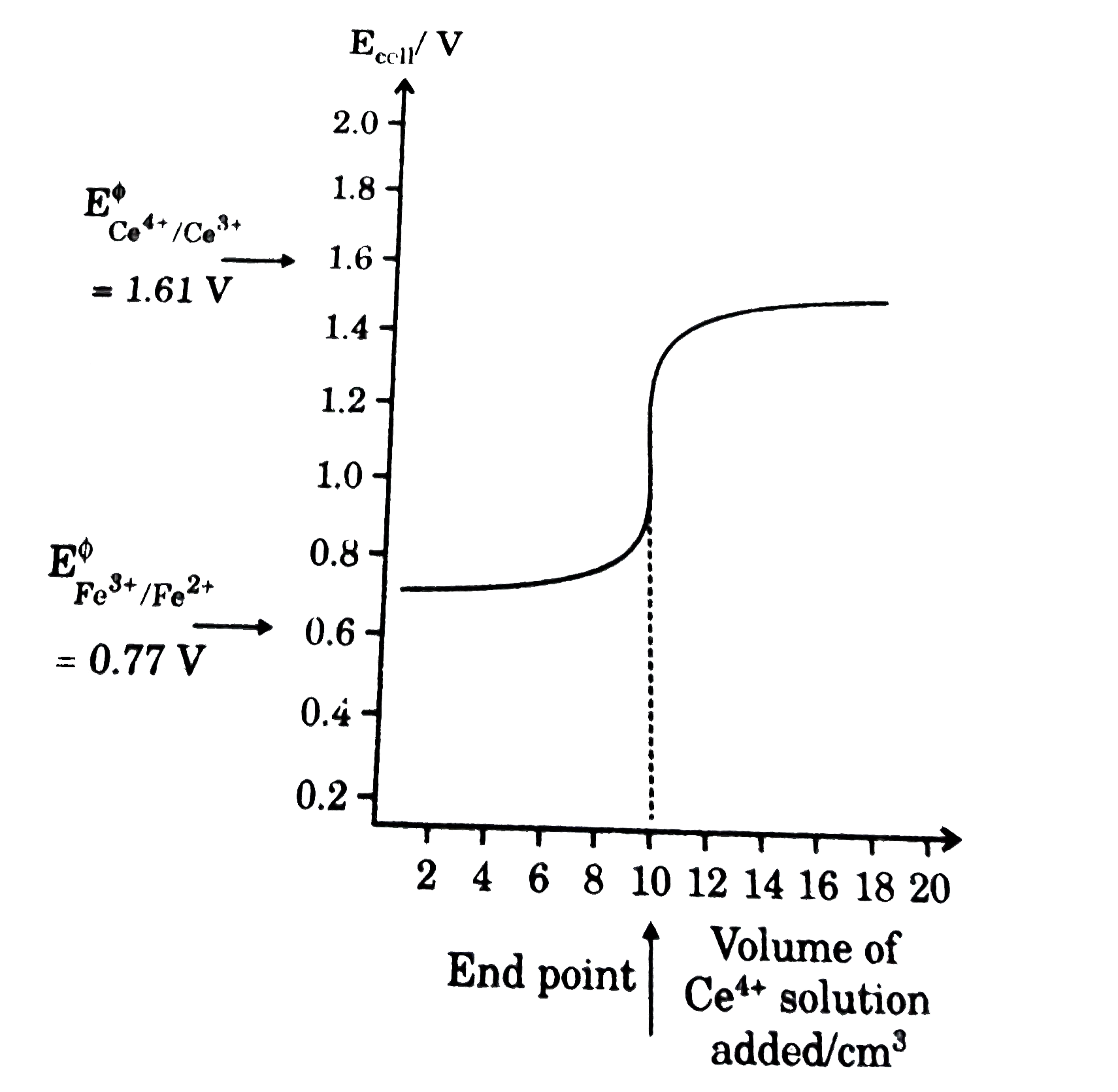
If we continue to add cerium (IV) solution , the number of iron (II) ions is gradually reduced and eventually only a very few are left (Table).At this stage the next few drops of cerium (IV) solution convert all the remaining irom (II) ions into iron (III), and some of the cerium (IV) ions are left unreacted. Once this happens we no longer have an iron `(III)//"iron"(II)` half-cell. Instead we have a solution in which there is a large number of cerium (III) ions and a smaller number of cerium (IV) ions. The solution in the beaker now behaves as a cerium `(IV)//"cerium"(III)`half-cell (although not a standard one.)
Just before all the iron (II) ions are converted into iron (III) we have a cell with an EMF of around `+0.77V.` After all the iron (II) ions are oxidised we have a cell with an emf of about `+1.61 V. ` This rapid rise in emf occurs with the addition of just one drop of cerium (IV) solution. You should be able to understand why a graph of cell emf against volume of cerium (IV) solution of the iron (II) solution calculated in the usual way.
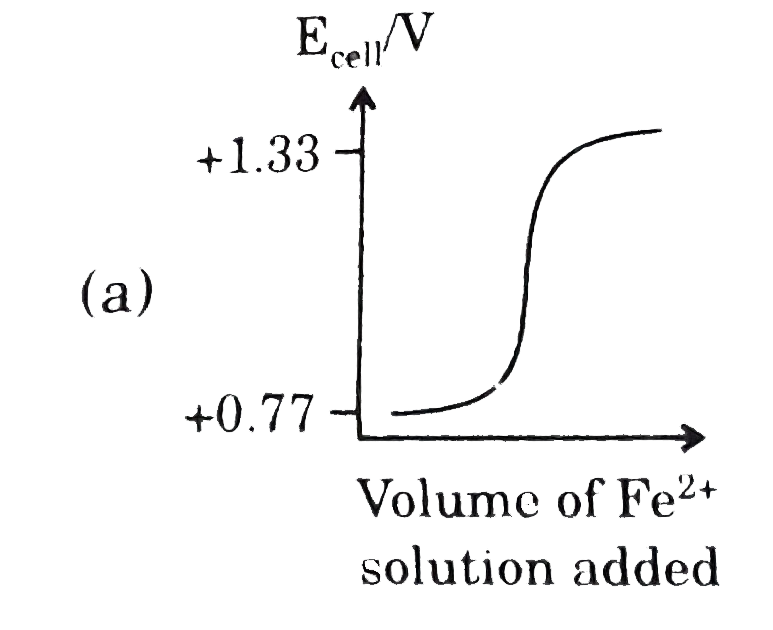
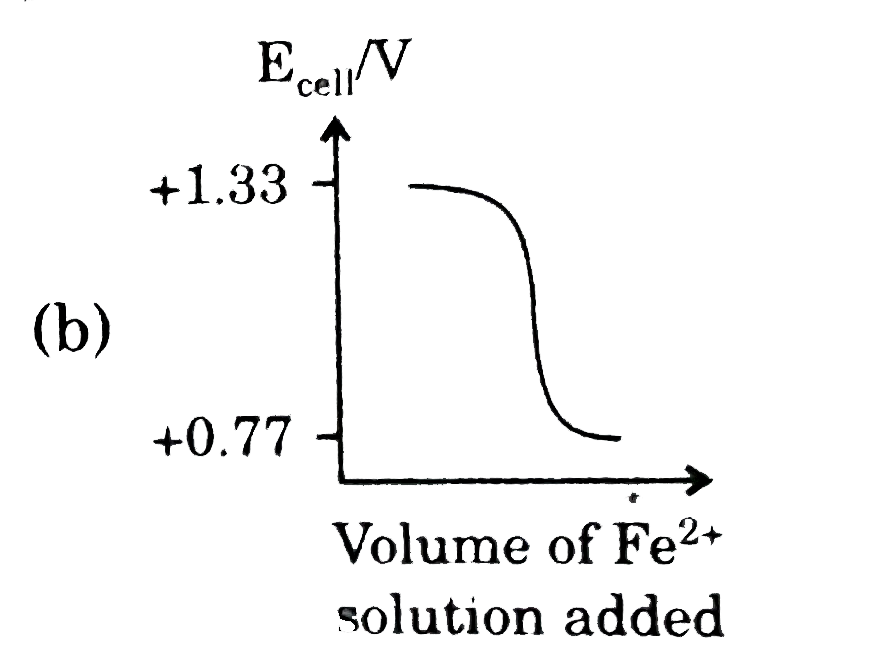
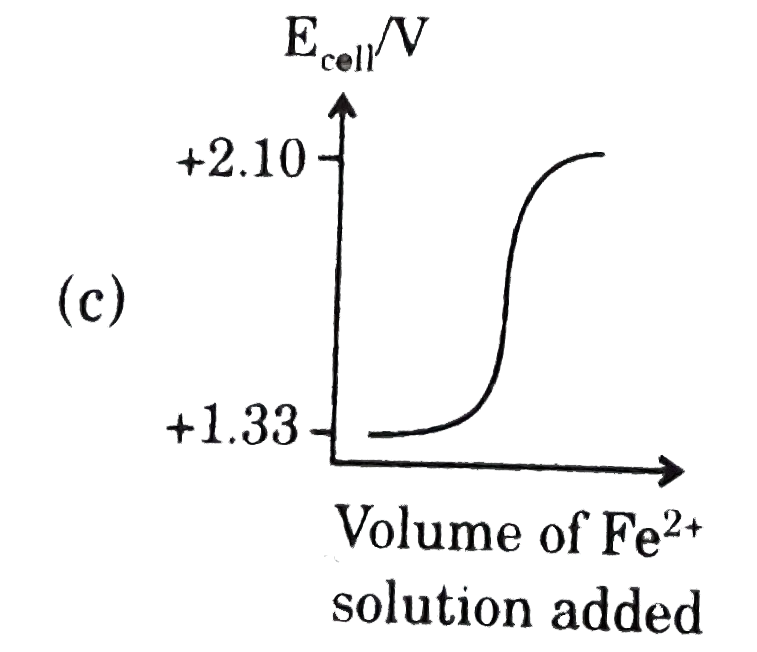
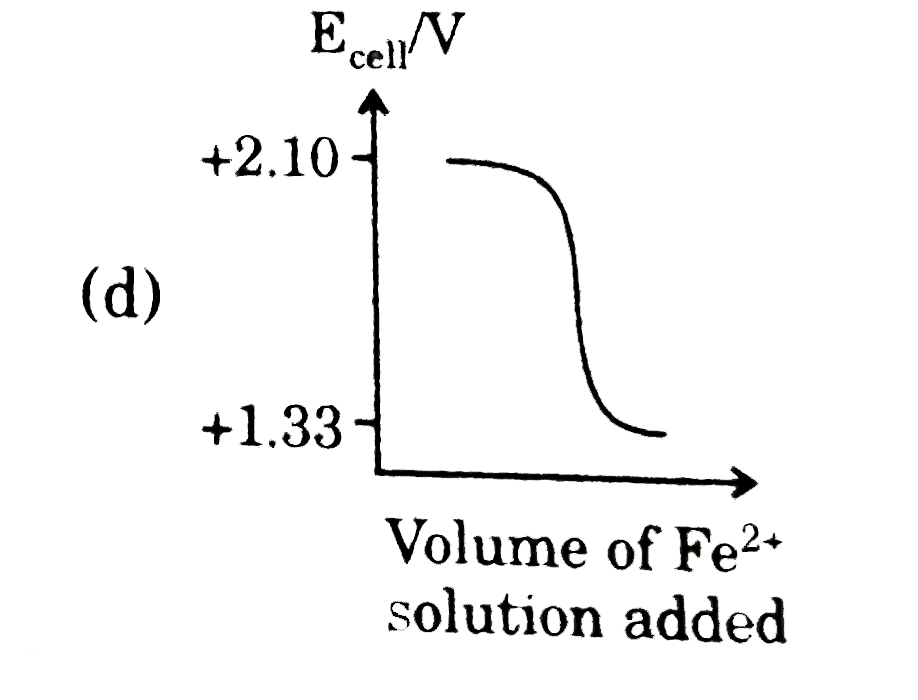
Imagine you were given a solution of potassium dichromate (VI) in a beaker and a solution of iron (II) sulphate in a burette. You do not know the concentration of dichromate (VI) ions , but the concentration of the iron (II) solution is known. Your task it to carry out a redox titration using the two solutions in order to determine the concentration of dichromate (VI) ions. Sketch a graph showing how the emf changes in the course of the above titration.
`E_(Cr_(2)O_(7)^(2-)//Cr^(3+)) = 1.33 V, E_(Fe^(3+)//Fe^(2+)) = 0.77 V`

A

B

C

D

Text Solution

Verified by Experts

The correct Answer is:

B
Promotional Banner

Topper's Solved these Questions

  • GRAPHICAL INTERPRETATION

    GRB PUBLICATION|Exercise Comprehension 2|1 Videos
  • GRAPHICAL INTERPRETATION

    GRB PUBLICATION|Exercise Comprehension 3|1 Videos
  • GRAPHICAL INTERPRETATION

    GRB PUBLICATION|Exercise Comprehension 1|1 Videos
  • F-BLOCK ELEMENTS

    GRB PUBLICATION|Exercise Subjective type|7 Videos
  • HYDROCARBON (ALIPHATIC)

    GRB PUBLICATION|Exercise Previous years jee questions|28 Videos
GRB PUBLICATION-GRAPHICAL INTERPRETATION-Comprehension
  1. The principle on conductometric titration is based in the fact that du...

    Text Solution

    |

  2. Titration are one of the methods we can use to discover the precise co...

    Text Solution

    |

  3. Titration are one of the methods we can use to discover the precise co...

    Text Solution

    |

  4. The speed of a molecule of a gas changes continuously as a result of c...

    Text Solution

    |

  5. The speed of a molecule of a gas changes continuously as a result of c...

    Text Solution

    |

  6. Concentrations measured as a function of time when gaseous N(2)O(5) at...

    Text Solution

    |

  7. Concentrations measured as a function of time when gaseous N(2)O(5) at...

    Text Solution

    |

  8. For the reversible reaction A underset(k(b))overset(k(f))(hArr)B (havi...

    Text Solution

    |

  9. According to collision theory for determining the variation of rate o...

    Text Solution

    |

  10. The adsorption of a gas at a metal surface is called occlusion. The ex...

    Text Solution

    |

  11. A,B and C react in the 1:1:1 stoichiometric ratio. The concentration o...

    Text Solution

    |

  12. Above graph is plotted for 1 mole of ideal monoatomic gas. Find net ...

    Text Solution

    |

  13. The process by which a gas through a small hole into vacuum is called ...

    Text Solution

    |

  14. Titration of diprotic acid (H(2)A) by strong base has been summarised...

    Text Solution

    |

  15. Titration of diprotic acid (H(2)A) by strong base has been summarised...

    Text Solution

    |

  16. For an ideal gas if heat given in process AB is 10kJ then answer the f...

    Text Solution

    |

  17. Thermodynamics stability is often used in chemical reactions to predic...

    Text Solution

    |

  18. This type of deviation is also expected in the following mixture :

    Text Solution

    |

  19. Total vapour pressure of mixture of 1 mol of volatile component A(p(A)...

    Text Solution

    |

  20. Figure explains elevation in boiling point when a non-volatile solute ...

    Text Solution

    |
