Home
Class 12
CHEMISTRY
R(r) is the radial part of the wave func...

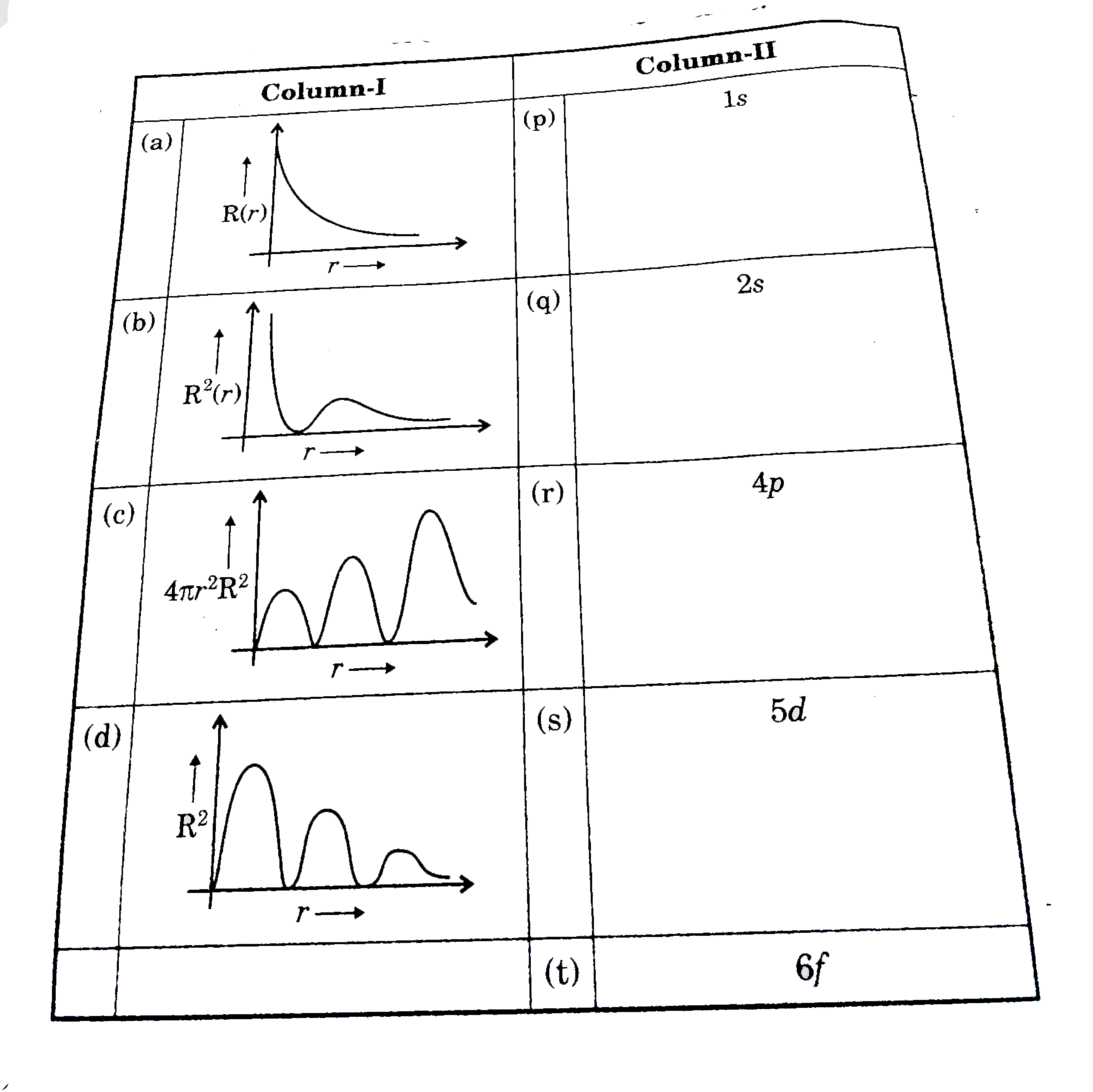
R(r) is the radial part of the wave function and r is the distance of electron from the nucleus.

Text Solution

Verified by Experts

The correct Answer is:

a-p; b-q; c-r,s,t; d-r,s,t
Promotional Banner

Topper's Solved these Questions

  • GRAPHICAL INTERPRETATION

    GRB PUBLICATION|Exercise Subjective Type|23 Videos
  • GRAPHICAL INTERPRETATION

    GRB PUBLICATION|Exercise Comprehension 29|1 Videos
  • F-BLOCK ELEMENTS

    GRB PUBLICATION|Exercise Subjective type|7 Videos
  • HYDROCARBON (ALIPHATIC)

    GRB PUBLICATION|Exercise Previous years jee questions|28 Videos

Similar Questions

Explore conceptually related problems

The variation of radial probability density R^2 (r) as a function of distance r of the electron from the nucleus for 3p orbital:

The Schrodinger wave equation for H-atom is nabla^(2) Psi = (8pi^(2)m)/(h^(2)) (E-V) Psi = 0 Where nabla^(2) = (del^(2))/(delx^(2)) +(del^(2))/(dely^(2)) +(del^(2))/(delz^(2)) E = Total energy and V=potential energy wave function Psi_(((r, theta,phi)))R_((r))Theta_((theta))Phi_((phi)) R is radial wave function which is function of ''r'' only, where r is the distance from nucleus. Theta and Phi are angular wave function. R^(2) is known as radial probability density and 4pir^(2)R^(2)dr is known as radial probability function i.e., the probability of finding the electron is spherical shell of thickness dr. Number of radial node =n -l - 1 Number of angular node = l For hydrogen atom, wave function for 1s and 2s-orbitals are: Psi_(1s) = sqrt((1)/(pia_(0)^(a)))e^(-z_(r)//a_(0)) Psi_(2s) = ((Z)/(2a_(0)))^(½) (1-(Zr)/(a_(0)))e^(-(Zr)/(a_(0))) The plot of radial probability function 4pir^(2)R^(2) aganist r will be: Answer the following questions: The following graph is plotted for ns-orbitals The value of 'n' will be:

The Schrodinger wave equation for H-atom is nabla^(2) Psi = (8pi^(2)m)/(h^(2)) (E-V) Psi = 0 Where nabla^(2) = (del^(2))/(delx^(2)) +(del^(2))/(dely^(2)) +(del^(2))/(delz^(2)) E = Total energy and V=potential energy wave function Psi_(((r, theta,phi)))R_((r))Theta_((theta))Phi_((phi)) R is radial wave function which is function of ''r'' only, where r is the distance from nucleus. Theta and Phi are angular wave function. R^(2) is known as radial probability density and 4pir^(2)R^(2)dr is known as radial probability function i.e., the probability of finding the electron is spherical shell of thickness dr. Number of radial node =n -l - 1 Number of angular node = l For hydrogen atom, wave function for 1s and 2s-orbitals are: Psi_(1s) = sqrt((1)/(pia_(0)^(a)))e^(-z_(r)//a_(0)) Psi_(2s) = ((Z)/(2a_(0)))^(½) (1-(Zr)/(a_(0)))e^(-(Zr)/(a_(0))) The plot of radial probability function 4pir^(2)R^(2) aganist r will be: Answer the following questions: The value of radius 'r' for 2s atomic orbital of H-atom at which the radial node will exist may be given as:

The Schrodinger wave equation for H-atom is nabla^(2) Psi = (8pi^(2)m)/(h^(2)) (E-V) Psi = 0 Where nabla^(2) = (del^(2))/(delx^(2)) +(del^(2))/(dely^(2)) +(del^(2))/(delz^(2)) E = Total energy and V=potential energy wave function Psi_(((r, theta,phi)))R_((r))Theta_((theta))Phi_((phi)) R is radial wave function which is function of ''r'' only, where r is the distance from nucleus. Theta and Phi are angular wave function. R^(2) is known as radial probability density and 4pir^(2)R^(2)dr is known as radial probability function i.e., the probability of finding the electron is spherical shell of thickness dr. Number of radial node =n -l - 1 Number of angular node = l For hydrogen atom, wave function for 1s and 2s-orbitals are: Psi_(1s) = sqrt((1)/(pia_(0)^(a)))e^(-z_(r)//a_(0)) Psi_(2s) = ((Z)/(2a_(0)))^(½) (1-(Zr)/(a_(0)))e^(-(Zr)/(a_(0))) The plot of radial probability function 4pir^(2)R^(2) aganist r will be: Answer the following questions: What will be number of angular nodes and spherical nodes for 4f atomic orbitals respectively.

For which of the following orbitals is the radial probaility density R^(2) the maximum at the nucleus and descrease sharply as the distance form the nucleus increases?

The potential energy function of a particle is given by U(r)=A/(2r^(2))-B/(3r) , where A and B are constant and r is the radial distance from the centre of the force. Choose the correct option (s)

In three dimension wave function may be expressed in spherical co-ordinate system (r,0,phi),r= distance of electron from the nucleus 0= Angle from 'z' axis varying from 0 to pi phi = Angle from 'x' axis …… 0 to 2pi ltbr. Psi may be represented as Psi (r,0,phi)=R (r) .A(0, phi) The R(r) is detemind by 'n' and 'l'. The A (0,phi) is determined by 'l' and 'm'. Angular part of 'H' atom wave equation A(0,phi)= (1)/sqrt(4pi). Hence , atomic orbital is:
