Home
Class 12
CHEMISTRY
For the reaction A(s) rarr A(g), the var...

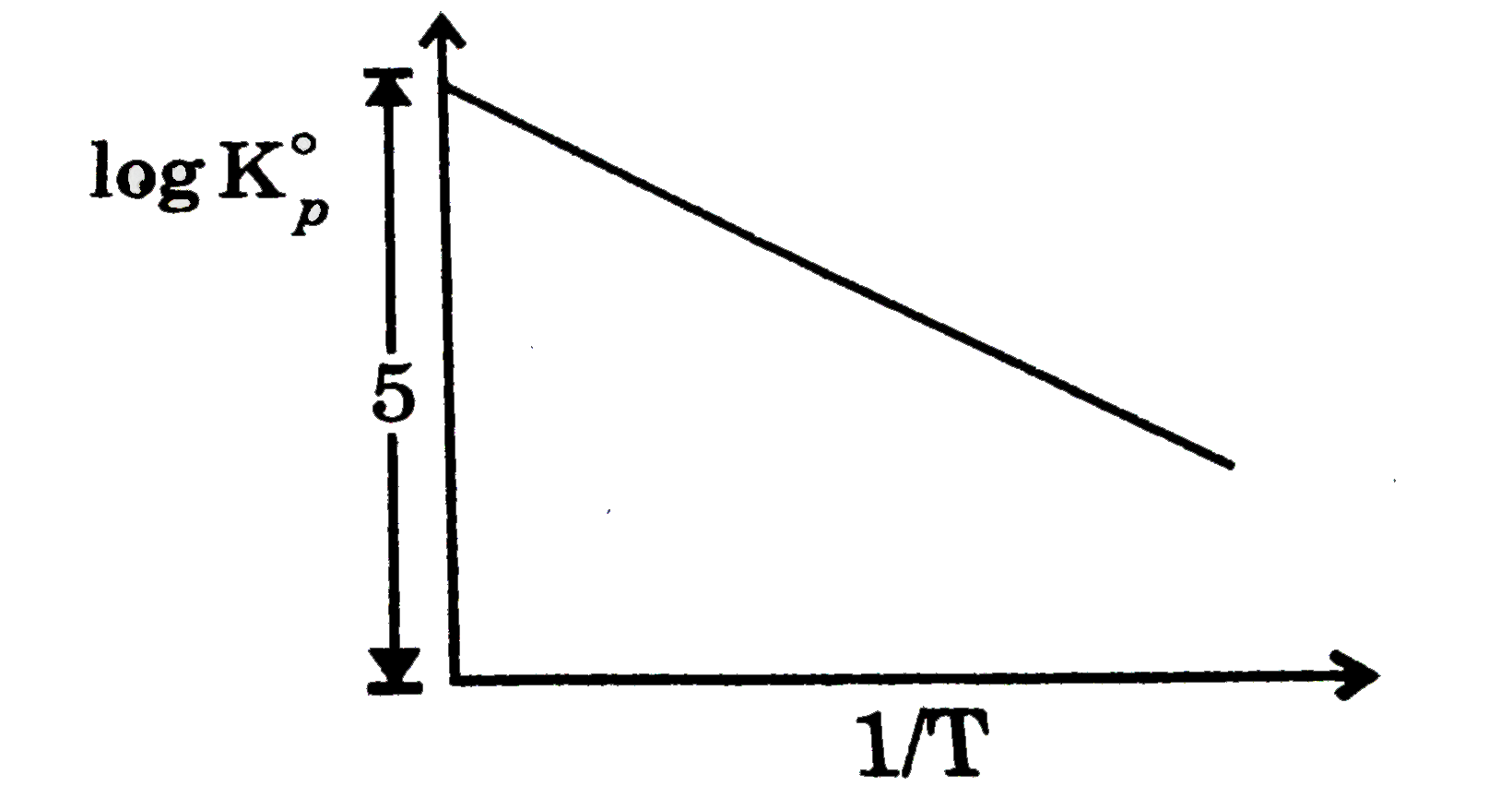
For the reaction `A(s) rarr A(g)`, the variation of log `K_(P)^(@)` us `(1)/(T)` is given by:

If `S_(m)^(@), A(g)` is `31.78 cal//K` mole, then calculate `S_(m)^(@) A(s)` in cal/K mole.

Text Solution

Verified by Experts

The correct Answer is:

9
Promotional Banner

Topper's Solved these Questions

  • GRAPHICAL INTERPRETATION

    GRB PUBLICATION|Exercise Match The Column Type|15 Videos
  • F-BLOCK ELEMENTS

    GRB PUBLICATION|Exercise Subjective type|7 Videos
  • HYDROCARBON (ALIPHATIC)

    GRB PUBLICATION|Exercise Previous years jee questions|28 Videos

Similar Questions

Explore conceptually related problems

For the reaction, A(g)+B(s)hArrC(g)+D(g).K_(c)=49 mol L^(-1)at 127^(@)C. Calculate k_(p).

Bomb calorimeters are the devices that are used to experimentally determine DeltaH and DeltaU of any reaction by measuring the temperature change in the water bath Hence , the experimatal data can be used for cross-checking theortical data, From the following theoretical data answer the question that follow: Thermodynamic data: DeltaH_(f)^(@)Ch_(4)(g)=- 15 kcal //"mole", DeltaH_(f)^(@) CO_(2)(g)=-90 kcal//"mole", DeltaH_(f)^(@)H_(2)O(l)=-60 Kcal//"mole" S_(m)^(@) CH_(4)(g)= 40 cal//"mole Kelivn" S_(m)^(@) O(g)= 45 cal//"mole Kelivn" S_(m)^(@) H_(2)O(g)= 15 cal//"mole Kelivn" S_(m)^(@) CO_(2)(g)= 50 cal//"mole Kelivn" Calorimeter data: (1) Water equivlent of calorimaeter = 36 gm (2) Sepcific heat capacity of water = 1 cal//gm .^(@)C (2) mass of water inthe water bath =164 gm All data at 300 K, R=2 cal//"mol "K . Calculate rise in temperature of calorimeter if 0.01 moles of CH_(4)(g) undergoes combustion in the above bonb calorimeter at 300 K .

Bomb calorimeters are the devices that are used to experimentally determine DeltaH and DeltaU of any reaction by measuring the temperature change in the water bath Hence , the experimatal data can be used for cross-checking theortical data, From the following theoretical data answer the question that follow: Thermodynamic data: DeltaH_(f)^(@)Ch_(4)(g)=- 15 kcal //"mole", DeltaH_(f)^(@) CO_(2)(g)=-90 kcal//"mole", DeltaH_(f)^(@)H_(2)O(l)=-60 Kcal//"mole" S_(m)^(@) CH_(4)(g)= 40 cal//"mole Kelivn" S_(m)^(@) O(g)= 45 cal//"mole Kelivn" S_(m)^(@) H_(2)O(g)= 15 cal//"mole Kelivn" S_(m)^(@) CO_(2)(g)= 50 cal//"mole Kelivn" Calorimeter data: (1) Water equivlent of calorimaeter = 36 gm (2) Sepcific heat capacity of water = 1 cal//gm .^(@)C (2) mass of water inthe water bath =164 gm All data at 300 K, R=2 cal//"mol "K . 1. Calculate DeltaU_("combustion") of CH_(4)(g) at 300 K.

Bomb calorimeters are the devices that are used to experimentally determine DeltaH and DeltaU of any reaction by measuring the temperature change in the water bath Hence , the experimatal data can be used for cross-checking theortical data, From the following theoretical data answer the question that follow: Thermodynamic data: DeltaH_(f)^(@)Ch_(4)(g)=- 15 kcal //"mole", DeltaH_(f)^(@) CO_(2)(g)=-90 kcal//"mole", DeltaH_(f)^(@)H_(2)O(l)=-60 Kcal//"mole" S_(m)^(@) CH_(4)(g)= 40 cal//"mole Kelivn" S_(m)^(@) O(g)= 45 cal//"mole Kelivn" S_(m)^(@) H_(2)O(g)= 15 cal//"mole Kelivn" S_(m)^(@) CO_(2)(g)= 50 cal//"mole Kelivn" Calorimeter data: (1) Water equivlent of calorimaeter = 36 gm (2) Sepcific heat capacity of water = 1 cal//gm .^(@)C (2) mass of water inthe water bath =164 gm All data at 300 K, R=2 cal//"mol "K . If calorimeter is modified so as to convert chemical energy into electrical by ensuring that the reaction is occurring at constant pressure then how much electron work can be obtained by combustion of 0.1 mole of CH_(4) (g) ?

For the reaction 2A (g) + B(g) to C (g) Delta U^(@) = 20 kcal/mole, Delta S^(@) = 100 cal/kmole at 300 K. Hence Delta G^(@) in kcal is __________ [R = 2 cal mol^(-1) K^(-1)]

For the reaction. A(l)rarr 2B(g) DeltaU="2.1 k Cal, "DeltaS="20 Cal K"^(-1)" at 300K Hence DeltaG" in kcal " is ?

For a reaction 2X(s)+2Y(s)rarr 2Cl(l)+D(g) The q_(p) at 27^(@)C is -28 K Cal. mol^(-1) . The q_(V) is ___________ K. Cal. mol^(-1) :-

GRB PUBLICATION-GRAPHICAL INTERPRETATION-Subjective Type
  1. From the graph of (d)/(P) us P at a constant temperature of 300 K. cal...

    Text Solution

    |

  2. For adsorption of gas over solid surface following data is obtained at...

    Text Solution

    |

  3. For a fixed amount of a real gas when a graph of Z us P was plotted th...

    Text Solution

    |

  4. 10 moles of an ideal gas is subjected to an isochoric process (volume ...

    Text Solution

    |

  5. For O(2) gas at T(1) and T(2) following Maxwell speed distribution is ...

    Text Solution

    |

  6. Two moles of an ideal gas undergoes the process depicted below. Given ...

    Text Solution

    |

  7. One mole of an ideal gas is subjected to a two step reversible process...

    Text Solution

    |

  8. Calculate DeltaG (in L atm) from the graph of an ideal gas undergoing ...

    Text Solution

    |

  9. One mole of an ideal monoatomic gas undergoes the following cyclic pro...

    Text Solution

    |

  10. One mole of a monoatomic ideal gas is taken through a cycle ABCDA as s...

    Text Solution

    |

  11. One mole of a gas is taken from state A to state B as shown in figure....

    Text Solution

    |

  12. One mole of an ideal monoatomic gas is heated according to path AB and...

    Text Solution

    |

  13. Find the heat absorbed by an ideal gas (in kJ)w it follows the graph (...

    Text Solution

    |

  14. If work done by an ideal gas in process 1-2 on the given graph is 0.4 ...

    Text Solution

    |

  15. Between two isotherms we have a cycle as shown. Find the work done by ...

    Text Solution

    |

  16. Calculate magnitude of net work in following cyclic process for 1 mole...

    Text Solution

    |

  17. One mole of monoatomic gas taken through a cyclic process as shown in ...

    Text Solution

    |

  18. For the reaction A(s) rarr A(g), the variation of log K(P)^(@) us (1)/...

    Text Solution

    |

  19. An ideal gas is subjected to the following changes. Answer the followi...

    Text Solution

    |

  20. For calculation of molecular weight of a dibasic acid using silver sal...

    Text Solution

    |
