Home
Class 12
PHYSICS
X and Y are large, parallel conducting p...

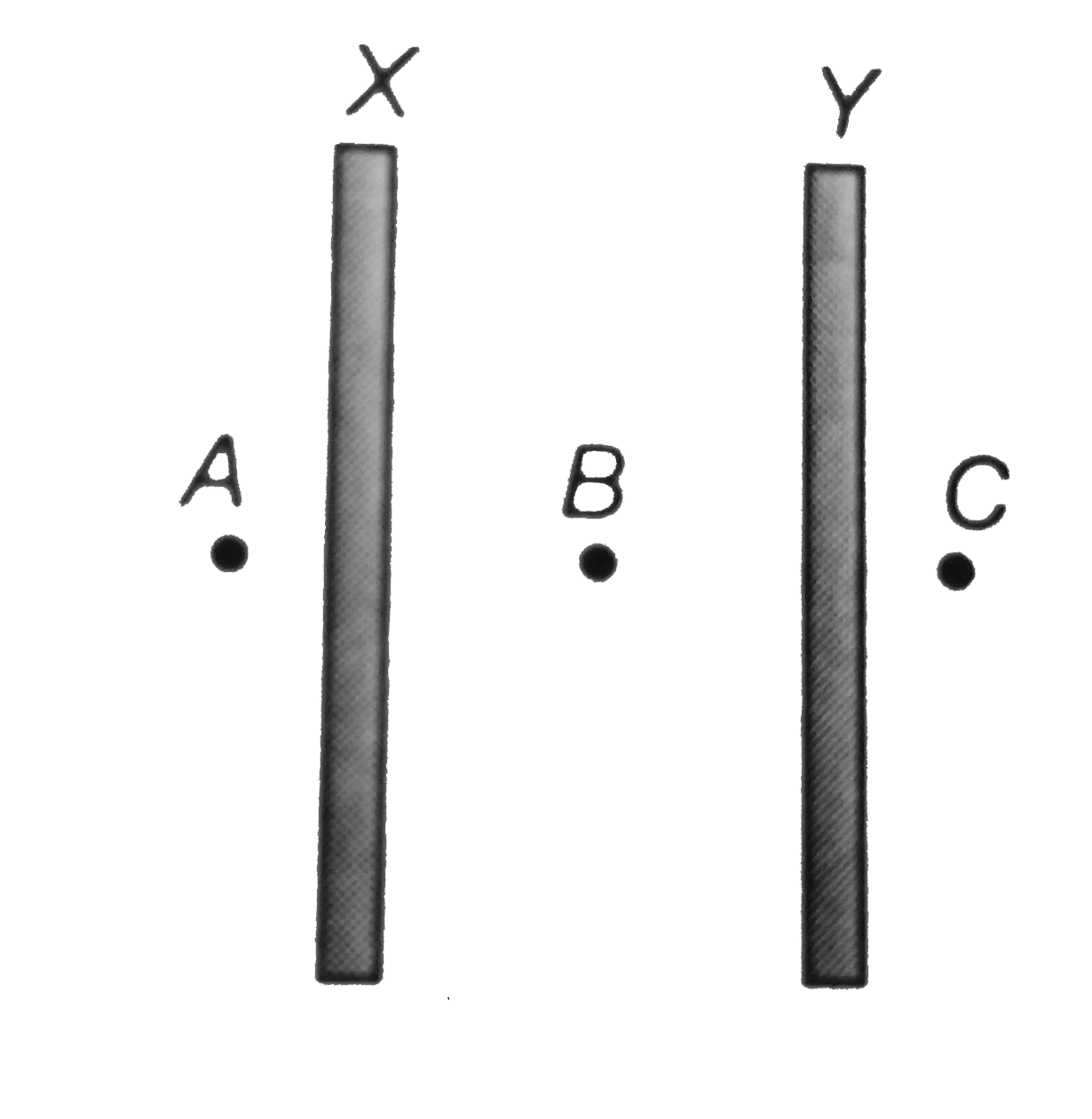
`X` and `Y` are large, parallel conducting plates close to each other. Each face has an area `A`. `X` is given a charge `Q`. `Y` is without any charge. Points `A,B` and `C` are as shown in the figure.

A

The field at `B` is `Q/(2 epsilon_(0)A)`

B

The field at `B` is `Q/(epsilon_(0)A)`

C

The fields at `A,B` and `C` are of the same magnitude

D

The field at `A` and `C` are of the same magnitude, but in opposite directions

Text Solution

Verified by Experts

The correct Answer is:

A, C, D
Promotional Banner

Topper's Solved these Questions

  • ELECTROMAGNETISM

    D MUKHERJEE|Exercise All Questions|91 Videos
  • EXPERIMENTAL PHYSICS

    D MUKHERJEE|Exercise chose the correct|4 Videos

Similar Questions

Explore conceptually related problems

A and B are two large identical thin metal plates placed parallel to each other at a small separation. Plate A is given a charge Q. (i) Find the amount of charge on each of the two faces of A and B. (ii) Another identical plate C having charge 3Q is inserted between plate A and B such that distance of C from B is twice its distance from A. Plate A and B is shorted using a conducting wire. Find charge on all six faces of plates A, B and C. (iii) In the situation described in (ii) the plate A is grounded. Now write the charge on all six faces.

Two large , parallel conducting plates X and Y , kept close to each other , are given Q_(1) and Q_(2) (Q_(1) gt Q_(2)) . The four surfaces of the plates are A,B,C and D , as shown (i) The charge on A is (1)/(2) (Q_(1) + Q_(2)) (ii) The charge on B is (1)/(2) (Q_(1) - Q_(2)) (iii) The charge on C is (1)/(2) (Q_(2) - Q_(1)) (iv) The charge on D is (1)/(2) (Q_(1) + Q_(2))

Two conducting plates A and B are placed parallel to each other. A is given a charge. Q_1 and B a charge Q_2 . Find the distribution of charges on the four surface.

Two large parallel conducting plates are placed close to each other ,the inner surface of the two plates have surface charge densities +sigma and -sigma .The outer surfaces are without charge.The electric field has a magnitude of

There are two metallic plates of a parallel plate capacitor. One plate is given a charge +q while the other is earthed as shown. Points P, P_1 and P_2 are taken as shown in adjoining figure. Then the electric intensity is not zero at :

Two conducting plates X and Y, having large surface area A (on one side), are placed parallel to each other as shown in figure. The plate X is given a charge Q whereas the other is neutral. Find : (a) The surface charge density at the inner surface of the plate X, (b) The electric field at a point to the left of the plates, (c) The electric field at a point in between the plates and (d) The electric field at a point to the right of the plates.

Three large plates A, B and C are placed parallel to each other and charges are given as shown. The charge that appears on the left surface of plate B is

Three large conducting plates with charges Q , -Q and Q are kept close to each other as shown in the figure. ( where Q = 2 uc ). Now all the three plates A, B, and C are connected by a thin conducting wire. Find the charge ( in C) on left surface of plate A at electristatic equailibrium

Two conducting plates A and B are placed parallel to each other. A is given a charge Q_1 and B a charge Q_2 . Prove that the charges on the inner surfaces are of equal magnitude and opposite sign.

D MUKHERJEE-ELECTROSTATICS-All Questions
  1. Two large parallel conducting plates are placed close to each other ,t...

    Text Solution

    |

  2. Two large , parallel conducting plates X and Y , kept close to each ot...

    Text Solution

    |

  3. X and Y are large, parallel conducting plates close to each other. Eac...

    Text Solution

    |

  4. A parallel plate capacitor is charged from a cell and then isolated fr...

    Text Solution

    |

  5. When a charge of amount Q is given to an isolated metal plate X of sur...

    Text Solution

    |

  6. In an isolated parallel plate capacitor of capacitance C, the four sur...

    Text Solution

    |

  7. A conductor A is given a charge of amount +Q and then placed inside a ...

    Text Solution

    |

  8. A conducting sphere of radius R and carrying a charge Q is joined to a...

    Text Solution

    |

  9. In the circuit shown, some potential difference is applied between A a...

    Text Solution

    |

  10. In the circuit shown, the potential difference across the 3muF capacit...

    Text Solution

    |

  11. The seperation between the plates of a parallel -plate capacitor is ma...

    Text Solution

    |

  12. A parallel-plate capacitor is charged from a cell and then disconnecte...

    Text Solution

    |

  13. In the circuit shown each capacitor has a capcitance C. The emf of the...

    Text Solution

    |

  14. In a parallel-plate capacitor of plate area A, plate separation d and ...

    Text Solution

    |

  15. The capacitance of a parallel -plate capacitor is C(0) when the region...

    Text Solution

    |

  16. A parallel plate air capacitor of capacitance C is connected to a cell...

    Text Solution

    |

  17. A conducting sphere A of radius a ,with charge Q , is placed concentri...

    Text Solution

    |

  18. A non conduction ring of radius R Has uniformly distributed positive ...

    Text Solution

    |

  19. Two positively charged particles X and Y are initially far away from ...

    Text Solution

    |

  20. Two particles X and Y of equal mass and with unequal positive charges,...

    Text Solution

    |
