Home
Class 12
PHYSICS
In an isolated parallel plate capacitor ...

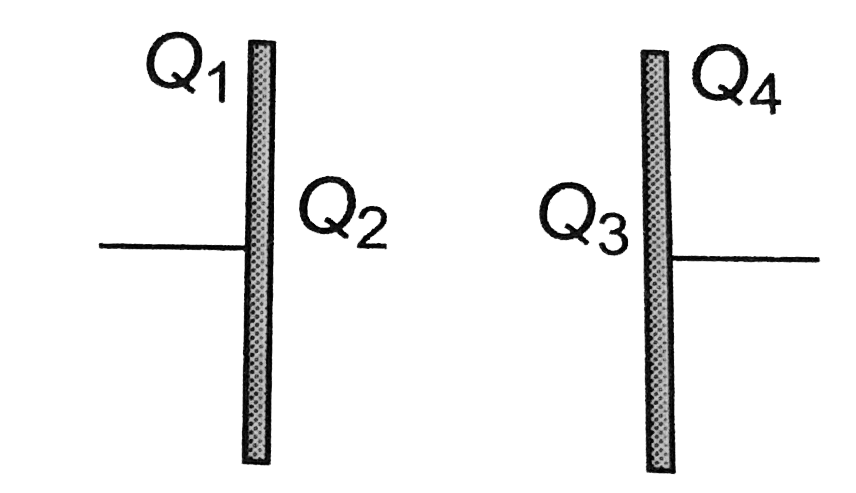
In an isolated parallel plate capacitor of capacitance `C`, the four surfaces have charges `Q_(1),Q_(2),Q_(3)` and `Q_(4)` as shown. The potential difference between the plates is

A

`(Q_(1)+Q_(2))/C`

B

`|(Q_(2))/C|`

C

`|(Q_(3))/C|`

D

`1/C [(Q_(1)+Q_(2))-(Q_(3)-Q_(4))]`

Text Solution

Verified by Experts

The correct Answer is:

B, C
Promotional Banner

Topper's Solved these Questions

  • ELECTROMAGNETISM

    D MUKHERJEE|Exercise All Questions|91 Videos
  • EXPERIMENTAL PHYSICS

    D MUKHERJEE|Exercise chose the correct|4 Videos

Similar Questions

Explore conceptually related problems

In an isolated parallel plate capacitor of capacitancee C , the four surface have chrges Q_(1),Q_(2),Q-(3) and Q_(4) as shown. The potential difference between the plates is

In an isolated parallel plate capacitor of capacitance C the four surfaces have charges Q_(1), Q_(2), Q_(3) and Q_(4) as shown in the figure. The potential difference between the plates is :

In an isolated parallel plate capacitor of capacitance C , the plates have charge Q_(1) and Q_(2) . The potential difference between the plates is

For an isolated parallel plate capacitor of capacitance C and potential difference V, what will be change in (i) charge on the plates (ii) potential difference across the plates (iii) electric field between the plates (iv) energy stored in the capacitor, when the distance between the plates is increased ?

Two parallel conducting plates of a capacitor of capacitance C containing charges Q and -2Q at a distance d apart. Find out potential difference between the plates of capacitors.

In a parallel plate capacitor of capacitor 1muF two plates are given charges 2muC and 4muC the potential difference between the plates of the capacitor is

The charges appearing on inner surfaces of a parallel plate capacitor are q_( i and )q_(2) . The charges appearing on outer surfaces of the capacitor are equal.Find the potential difference between plates of the capacitor if capacitances is C.

An isolated parallel-plate capacitor of capacitor C has paltes X and Y. If plate X is given charge Q, the potential difference between X and Y Is

D MUKHERJEE-ELECTROSTATICS-All Questions
  1. A parallel plate capacitor is charged from a cell and then isolated fr...

    Text Solution

    |

  2. When a charge of amount Q is given to an isolated metal plate X of sur...

    Text Solution

    |

  3. In an isolated parallel plate capacitor of capacitance C, the four sur...

    Text Solution

    |

  4. A conductor A is given a charge of amount +Q and then placed inside a ...

    Text Solution

    |

  5. A conducting sphere of radius R and carrying a charge Q is joined to a...

    Text Solution

    |

  6. In the circuit shown, some potential difference is applied between A a...

    Text Solution

    |

  7. In the circuit shown, the potential difference across the 3muF capacit...

    Text Solution

    |

  8. The seperation between the plates of a parallel -plate capacitor is ma...

    Text Solution

    |

  9. A parallel-plate capacitor is charged from a cell and then disconnecte...

    Text Solution

    |

  10. In the circuit shown each capacitor has a capcitance C. The emf of the...

    Text Solution

    |

  11. In a parallel-plate capacitor of plate area A, plate separation d and ...

    Text Solution

    |

  12. The capacitance of a parallel -plate capacitor is C(0) when the region...

    Text Solution

    |

  13. A parallel plate air capacitor of capacitance C is connected to a cell...

    Text Solution

    |

  14. A conducting sphere A of radius a ,with charge Q , is placed concentri...

    Text Solution

    |

  15. A non conduction ring of radius R Has uniformly distributed positive ...

    Text Solution

    |

  16. Two positively charged particles X and Y are initially far away from ...

    Text Solution

    |

  17. Two particles X and Y of equal mass and with unequal positive charges,...

    Text Solution

    |

  18. In a uniform electric field, the potential is 10V at the origin of co...

    Text Solution

    |

  19. Two conducting concentric, hollow spheres A and B have radii a and b r...

    Text Solution

    |

  20. A positive charge is fixed at the origin of coordinates. An electri di...

    Text Solution

    |
