Home
Class 11
PHYSICS
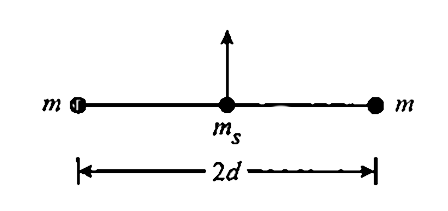
Two masses of mass m each are fixed at a...

Two masses of mass m each are fixed at a separation distance of `2d`. A small mass `m_(s)` placed midway, when displaced slightly, starts oscillating. Then :

A

Frequency of simple harmonic motion is given by `1/(2pi)sqrt((4Gm)/(d^(3)))`

B

Frequency of simple harmonic motion is given by `1/(2pi)sqrt((2Gm)/(d^(3)))`

C

Accleration of the mass `m_(s)`, is given by `(Gm)/(d^(2))`

D

Time period of vibration is `2pisqrt((GM)/((2d)^(3))`

Text Solution

Verified by Experts

The correct Answer is:

B
Promotional Banner

Topper's Solved these Questions

  • GRAVITATION

    PHYSICS GALAXY - ASHISH ARORA|Exercise Advance MCQs|17 Videos
  • GRAVITATION

    PHYSICS GALAXY - ASHISH ARORA|Exercise Unsolved Numerical|94 Videos
  • GRAVITATION

    PHYSICS GALAXY - ASHISH ARORA|Exercise Concetual MCQ|39 Videos
  • FLUID MECHANICS

    PHYSICS GALAXY - ASHISH ARORA|Exercise Unsolved Numerical Problems|86 Videos
  • KINEMATICS

    PHYSICS GALAXY - ASHISH ARORA|Exercise Unsolved Numerical Pro.|83 Videos

Similar Questions

Explore conceptually related problems

Two electrons each are fixed at a distance '2d'. A third charge proton placed at the midpoint is displaced slightly by a distance x (x lt lt d) perpendicular to the line joining the two fixed charges. Proton will execute simple harmonic motion having angular frequency : (m = mass of charged particle)

Two point masses, each equal to M, are placed a distance 2a apart. Show that a small mass m placed midway between them on the line joining them will be in equilibrium and if it is slightly displaced from this position along the line perpendicular to the line joining the masses, it will execute simple harmonic oscillations. Calculate the frequnency of these oscillations.

We know that when two equal masses are placed on a line then, gravitational force on a third mass is zero due to these two masses when the third is placed at the centre of line joining the two masses. But if third mass is placed anywhere else on the x-axis, the gravitational force acts on that mass due to these two masses. Consider a system shown in figure. In this system two point masses of mass M each are placed at y-axis at a distance a from origin and these masses are fixed. If a third point mass of mass m is released at a distance x from origin on x-axis, then answer the following questions. The distance between positions of maximum force on mass m is

We know that when two equal masses are placed on a line then, gravitational force on a third mass is zero due to these two masses when the third is placed at the centre of line joining the two masses. But if third mass is placed anywhere else on the x-axis, the gravitational force acts on that mass due to these two masses. Consider a system shown in figure. In this system two point masses of mass M each are placed at y-axis at a distance a from origin and these masses are fixed. If a third point mass of mass m is released at a distance x from origin on x-axis, then answer the following questions. Which of the following graphs best represents the variation of force on mass m with distance x ?

We know that when two equal masses are placed on a line then, gravitational force on a third mass is zero due to these two masses when the third is placed at the centre of line joining the two masses. But if third mass is placed anywhere else on the x-axis, the gravitational force acts on that mass due to these two masses. Consider a system shown in figure. In this system two point masses of mass M each are placed at y-axis at a distance a from origin and these masses are fixed. If a third point mass of mass m is released at a distance x from origin on x-axis, then answer the following questions. If a gt gt x, then which of the following statements is correct about the motion of mass m ?

Two bodies, each of mass M, are kept fixed with a separation 2L. A particle of mass m is projected from the midpoint of the line joining their centres, perpendicular to the line. The gravitational constant is G. The correct statement (s) is (are)

Two spheres of masses m and 2m are separated by distance d . A particle of mass (m)/(5) is projected straight from 2m towards m with a velocity v_(0) . Which of the following statements is correct ?

We know that when two equal masses are placed on a line then, gravitational force on a third mass is zero due to these two masses when the third is placed at the centre of line joining the two masses. But if third mass is placed anywhere else on the x-axis, the gravitational force acts on that mass due to these two masses. Consider a system shown in figure. In this system two point masses of mass M each are placed at y-axis at a distance a from origin and these masses are fixed. If a third point mass of mass m is released at a distance x from origin on x-axis, then answer the following questions. The net force on the mass m is when vec(x) is position vector of the point mass of mass m.

A plank of mass 'm' and area of cross - section A is floating as shown in figure. When slightly displaced from mean position, plank starts oscillations. Find time period of these osillations.

PHYSICS GALAXY - ASHISH ARORA-GRAVITATION-Numerial MCQs
  1. A body which is initially at rest at a height R above the surface of t...

    Text Solution

    |

  2. Two satellite A and B are moving round a planet in circular orbit hav...

    Text Solution

    |

  3. The radius of a planet is R. A satellite revolves around it in a circl...

    Text Solution

    |

  4. The gravitational field in a in region is given by vecg = (4hati + vec...

    Text Solution

    |

  5. The figure shows a spherical shell of mass M. The point A is not at th...

    Text Solution

    |

  6. Supernova refer to the explosion of a massive star. The material in th...

    Text Solution

    |

  7. Supernova refer to the explosion of a massive star. The material in th...

    Text Solution

    |

  8. Supernova refer to the explosion of a massive star. The material in th...

    Text Solution

    |

  9. A hole is drilled from the surface of earth to its centre. A particle ...

    Text Solution

    |

  10. Two small balls of mass m each are suspended side by side by two equal...

    Text Solution

    |

  11. Two masses of mass m each are fixed at a separation distance of 2d. A ...

    Text Solution

    |

  12. Mass M is uniformly distributed only on curved surface of a thin hemis...

    Text Solution

    |

  13. Figure shows a uniformly charges hemispherical shell. The direction of...

    Text Solution

    |

  14. A straight rod of length L extends from x=a to x=L+a. Find the gravita...

    Text Solution

    |

  15. The planets with radii R(1) and R(2) have densities p(1),p(2) respect...

    Text Solution

    |

  16. A satellite of mass m orbits the earth in an elliptical orbit having a...

    Text Solution

    |

  17. A uniform thin rod of mass m and length R is placed normally on surfac...

    Text Solution

    |

  18. A small body of superdense material, whose mass is twice the mass of t...

    Text Solution

    |

  19. Consider a mass m(0) enclosed by a closed imaginary surface S. Let vec...

    Text Solution

    |

  20. A solid sphere of uniform density and radius R applies a gravitational...

    Text Solution

    |
