Home
Class 12
MATHS
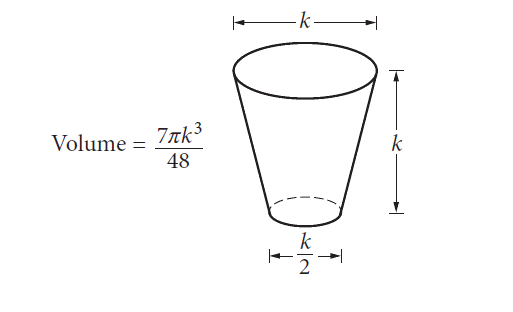
The glass pictured above can hold a maxi...


The glass pictured above can hold a maximum volume of 473 cubic centimeters, which is approximately 16 fluid ounces.
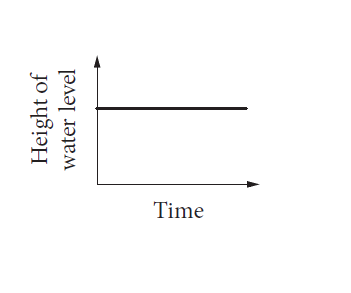
Water pours into the glass slowly and at a constant rate. Which of the following graphs best illustrates the height of the water level in the glass as it fills?

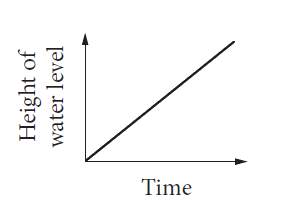
A

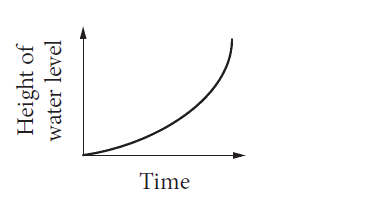
B

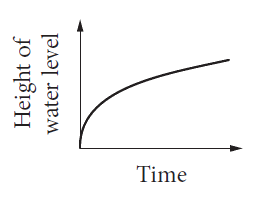
C

D

Text Solution

Verified by Experts

The correct Answer is:

C

Due to the shape of the glass, if the water is poured at a constant rate, the height of the water level will increase faster initially, where the diameter of the glass is smaller, and increase more slowly later, as the diameter of the glass increases. Choice C is the only graph that shows this behavior: it is steeper initially and then gets less steep.
Choice A is incorrect since it shows the height of the water level increasing at a constant rate over time. Choice B is incorrect since it shows the height of the water level increasing slowly at first and faster later. Choice D is incorrect since it shows the height of the water level staying constant even as water is being poured into the glass.
Promotional Banner

Similar Questions

Explore conceptually related problems

The glass pictured above can hold a maximum volume of 473 cubic centimeters, which is approximately 16 fluid ounces. What is the value of k, in centimeters?

A water tank has the shape of an inverted righ circular cone with its axis vertical and vertex lowermost . Its semi-vertical angle is tan^(-1)(0.5) . Water is poured into it at a constant rate of 4 cubic meter per hour . Find the rate at which the level of the water is rising at the instant when the depth of water in the tank is 2 m.

Jenny has a pitcher that contains 1 gallon of water. How many times could Jenny completely fill the glass with approximately 16 fluid ounces? (1 gallon = 128 fluid ounces)

A water tank has the shape of an inverted right circular cone with its axis vertical and vertex lowermost. Its semi-vertical angle is tan^(-1)(0. 5) . Water is poured into it at a constant rate of 5 cubic metre per hour. Find the rate at which the level of the water is rising at the instant when the depth of water in the tank is 4m.

A glass tumbler containing hot water is kept in the freezer compartment of a refrigerator (temperature lt 0^(@) C ). If you could measure the temperature of the content of the tumbler , which of the following graphs would correctly represent the change in its temperature as a function of time.

V =1/3 pi ((d)/(2)) ^(2) h A circle of rubber with a constant diameter d is placed on a table, its perimeter is anchored to the table and a string is attached to its centre. When the string is pulled upwards, a cone is formed with height h and volume V. The relationship between d, h, and V is represented above. Which of the following statements must be true ? I. As the volume of the cone decreases, the height also decreases. II. If the diameter of the base of the cone is 6 centimeters, the height can be determined by dividing the volume by 3pi. III. If the height of the conc triples, the volume must also triple.

When an object moves through a fluid, as when a ball falls through air or a glass sphere falls through water te fluid exerts a viscous foce F on the object this force tends to slow the object for a small sphere of radius r moving is given by stoke's law, F_(w)=6pietarv . in this formula eta in the coefficient of viscosity of the fluid which is the proportionality constant that determines how much tangential force is required to move a fluid layer at a constant speed v, when the layer has an area A and is located a perpendicular distance z from and immobile surface. the magnitude of the force is given by F=etaAv//z . For a viscous fluid to move from location 2 to location 1 along 2 must exceed that at location 1, poiseuilles's law given the volumes flow rate Q that results from such a pressure difference P_(2)-P_(1) . The flow rate of expressed by the formula Q=(piR^(4)(P_(2)-P_(1)))/(8etaL) poiseuille's law remains valid as long as the fluid flow is laminar. For a sfficiently high speed however the flow becomes turbulent flow is laminar as long as the reynolds number is less than approximately 2000. This number is given by the formula R_(e)=(2overline(v)rhoR)/(eta) In which overline(v) is the average speed rho is the density eta is the coefficient of viscosity of the fluid and R is the radius of the pipe. Take the density of water to be rho=1000kg//m^(3) Q. Which of the following may be concluded from the information in the passage?
