Home
Class 12
MATHS
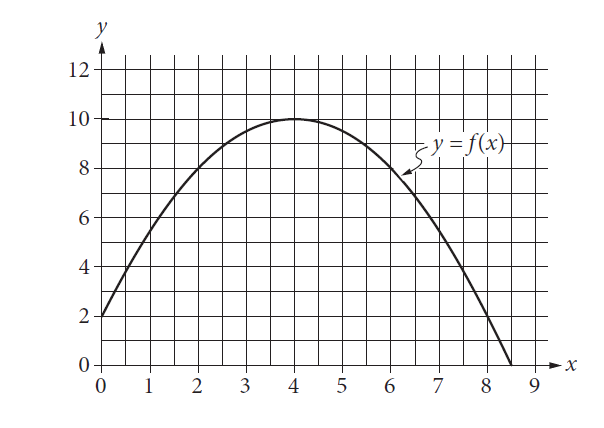
The graph of the function f, defined by ...


The graph of the function f, defined by `f(x)=-1/2(x-4)^2 +10`, is shown in the xy-plane above. If the function g (not shown) is defined by g(x) = −x + 10, what is one possible value of a such that f (a) = g(a) ?

Text Solution

Verified by Experts

The correct Answer is:

2 AND 8

Substituting x = a in the definitions for f and g gives `f(a)=-1/2(a-4)^2 + 10` and g(a)=-a+10, respectively. If f(a)=g(a) , then `-1/2(a-4)^2+10 =-a +10` Subtracting 10 from both sides of this equation gives `-1/2(a-4)^2=-a` . Multiplying both sides by -2 gives `(a-4)^2=2a`. Expanding `(a-4)^2` gives `a^2-8a+16=2a`. Combining the like terms on one side of the equation gives `a^2 − 10a + 16 = 0`. One way to solve this equation is to factor `a^2 − 10a + 16` by identifying two numbers with a sum of −10 and a product of 16. These numbers are −2 and −8, so the quadratic equation can be factored as (a − 2)(a − 8) = 0. Therefore, the possible values of a are either 2 or 8. Either 2 or 8 will be scored as a correct answer.
Alternate approach: Graphically, the condition f (a) = g(a) implies the graphs of the functions y = f (x) and y = g(x) intersect at x = a. The graph y = f (x) is given, and the graph of y = g(x) may be sketched as a line with y-intercept 10 and a slope of −1 (taking care to note the different scales on each axis). These two graphs intersect at x = 2 and x = 8.
Promotional Banner

Similar Questions

Explore conceptually related problems

The figure above shows the complete graph of the function f in the xy-plane. The function g (not shown) is defined by g(x) = f (x) + 6.What is the maximum value of the function g ?

The graph of the linear function f is shown in the xy-plane above. The graph of the linear function g (not shown) is perpendicular to the graph of f and passes through the point (1,3). What is the value of g(0) ?

f:R to R is a function defined by f(x)= 10x -7, if g=f^(-1) then g(x)=

Graphs of the functions f and g are shown in the xy-plane above. For which of the following values of x does f(x) + g(x) =0 ?

The function f and g are defined as f(x) = 2x - 3 and g(x) = x + 3//2 . For what value of y is f(y) = g(y- 3) ?

The complete graph of the function f is shown in the xy-plane above. For what value of x is the value of f(x) at its minimum?

The function f and g are defined as f(x , y) = 2x + y and g(x,y) = x + 2y . What is the value of f(3,4) ?

Let f : N rarr R be the function defined by f(x) = (2x-1)/(2) and g : Q rarr R be another function defined by g(x) = x + 2. Then (gof) ((3)/(2)) is
