Home
Class 12
MATHS
In an experiment, a heated cup of coffee...


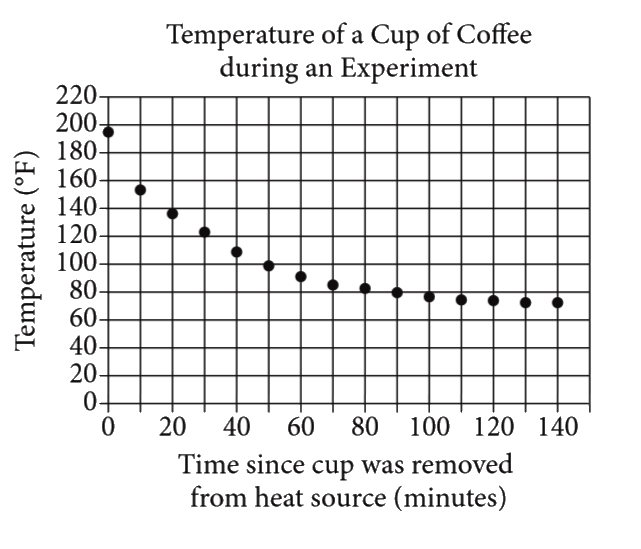
In an experiment, a heated cup of coffee is removed from a heat source, and the cup of coffee is then left in a room that is kept at a constant temperature. The graph above shows the temperature, in degrees Fahrenheit `(.^@F)`, of the coffee immediately after being removed from the heat source and at 10-minute intervals thereafter.
During which of the following 10-minute intervals does the temperature of the coffee decrease at the greatest average rate?

A

Between 0 and 10 minutes

B

Between 30 and 40 minutes

C

Between 50 and 60 minutes

D

Between 90 and 100 minutes

Text Solution

Verified by Experts

The correct Answer is:

A

The average rate of change in temperature of the coffee in degrees Fahrenheit per minute is calculated by dividing the difference between two recorded temperatures by the number of minutes in the corresponding interval of time. Since the time intervals given are all 10 minutes, the average rate of change is greatest for the points with the greatest difference in temperature. Of the choices, the greatest difference in temperature occurs between 0 and 10 minutes.
Choices B, C, and D are incorrect and may result from misinterpreting the average rate of change from the graph.
Promotional Banner

Similar Questions

Explore conceptually related problems

In an experiment, a heated cup of coffee is removed from a heat source, and the cup of coffee is then left in a room that is kept at a constant temperature. The graph above shows the temperature, in degrees Fahrenheit (.^@F) , of the coffee immediately after being removed from the heat source and at 10-minute intervals thereafter. Of the following, which best approximates the temperature, in degrees Fahrenheit, of the coffee when it is first removed from the heat source?

Temperature and heat are not :-

If a piece of metal is heated to temperature theta and the allowed to cool in a room which is at temperature theta_0 , the graph between the temperature T of the metal and time t will be closet to

if quantity of heat 1163.4 J supplied to one mole of nitrogen gas , at room temperature at constant pressure , then the rise in temperature is

In a carnot engine, when heat is absorbed from the source, its temperature

In the above problem if heat is supplied at a constant rate of q= 10 cal//min , then plot temperature versus time graph.

The graph shows the correlation between ambient air temperature, t, in degress Fahrenheit and the number of chirps, c, per minute that a snowy tree cricket makes at that temperature. Which of the following equations represents the line shown in the graph ?

Heat flows from a body at a high temperature to a body at a low temperature when they are kept in contact

If liquefied oxygen at 1 atmospheric pressure is heated from 50K to 300k by supplying heat at constant rate. The graph of temperature vs time will be

Room temperature is 30^(@)C . Express this is degree Fahrenheit and Kelvin.
