Home
Class 11
PHYSICS
A block attached to a spring, pulled by ...

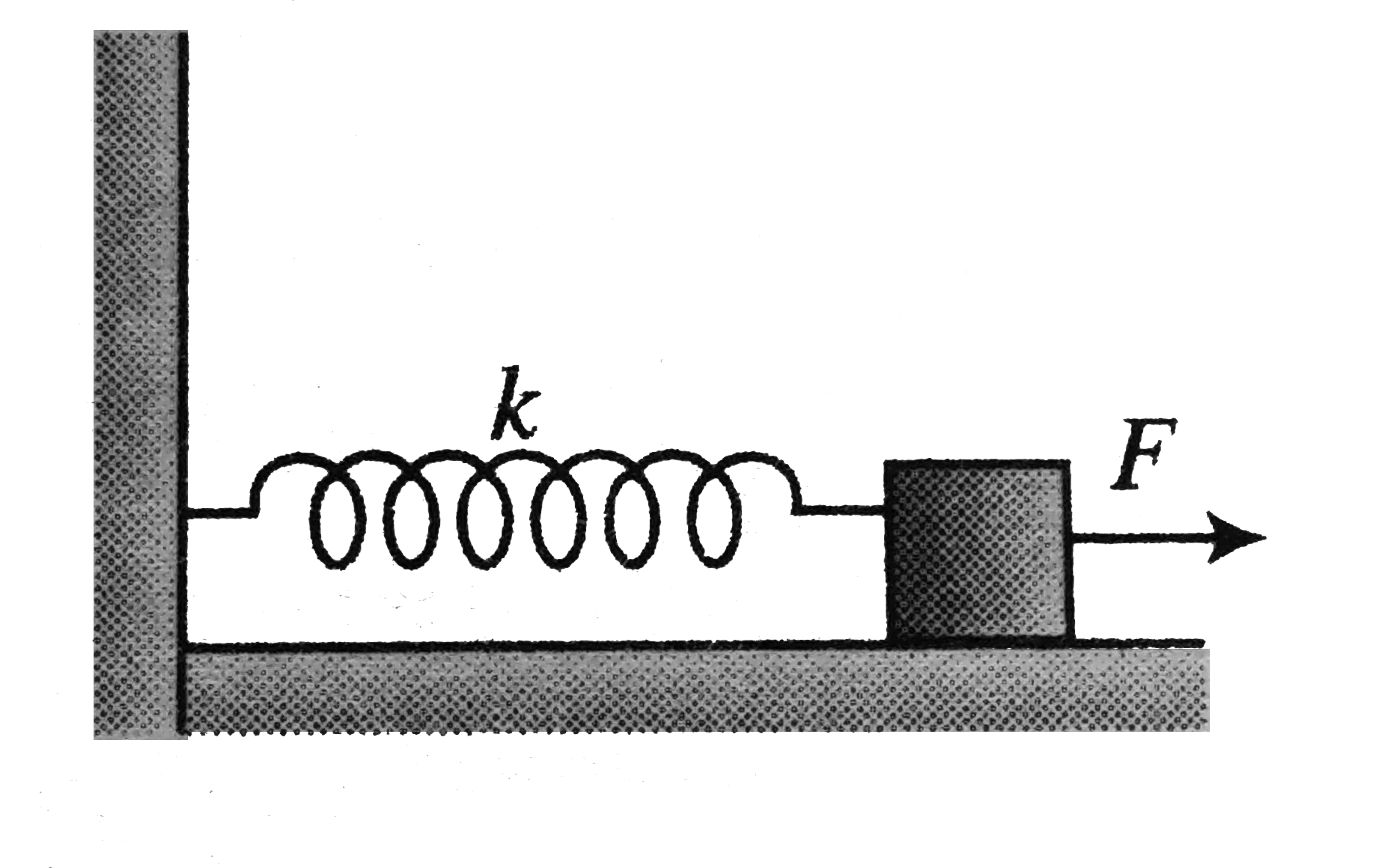
A block attached to a spring, pulled by a constant horizontal force, is kept on a smooth surface as shown in figure. Initially, the spring is in the natural length state. Then the maximum positive work that the applied force F can do is (give that string does not break)

A

`(F^(2))/(k)`

B

`(2F^(2))/(k)`

C

`(4F^(2))/(k)`

D

`(F^(2))/(2k)`

Text Solution

Verified by Experts

The correct Answer is:

d
Promotional Banner

Topper's Solved these Questions

  • WORK, POWER AND ENERGY

    DC PANDEY|Exercise B More than One Option is Correct|26 Videos
  • WORK, POWER AND ENERGY

    DC PANDEY|Exercise C Comprehension Type Questions|18 Videos
  • WORK, POWER AND ENERGY

    DC PANDEY|Exercise E Integer Type Questions|11 Videos
  • WORK, ENERGY AND POWER

    DC PANDEY|Exercise MEDICAL ENTRACES GALLERY|33 Videos

Similar Questions

Explore conceptually related problems

A block of mass m is attached to a spring of force constant k whose other end is fixed to a horizontal surface. Initially the spring is in its natural length and the block is released from rest. The average force acting on the surface by the spring till the instant when the block has zero acceleration for the first time is

Four blocks each of mass M connected by a massless strings are pulled by a force F on a smooth horizontal surface, as shown in figure.

The two blocks A and B of same mass connected to a spring and placed on a smooth surface. They are given velocities (as shown in the figure) when the spring is in its natural length :

A body kept on a smooth horizontal surface is pulled by a constant horizontal force applied at the top point of the body. If the body rolls purely on the surface, its shape can be-

A block of mass m is attached to the two springs in vertical plane as shown in the figure - 3.95. If initially both the springs are at their natural lengths then velocity of the block is maximum at displacement x given as

A dumbbell consists of two balls A and B of mass m=1 kg and connected by a spring. The whole system is placed on a smooth horizontal surface as shown in the figure. Initially the spring is at its natural length, the ball B is imparted a velocity v_(0)=8/(sqrt(7))m//s in the direction shown. The spring constant of the spring is adjusted so that the length of the spring at maximum elongation is twice that of the natural, length of the spring. Find the maximum potential energy stored (in Joule) in the spring during the motion.

A block attached with an ideal spring is kept on a smooth horizontal surface. Now the free end of the spring is pulled with a constant velocity u horizontally. Then the maximum energy stored in the spring and bock system during subsequent motion is :

Two blocks having masses 8kg and 16kg are connected to the two ends of a light spring. The system is placed on a smooth horizontal floor. An inextensible string also connects B with ceiling as shown in the figure at the initial moment. Initially the spring has its natural length. A constant horizontal force F is applied to the heavier block as shown. What is the maximum possible value of F so the lighter block doesn't loose contact with ground?

A block of mass m connected to a spring of stiffness k is placed on horizontal smooth surface. When block is at x=0 , spring is in natural length. The block is also subjected to a force F=(k|x|)/(@) then

A system of wedge and block as shown in figure, is released with the spring in its natural length. All surfaces are frictionless. Maximum elongation in the spring will be .

DC PANDEY-WORK, POWER AND ENERGY-A Only One Option is Correct
  1. A system consists of two cubes of mass m(1), and m(2) respectively con...

    Text Solution

    |

  2. A block mass m = 2 kg is moving with velocityv(0) towards a mass less ...

    Text Solution

    |

  3. In a projectile motion, if we plot a graph between power of the force ...

    Text Solution

    |

  4. Potential energy of a particle moving along x-axis under the action of...

    Text Solution

    |

  5. Acceleration of a particle moving in x-y plane varies with time t as. ...

    Text Solution

    |

  6. A small mass slides down an inclined plane of inclination theta with t...

    Text Solution

    |

  7. Figure, a block slides along a track from one level to a higher level ...

    Text Solution

    |

  8. In the figure the variation of compenents of acceleration of a particl...

    Text Solution

    |

  9. A block attached to a spring, pulled by a constant horizontal force, i...

    Text Solution

    |

  10. A man is supplying a constant power of 500(J)/(s) to a massless string...

    Text Solution

    |

  11. In the figure shown all the surfaces are frictionless and mass of bloc...

    Text Solution

    |

  12. As shown in the figure a block of mass 'm' is placed on a smooth wedge...

    Text Solution

    |

  13. A body is moving up an inclined plane of angle theta with an anitial k...

    Text Solution

    |

  14. Three components of a force acting on a particle are varying according...

    Text Solution

    |

  15. A floor-mat of mass M made up of extensible material, is rolled along ...

    Text Solution

    |

  16. A block of mass m is attached to a frame by a light spring of force co...

    Text Solution

    |

  17. Figure shows two small blocks placed on smooth horizontal surface. The...

    Text Solution

    |

  18. Inside a smooth hemispherical cavity, a particle P can slide freely. T...

    Text Solution

    |

  19. A block of mass M slides along a horizontal table with speed v(0). At ...

    Text Solution

    |

  20. A ball of mass m is thrown upward with a velocity upsilon. If air exer...

    Text Solution

    |
