Home
Class 11
PHYSICS
A block of mass m lies on a wedge of ma...

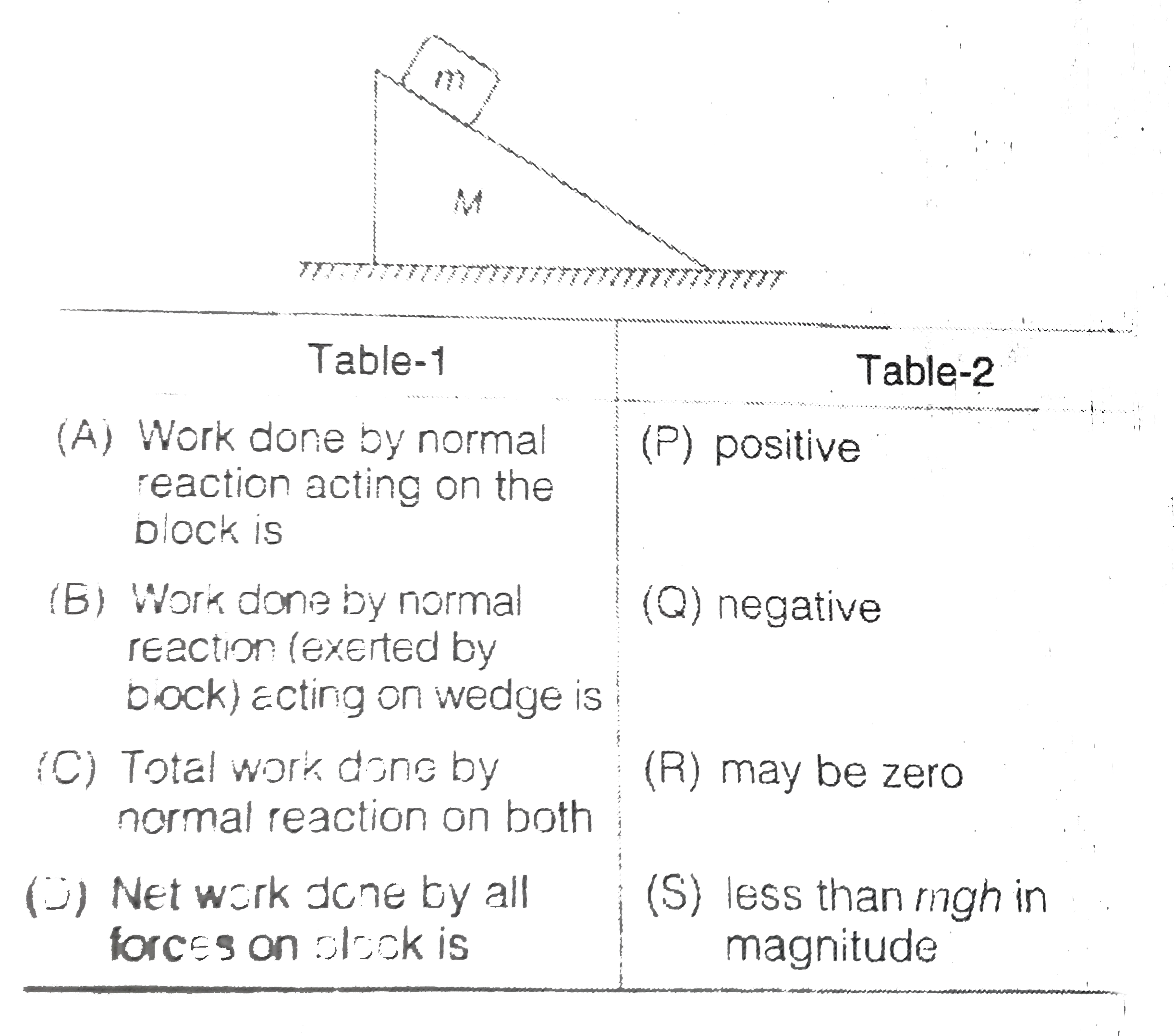
A block of mass m lies on a wedge of mass M. The wedge in turn lies on smooth horizontal surface. Friction is absent everywhere. The wedge block system is released from rest. All situations given in Table-1 are tol be estimated in the duration the block undergoes a vertical displacement 'h' starting from rest. Match the statement in Table-1 with the results in Table-2 ltbgt

Text Solution

Verified by Experts

The correct Answer is:

(A) PS, (B) PS, (C ) R (D) PS
Promotional Banner

Topper's Solved these Questions

  • WORK, POWER AND ENERGY

    DC PANDEY|Exercise E Integer Type Questions|11 Videos
  • WORK, POWER AND ENERGY

    DC PANDEY|Exercise C Comprehension Type Questions|18 Videos
  • WORK, ENERGY AND POWER

    DC PANDEY|Exercise MEDICAL ENTRACES GALLERY|33 Videos

Similar Questions

Explore conceptually related problems

A block of mass m rests on a stationary wedge of mass M. The wedge can slide freely on a smooth horizontal surface as shown in figure. If the block starts from rest

A block of mass m is placed at rest on a smooth wedge of mass M placed at rest on a smooth horizontal surface. As the system is released

A block A of mass m kg lies on a block B of mass m kg. B in turn lies on smooth horizontal plane. The coefficient of friction between A and B is mu . Both the blocks are initially at rest. A horizontal force F is applied to lower block B at t = 0 till the lower block B undergoes a displacement of magnitude L. Match the statements in Table-1 with the results in Table-2.

Two blocks A and B of equal mass m are connected through a massless string and arranged as shown in figure. The wedge is fixed on horizontal surface. Friction is absent everwhere. When the system is released from rest.

A block of mass m slides down on inclined wedge of same mass m as shown in figure . Friction is absent everywhere . Acceleration of centre of mass of the block and wedge is

A block of mass 1 kg is released from the top of a wedge of mass 2 kg. Height of wedge is 10 meter and all the surfaces are frictionless. Then

A block of mass m is released from a wedge of mass m as shown in figure . Find the time taken by the block to reach the end of the wedge.

A block of mass m lies on wedge of mass Mas shown in figure. Find the minimum friction coeffcient required between wedge Mand ground so that it does not move while block m slips down on it.

A smooth block of mass m is held stationary on a smooth wedge of mass M and inclination theta as shown in figure .If the system is released from rest , then the normal reaction between the block and the wedge is

A block of mass m is placed on a smooth wedge of inclination theta & mass M. The whole system is slip on the wedge. Then the normal reaction on the wedge acting from the ground :
