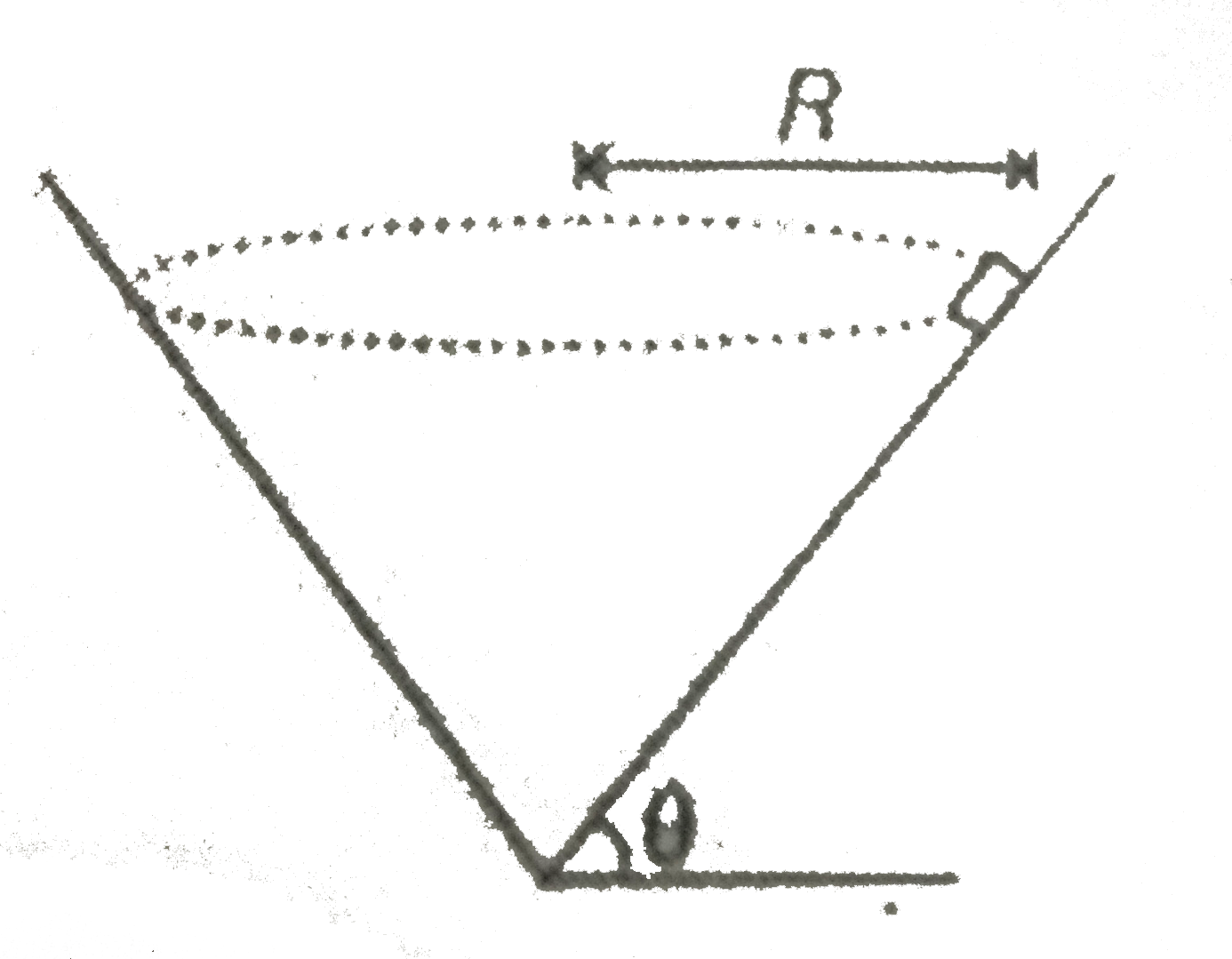
A
B
C
D
Text Solution
Verified by Experts
The correct Answer is:



Topper's Solved these Questions
CIRCULAR MOTION
DC PANDEY|Exercise Comprehension|13 VideosCIRCULAR MOTION
DC PANDEY|Exercise Matrix Matching|7 VideosCIRCULAR MOTION
DC PANDEY|Exercise JEE Advanced|25 VideosCENTRE OF MASS, LINEAR MOMENTUM AND COLLISION
DC PANDEY|Exercise Level 2 Subjective|21 VideosCOMMUNICATION SYSTEM
DC PANDEY|Exercise Only One Option is Correct|27 Videos
Similar Questions
Explore conceptually related problems
DC PANDEY-CIRCULAR MOTION-More than One Option is Correct
- A particle is moving in a circle of radius 1 m with speed varying with...
Text Solution
|
- During uniform circular motion of a particle
Text Solution
|
- A small spherical ball is suspended through a string of length l. The ...
Text Solution
|
- In the system shown in the figure the mass m moves in a circular arc o...
Text Solution
|
- A small block of mass m is released from rest from position A inside a...
Text Solution
|
- A curved road is banked for speed v(0). When a car moves along the roa...
Text Solution
|
- A block of mass m is moving in a circle of radius R with speed v insi...
Text Solution
|
- A stone is tied to a string and swings with uniform motion in a horizo...
Text Solution
|
- In the figure, the block on the smooth table is set into motion in a c...
Text Solution
|
- Velocity of a particle moving in a curvilinear path varies with time a...
Text Solution
|
- The centre of gravity of a car is at a height h and the distance betwe...
Text Solution
|
- A small spehre of mass m is connected by a stirng to a nail at O and m...
Text Solution
|
- A particle of mass 'm' is moving in horizontal circle inside a smooth ...
Text Solution
|