Home
Class 12
PHYSICS
ABC is a traiangular plate of uniform th...

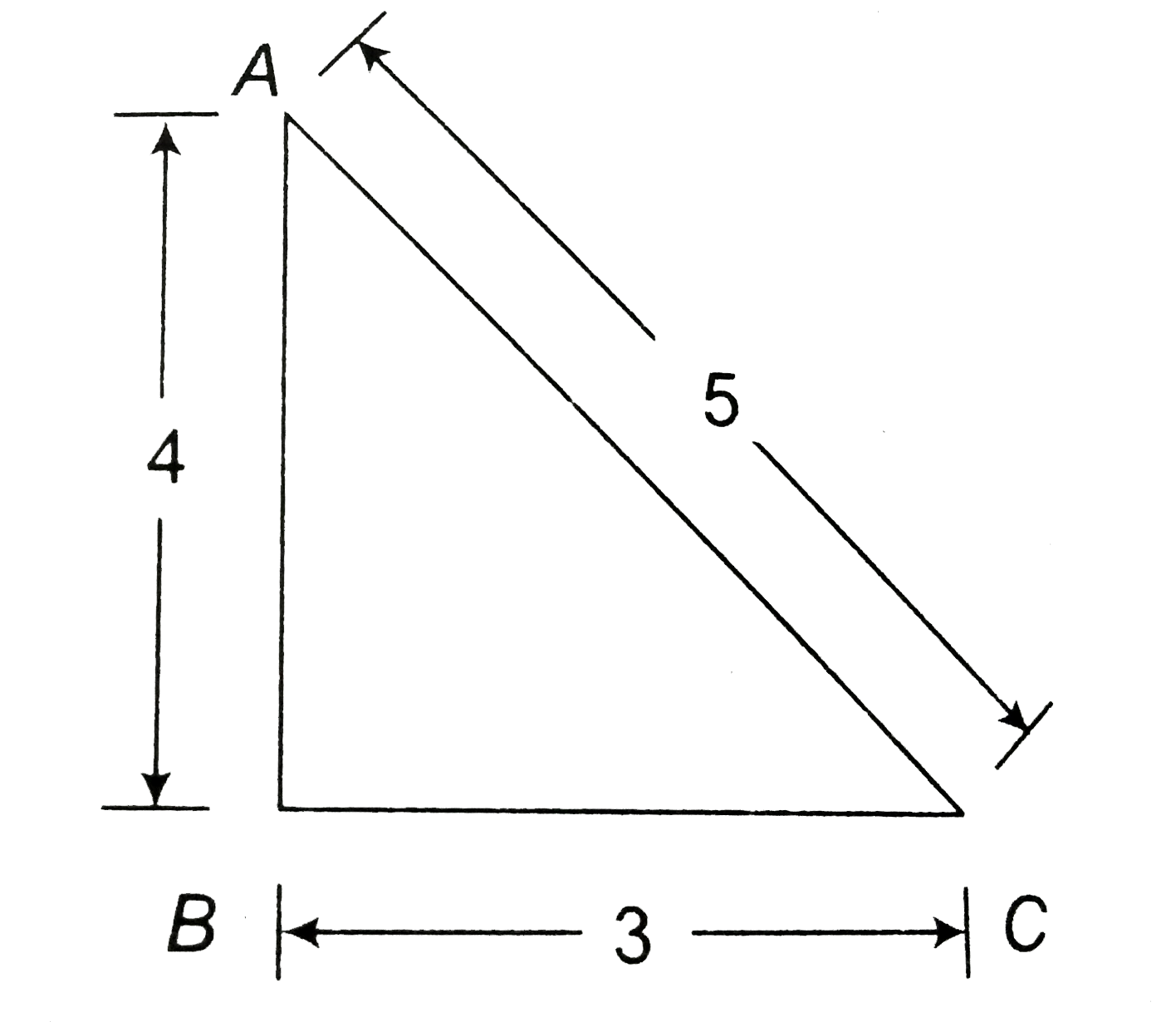
`ABC` is a traiangular plate of uniform thickness. The sides are in the ratio shown in the figure. `I_(AB)`, `I_(BC)` and `I_(CA)` are the moments of inertia of the plate about `AB`, `BC` and `CA` repectively. Which one of the following relations is correct?

A

`I_(AB)+I_(BC)=I_(CA)`

B

`I_(CA)` is maximum

C

`I_(AB) gt I_(BC)`

D

`I_(BC) gt I_(AC)`

Text Solution

Verified by Experts

The correct Answer is:

D

In the given triangular plate, BC is the shortest side.
The M.I. of the triangular plate is maximum about BC as the axis, because the particles of the plate are distributed at maximum distance from BC.
From the figure,we find that,
`I_(BC) gt I_(AB) gt I_(AC) or I_(BC) gt I_(AC)`
Promotional Banner

Topper's Solved these Questions

  • ROTATIONAL MOTION

    MARVEL PUBLICATION|Exercise TEST YOUR GRASP - 3|8 Videos
  • OSCILLATIONS

    MARVEL PUBLICATION|Exercise MCQ|368 Videos
  • SEMICONDUCTORS

    MARVEL PUBLICATION|Exercise MCQs|261 Videos

Similar Questions

Explore conceptually related problems

ABC is a right angled triangular plate of uniform thickness. The sides are such that AB gt BC as shown in figure. I_(1), I_(2), I_(3) are moments of inertia about AB, BC and AC respectively. Then which of the following relations is correct?

ABC is a triangle in which BC = 10 cm, CA = 6 cm and AB = 8 cm, Which one of the following is a correct?

Consider a uniform square plate shown in the figure. I_(1), I_(2), I_(3) and I_(4) are moment of inertia of the plate about the axes 1, 2, 3 and 4 respectively. Axes 1 and 2 are diagonals and 3 and 4 are lines passing through centre parallel to sides of the square. The moment of inertia of the plate about an axis passing through centre and perpendicular to the plane of the figure is equal to which of the followings. (a) I_(3) + I_(4) (b) I_(1) + I_(3) (c) I_(2) + I_(3) (d) (1)/(2) (I_(1) + I_(2) + I_(3) + I_(4))

ABC is a triangle in which BC = 10 cm, CA = 6 cm and AB = 8 cm. Which one of the following is correct ?

Let I_(1) and I_(2) be the moment of inertia of a uniform square plate about axes shown in the figure. Then the ratio I_(1):I_(2) is

ABC is a triangle and AD is perpendicular to BC. It is given that the lengths of AB, BC, CA are all rational numbers. Which one of the following is correct?
