

Home
Class 11
PHYSICS
A three wheeler starts from rest, accele...

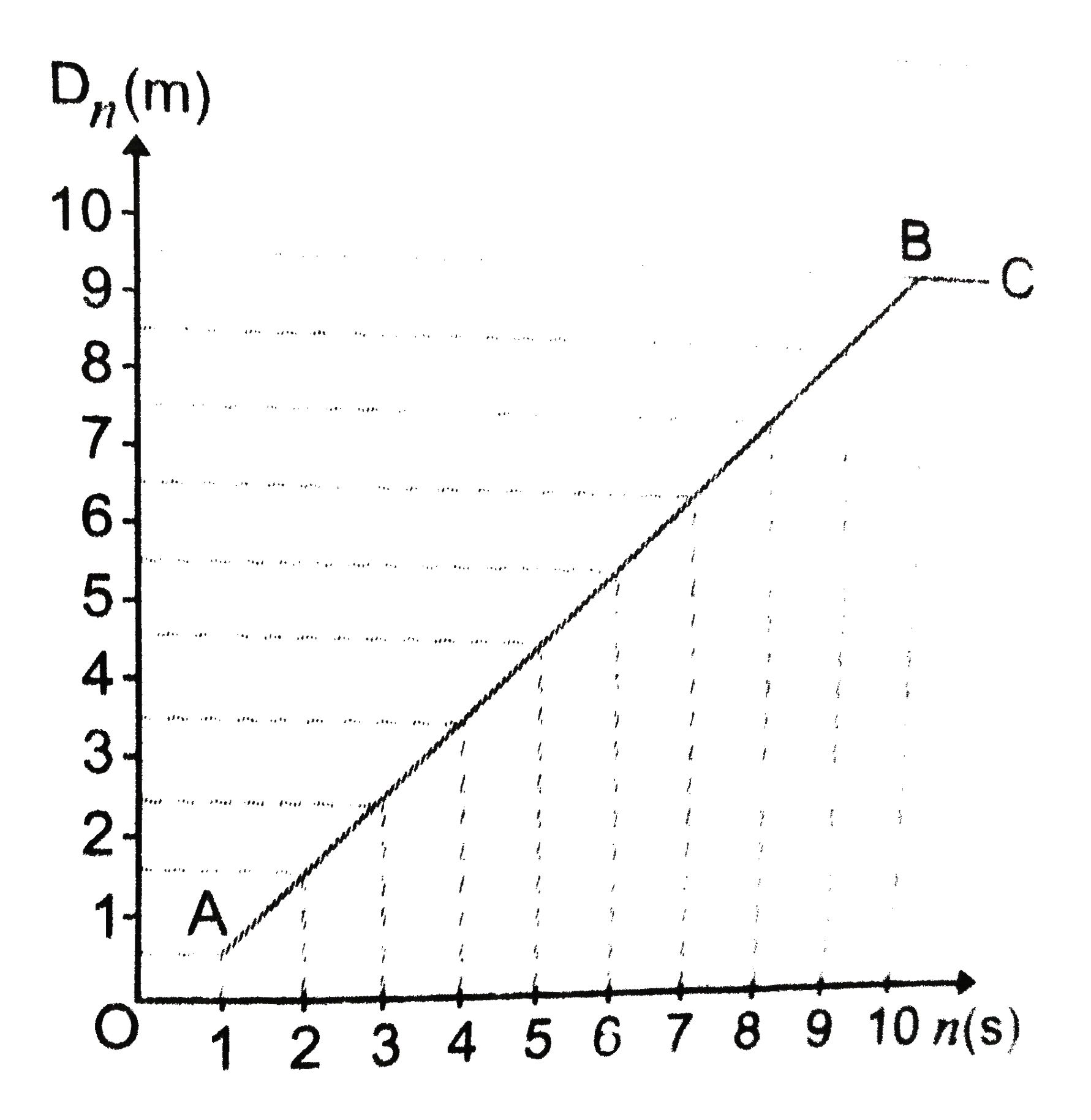
A three wheeler starts from rest, accelerates uniformly with ` 1 ms^(-2)` on a straight road for ` 10 s` and then moves with uniform velocity . Plot a graph between the distance covered by the vehicle during the nth second ( n = 1,2,3, ……..) versus (n) What do you expect the plot to be during accelerated motion: a straight line or a parabola ?
.

Promotional Banner

Similar Questions

Explore conceptually related problems

A three wheeler starts from rest, accelrates uniformly with 1 ms^(-2) on a straight road for 10 s and then moves with uniform velocity . Plot a graph between the distance coverd by the vehicle during the nth second ( n = 1,2,3, ……..) v ersus (n) What do you expect the plot to be during acclerated motion: a straight line or a parabola ? .

Starting from rest a car accelerates unifromly with 3 ms^(-2) for 5 s and then moves with uniform velocity. Drwa the distance-time graph of the motion of the car upto t = 7s.

A body starts from rest and moves with a uniform acceleration of 10ms^(-2) for 5 seconds. During the next 10 seconds it moves with uniform velocity. Find the total distance travelled by the body (Using graphical analysis).

An object accelerates from rest to a velocity 27.5ms in 10s ,then find distance covered by the object during next "10s

A train starting from rest accelerates uniformly for 100 s, then comes to a stop with a uniform retardation in the next 200 s. During the motion, it covers a distance of 3 km. Choose the wrong option

A race car accelerates on a straight road from rest to a speed of 180 kmh^(-1) in 25s. Assuming uniform acceleration of the car throughout, find the distance covered in this time.

A body starting from rest is moving with a uniform acceleration of 8m/s^(2) . Then the distance travelled by it in 5th second will be

The initial velocity of a body moving along a straight lines is 7m//s . It has a uniform acceleration of 4 m//s^(2) the distance covered by the body in the 5^(th) second of its motion is-