Home
Class 11
PHYSICS
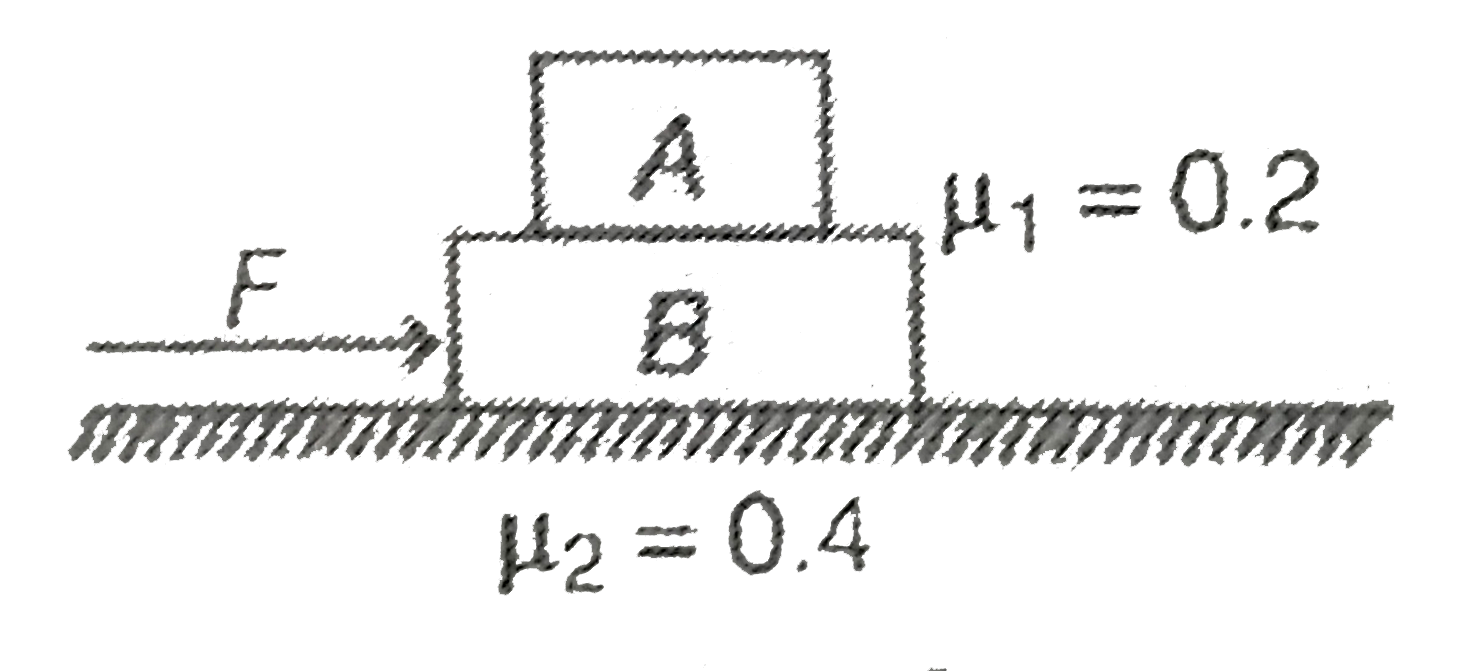
In the figure, m(A)=2 kg and m(B)=4kg. F...

In the figure, `m_(A)=2 kg` and `m_(B)=4kg`. For what minimum value of F,A starts slipping over B? `(g=10m//s^(2))`

A

24N

B

36N

C

12N

D

20N

Text Solution

Verified by Experts

The correct Answer is:

b
Promotional Banner

Similar Questions

Explore conceptually related problems

In the figure , m_A =2kg and m_b=4kg For what minimum value of F A starts slipping over B (g=10 ms ^(-2)) ?

A block of mass 10 kg is held at rest against a rough vertical wall [mu=0.5] under the action a force F as shown in figure. The minimum value of F required for it is (g=10m//s^(2))

Two masses m_(1) kg and m_(2) kg passes over an atwoods machine. Find the ratio of masses m_(1) and m_(2) so that string passing over the pulley will just start slipping over its surface. The friction coefficient between the string and pulley surface is 0.2.

m_(A) = 1 kg, m_(B) = 2 kg, m_(C) = 10 kg

In the situation shown in figure-2.99. (a) For what minimum value of the force F will the system or any part of it start to move ? (b) Find the values of force F when slipping starts between (i) A and B and (ii) B and C. Take g = 10m//s^(2)

In figure shown if m_(A) = 20 kg and m_(B) = 80 kg. The acceleration of block A if the system is set free to move is beta m//s^(2) . Find the value of beta . (Take g = 10 ms^(-2) )

Two block A and B are arrenged as shown in figure (m_(A) = 5 kg and m_(B) = 10 kg) Find the acceleration of blocks if F = 40 N

Pulleys are ideal and string are massless. The masses of blocks are m_(1) = 4kg and m_(2) = 1kg as shown.If all surfaces are smooth then the acceleration of m_(2) in m//s^(2) is ( g =10 m//s^(2) )

In the system shown in fig., all pulleys are mass less and the string is inextensible and light. (a) After the system is released, find the acceleration of mass m_(1) (b) If m_(1) = 1 kg, m_(2) = 2 kg "and" m_(3) = 3 kg then what must be value of mass m_(4) so that it accelerates downwards?

In the figure shown, m_(1) = 10kg, m_(2) = 6kg, m_(3) = 4kg. If T_(3) = 40 N, T_(2) = ?
