Home
Class 11
PHYSICS
In the arrangement shown in figure m(A)=...

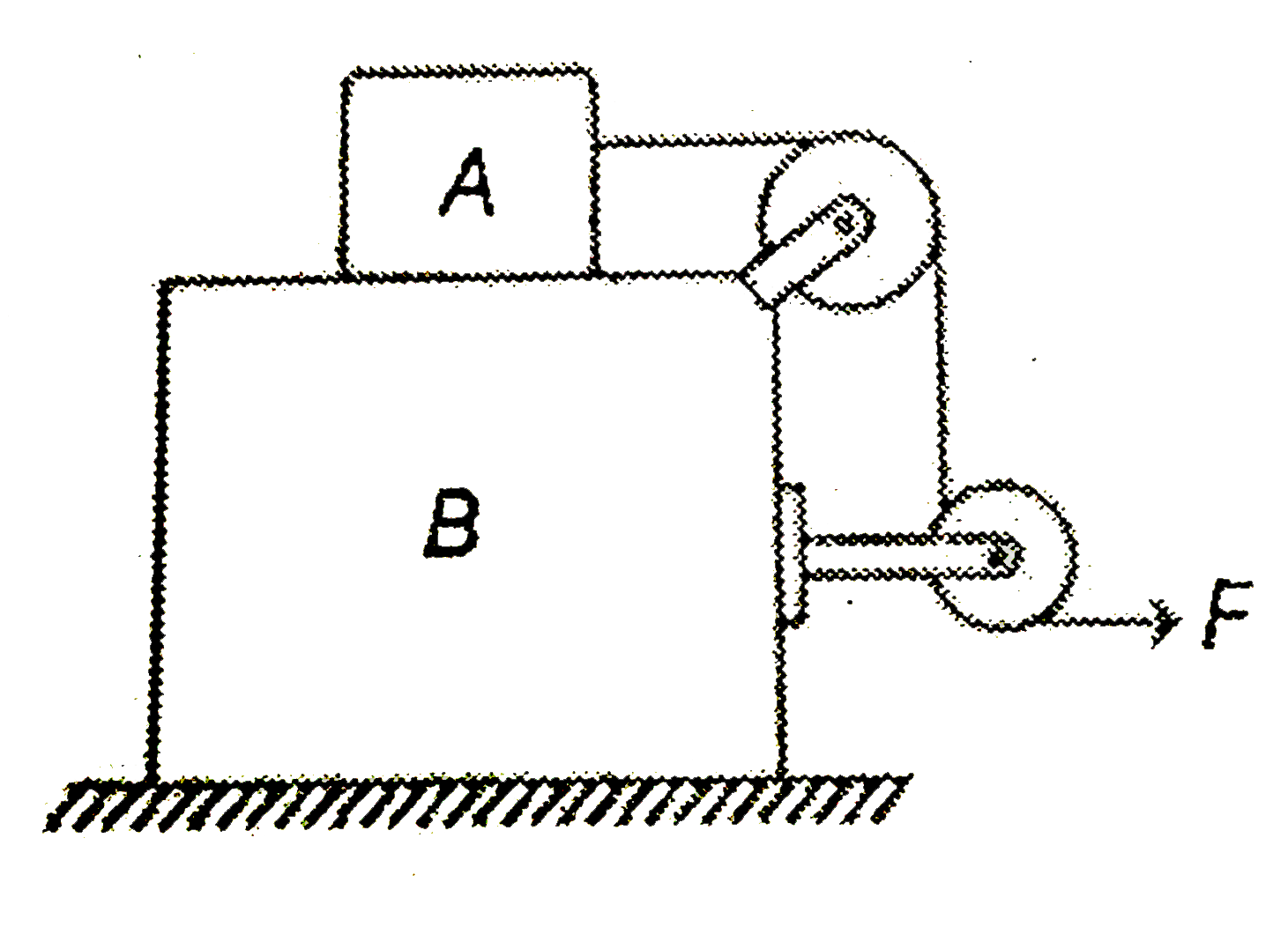
In the arrangement shown in figure `m_(A)=m_(B) =2 kg`. String is massless and pulley is frictionless. Block B is resting on a smooth horizontal surface, while friction coefficient between blocks A and B is `mu=0.5`. What maximum horizontal force F can be applied so that block A does not slip over the block B? `(g=10 m//s^(2))`

A

25 N

B

40 N

C

30 N

D

20 N

Text Solution

Verified by Experts

The correct Answer is:

D
Promotional Banner

Similar Questions

Explore conceptually related problems

In the arrangement shown in figure, m_A = m_B = 2kg. String is massless and pulley is frictionless. Block B is resting on a smooth horizontal surface, while friction coefficient beteen block A and B is mu=0.5 . the Maximum horizontal force F that can be applied so that block A does not slip over block B is.

A block is kept on a rough horizontal surface as shown. Its mass is 2 kg and coefficient of friction between block and surface (mu)=0.5. A horizontal force F is acting on the block. When

Two block A and B of masses 5 kg. and 3 kg. respectively rest on smooth horizontal surface with B over A. The coefficient of friction between A and B. 0.5 the maximum horizontal force that can be applied to A so that there will be motion of A and B without separation is :-

The coefficient of static friction between the two blocks shown in figure is mu and the table is smooth. What maximum horizontal forced F can be applied to he block of mass M so that the block move together?

A 3 kg block is placed over a 10 kg block and both are palced on a smooth horizontal surface. The coefficient of friction between the block is 0.2 . If a horizontal force of 20 N is applied to 3 kg block, accelerations of the two block in ms^(-2) are (take, g=ms^(-2) )

In the arrangement shown in figure the wall is smooth and friction coefficient between the blocks is mu = 0.1 . A horizontal force F = 1000 N is applied on the 2kg block. The wrong statement is :

Two block "A&B" of mass M_(A)=1kg&M_(B)=3kg are kept on a smooth table as shown in the figure.The coefficient of friction between "A&B" is "0.2" .The maximum force "F" that can be applied on "B" horizontally,so that the block "A" do not slide over the block "B" is Take g=10m/s^(2)andk=400N/m)

A block of mass m is placed on another block of mass M lying on a smooth horizontal surface as shown in the figure. The co-efficient of friction between the blocks is mu . Find the maximum horizontal force F (in Newton) that can be applied to the block M so that the blocks together with same acceleration? (M=3kg, m=2kg, mu=0.1, g=10m//s^(2))

A block of mass m=5kg is resting on a rough horizontal surface for which the coefficient of friction is 0.2 . When a force F=40N is applied, the acceleration of the block will be (g=10m//s^(2)) .

A bar of mass m is placed on a triangular block of mass M as shown in figure The friction coefficient between the two surface is mu and ground is smooth find the minimum and maximum horizontal force F required to be applied on block so that the bar will not slip on the inclined surface of block
