Home
Class 11
PHYSICS
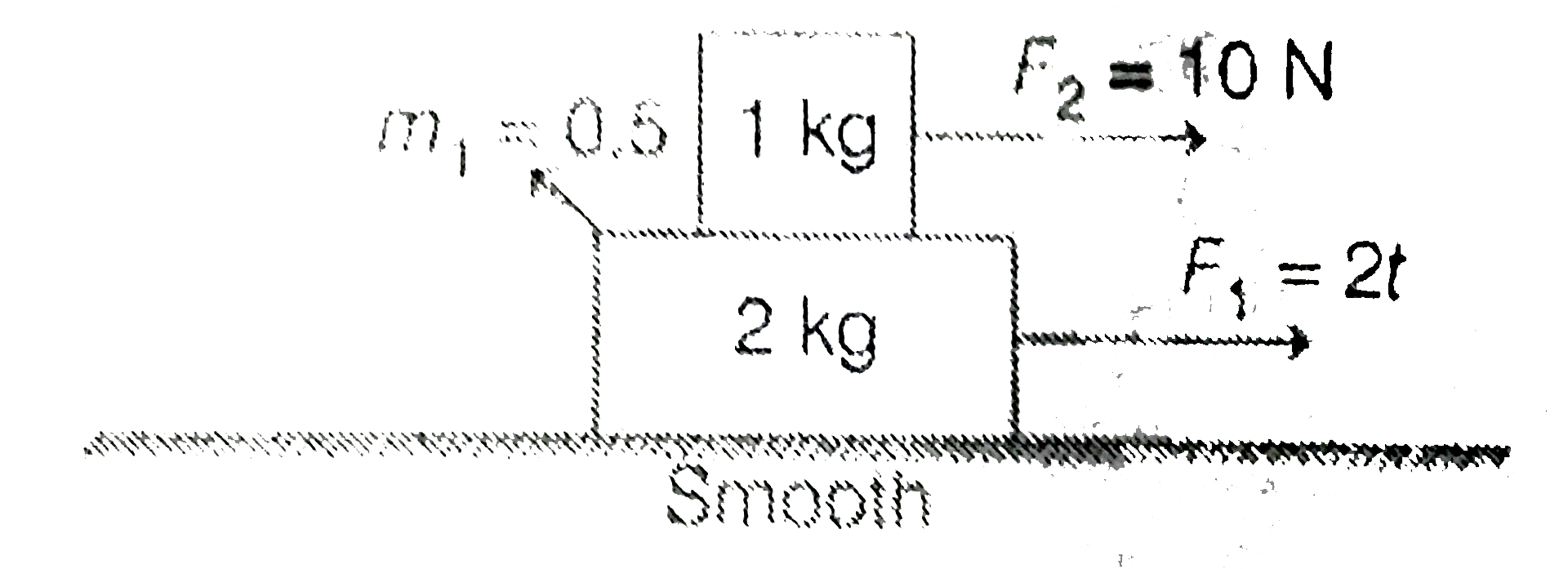
In the figure shown, block of mass 2 kg ...

In the figure shown, block of mass 2 kg is very long. Force of friction on 1 kg block is

A

always towards right

B

always towards left

C

is first towards right and then towards left

D

is first towards left and then towards right

Text Solution

Verified by Experts

The correct Answer is:

D
Promotional Banner

Similar Questions

Explore conceptually related problems

The frictional force acting on 1 kg block is

A force of 200N is applied as shown in the figure on block of 3 kg. The coefficient of friction between the block and the wall is 0.3. Find the friction acting on the block. (in N) {Take g = 10 m//s^(2)

On a smooth horizontal surface a block A of mass 10kg is kept. On this block a second block B of mass 5kg is kept. The coefficient of friction between the two blocks is 0.4 .A horizontal force of 30N is applied on the lower block as shown. The force of friction between the blocks is

Two blocks of masses 1 kg and 2 kg are joined by a massless inextensible string of length 3m. Both blocks are kept on a horizontal table as shown. Friction coefficient between 2 kg block and table is zero. They are rotated about a vertical axis passing at a distance of 1m from 1 kg. Force of friction on 1kg block is (assume that there is enough friction between 1 kg block ground)

In the diagram shown coefficient of friction between 2 kg block and 4 kg block is mu =0.1 and between 4 kg and ground is mu =0.2 then answer the following quwstions .(tis time) Force of friction on 2 kg block at t=(1)/(2) s will be

In the figure shown, there is no relative motion between the two blokcs. Force of friction acting on 1 kg block is

In the figure shown, the coefficient of static friction between the block A of mass 20 kg and horizontal table is 0.2. What should be the minimum mass of hanging block just beyond which blocks start moving?

2gk block is kept on 1kg block as shown . The friction between 1kg block and fixed surface is absent and the coefficient of friction between 2kg block is mu=0.1 . A constant horizontal force F=4N is applied on 1kg block. If the work done by the friction on 1 kg block in 2s is -X J , then find X . Take g=10m//s^(2) .

Consider the shown arrangement. The coefficient of friction between the two blocks is 0.5 . There is no friction between the 4 kg block and of 12 N is applied on the 2 kg block as shown in the figure, the acceleration of the 4 kg block would be

In the figures shown, 1 kg block is stationary while 2 kg block is being pulled with constant speed. The spring is exerting a force of 1N on the block
