Home
Class 11
PHYSICS
A cylinder of mass m rests on a supporti...

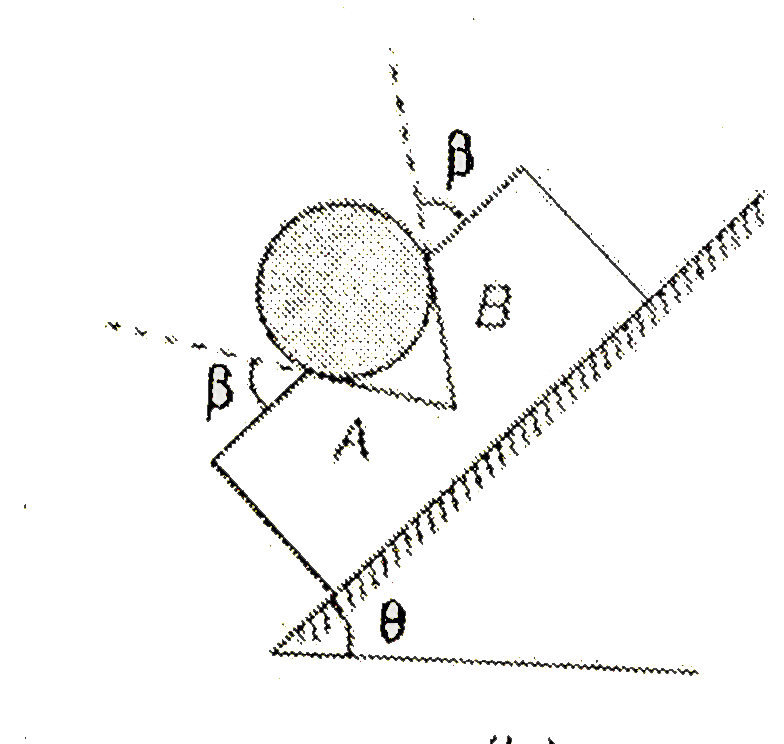
A cylinder of mass `m` rests on a supporting block as shown. If `beta=60^(@) " and " theta=30^(@)`, calculate the maximum acceleration 'a' which the block may be given up the incline so that the cylinder does not lose contact at B. Neglect friction anywhere).

A

`g//2`

B

g

C

`g//3`

D

`g//4`

Text Solution

Verified by Experts

The correct Answer is:

B
Promotional Banner

Similar Questions

Explore conceptually related problems

A block of metal is lying on the floor of a bus. The maximum acceleration which can be given to the bus so that the block may remain at rest, will be -

A cylinder of mass m and radius R rolls down an inclined plane of inclination theta . Calculate the linear acceleration of the axis of cylinder.

A cylinder of mass m and radius R rolls down an inclined plane of inclination theta . Calculate the linear acceleration of the axis of cylinder.

In the fig. shown, the pulley and string are mass less and the incline is frictionless. The segment AP of the string is parallel to the incline and the segment PB is perpendicular to the incline. End of the string is pulled with a constant force F. (a) If the block is moving up the incline with acceleration while being in contact with the incline , then angle theta must be less than theta_(0) . Find theta_(0) If theta = (theta_(0))/(2) find the maximum acceleration with which the block can move up the plane without losing contact with the incline.

A block of mass m is placed on the rough incline of a wedge of mass M and inclination alpha to the horizontal. Calculate the maximum and minimum acceleration that can be imparted to the wedge so that the block may remain stationary relative to the wedge. The coefficient iof friction between the block and the wedge is mu .

A block of mass 1.0 kg rests on a wedge of angle theta . The acceleration which should be given to the wedge so that the block falls freely is :

A system consists of block A and B each of mass m connected by a light spring as shown in the figure with block B in contact with a wall. The block A compresses the spring by 3mg/k from natural length of spring and then released from rest. Neglect friction anywhere. Maximum extension in the spring after system loses contact with wall

A system consists of block A and B each of mass m connected by a light spring as shown in the figure with block B in contact with a wall. The block A compresses the spring by 3mg/k from natural length of spring and then released from rest. Neglect friction anywhere. Velocity of centre of mass of system comprising A and B when block B just loses contact with the wall

A block of mass 2 kg is kept at rest on a smooth inclied plane as shown in (a) with the help of a string Find the tension in the string and reaction on the block if the string is cut, find the acceleration of the block neglecting friction.
