Home
Class 11
PHYSICS
A block of mass m slides down on a wedge...

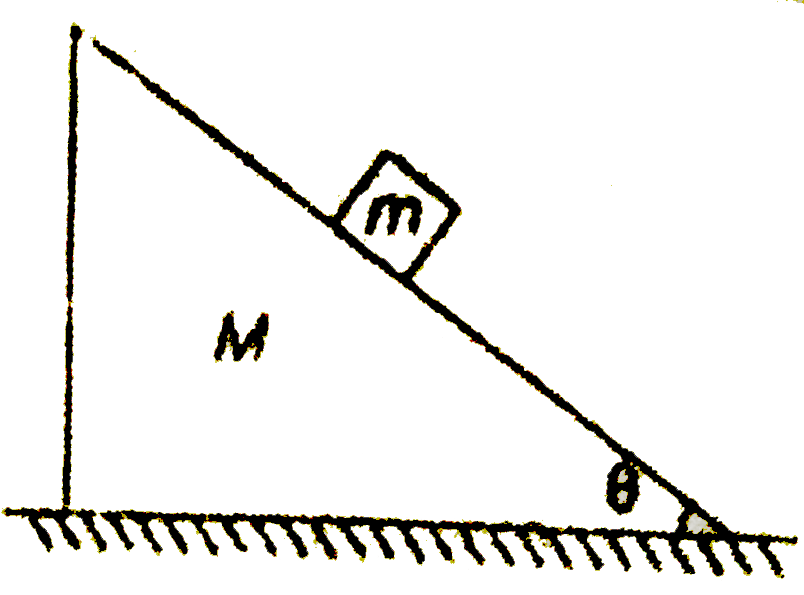
A block of mass m slides down on a wedge of mass M as shown in figure .Let `a_(1)` be the asseleration of the acceleration of and `a_(2)` the the acceleration od block 1`N_(1)` is the normal reaction between block and wedge and `N_(2)` the normal reaction between wedge and gound .frication is absent everwhere .Select the correct alternative(s)

A

`N_(2)lt(M+m)g`

B

`N_(2)ltM(g cos theta-|a_(1)|sintheta)`

C

`N_(1)sin theta=M|a_(1)|`

D

`ma_(2)=-Ma_(1)`

Text Solution

Verified by Experts

The correct Answer is:

a,b,c
Promotional Banner

Similar Questions

Explore conceptually related problems

A block of mass m is released from a wedge of mass m as shown in figure . Find the time taken by the block to reach the end of the wedge.

A block of mass m slides down on inclined wedge of same mass m as shown in figure . Friction is absent everywhere . Acceleration of centre of mass of the block and wedge is

A block of mass m is at rest on wedge as shown in figure. Let N be the normal reaction between two and f the force of friction, then choose the wrong option.

A block of mass m, is kept on a wedge of mass M, as shown in figure such that mass m remains stationary w.r.t. wedge. The magnitude of force P is

A block of mass m is at rest on a rought wedge as shown in figure. What is the force exerted by the wedge on the block?

A block of mass m lies on wedge of mass. Mas shown in figure. With what minimum acceleration must the wedge be moved towared right horizontally so that block m falls freely.

A block of mass 2kg slides down the face of a smooth 45^@ wedge of mass 9 kg as shown in the figure. The wedge is placed on a frictionless horizontal surface. Determine the acceleration of the wedge.

A block of mass m is placed on a wedge of mass M. Coefficient between then is mu lt cot theta . The wedge is given an acceleration to its left. Find the maximum acceleration at which block apears stationary relative to wedge.

A block of mass m is placed on the inclined sufrace of a wedge as shown in fig. Calculate the acceleration of the wedge and the block when the block is released. Assume all surfaces are frictionless.
