Home
Class 11
PHYSICS
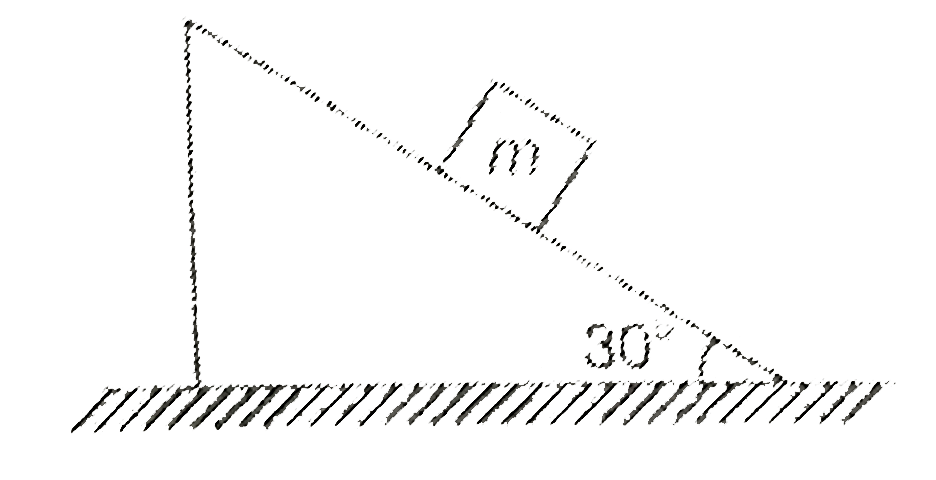
A block of mass m is placed over the we...

A block of mass m is placed over the wedge as shown in figue Coefficent of frition `mu` is half the minimum value required to keep it in this postion.

what is the minimum value of accleration of wedge to keep the blok statinary with respect to the wedge in either of the four cases?

A

`(g)/(2sqrt(3))`

B

`(sqrt(3)g)/(4)`

C

`(sqrt(3)g)/(7)`

D

`(g)/(2sqrt(5))`

Text Solution

Verified by Experts

The correct Answer is:

c
Promotional Banner

Similar Questions

Explore conceptually related problems

A block of mass m is placed over the wedge as shown in figue Coefficent of frition mu is half the minimum value required to keep it in this postion. Bloock can be kept rest even with this value of mu with respect to wedge if the wedge is moved is moved with an accelartion a towards

In the adjoining figure, the coefficient of friction between wedge ( of mass M) and block ( of mass m) is mu . Find the minimum horizontal force F rquired to keep the block stationary with respect to wedge

A block of mass 1 kg is placed on a wedge shown in figure. Find out minimum coefficient of friction between wedge and block to stop the block on it.

In the adjoining figure, the coefficient of friction between wedge (of mass M ) and block (of mass m ) is mu . Find the minimum horizontal force F required to keep the block stationary with respect to wedge.

A ladder of length 5 m is placed against a smooth wall as shown in figure. The coefficient or friction is mu between ladder and ground. What is the minimum value of mu , If the ladder is not to slip?

A block of mass m resting on a wedge of angle theta as shown in the figure. The wedge is given an acceleration a. What is the minimum value of a so that the mass m falls freely ?

A block of mass m is placed at rest on a horizontal rought surface with angle of friction phi . The block is pulley with a force F at an angle theta with the horizontal. The minimum value of F required to move the block is

A block of mass m is placed on the rough incline of a wedge of mass M and inclination alpha to the horizontal. Calculate the maximum and minimum acceleration that can be imparted to the wedge so that the block may remain stationary relative to the wedge. The coefficient iof friction between the block and the wedge is mu .

In the arrangement shown in figure, a block A of mass m has been placed on a smooth wedge B of mass M. The wedge lies on a horizontal smooth surface. Another block C of mass (M)/(4) has been placed in contact with the wedge B as shown. The coefficient of friction between the block C and the vertical wedge wall is mu= (3)/(4) . Find the ratio (m)/(M) for which the block C will not slide with respect to the wedge after the system is released?
