Home
Class 11
PHYSICS
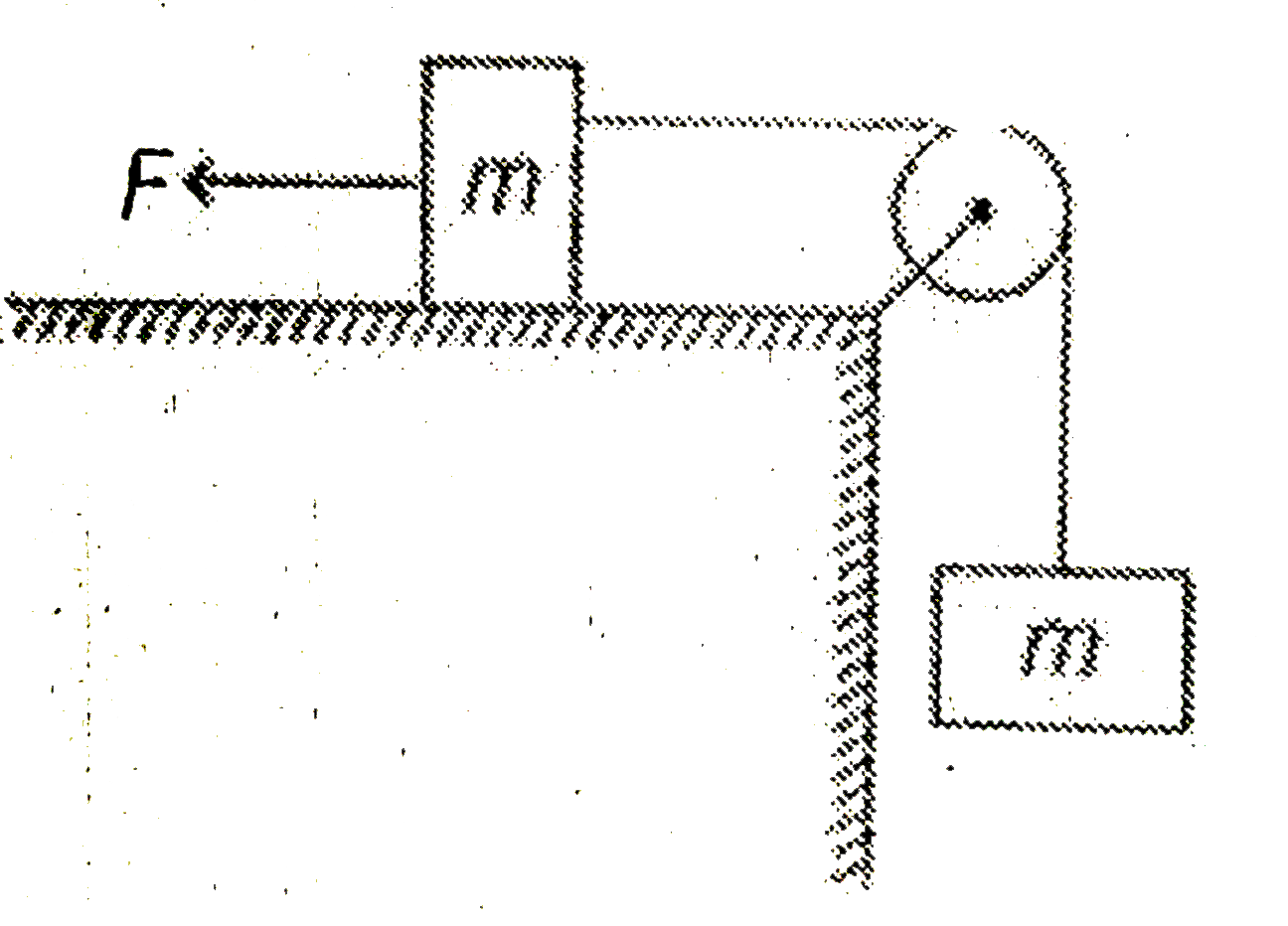
Consider the situation shown in figure. ...

Consider the situation shown in figure. The force F is equal to mg. If area of cross-section of the string is A and its Young's modulus is Y, the strain developed in the wire is (the string is light and there is no friction anywhere)

A

`(mg)/(AY)`

B

`(2mg)/(AY)`

C

`(mg)/(2AY)`

D

`(3mg)/(2AY)`

Text Solution

Verified by Experts

The correct Answer is:

A
Promotional Banner

Topper's Solved these Questions

  • PROPERTIES OF MATTER

    DC PANDEY|Exercise JEE Advanced|57 Videos
  • PROPERTIES OF MATTER

    DC PANDEY|Exercise More than one option is correct|21 Videos
  • PROJECTILE MOTION

    DC PANDEY|Exercise Level - 2 Subjective|10 Videos
  • RAY OPTICS

    DC PANDEY|Exercise Integer type q.|15 Videos

Similar Questions

Explore conceptually related problems

Consider the situation shown in figure. The force F is equalk to the m_2g/2 . If the area of cross section of the string is A and its Young modulus Y, find the strain develolped in it. The string is lilght and there is no friction anywhere.

Consider the situation shown in figure. Find the acceleration of the system and the tension in the strings.

A force F doubles the length of wire of cross-section a The Young modulus of wire is

Consider the situation shown in figure. All the surfaces are frictions and the string and the pulley are light. Find the magnitude of the acceleration of the two blocks.

A block of mass M is suspended from a wire of length L, area of cross-section A and Young's modulus Y. The elastic potential energy stored in the wire is

Consider the situation shown in the figure. The surface is smooth and the string and the pulley are light. Find the acceleration of each block and tension in the string.

Which one of the following is the Young's modulus (in N/m) for the wire having the stress-strain curve shown in the figure

A rod of length L kept on a smooth horizontal surface is pulled along its length by a force F. The area of cross-section is A and Young's modulus is Y. The extension in the rod is

A metal wire of length L, area of cross-section A and Young's modulus Y behaves as a spring of spring constant k.

Two wires have identical lengths and areas of cross-section are suspended by mass M . Their Young's modulus are in the ratio 2:5 .
