Home
Class 12
CHEMISTRY
Which of the following dicarboxylic acid...

Which of the following dicarboxylic acids gives a cyclic anhydride on heating?

A

`CH_(2)(CO OH)_(2)`

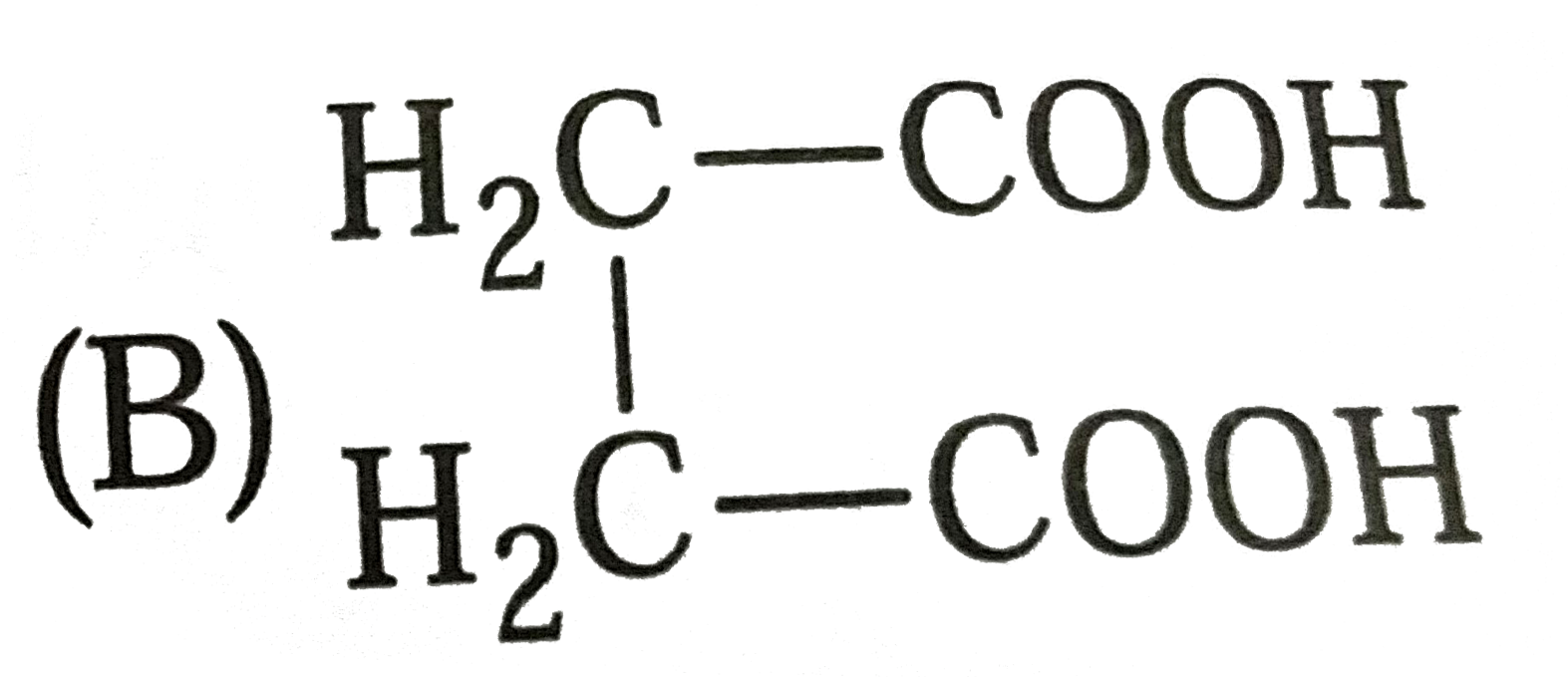
B

C

`HO OC(CH_(2))_(4)CO OH`

D

`HO OC(CH_(2))_(5)CO OH`

Text Solution

Verified by Experts

The correct Answer is:

B

Succinic acid on heating forms its anhydride
Promotional Banner

Topper's Solved these Questions

  • BIOMOLECULES

    NARAYNA|Exercise EXERCISE-4 (NCERT EXAMPLAR PROBLEMS)|12 Videos
  • CHEMICAL KINETICS

    NARAYNA|Exercise EXERCISE -4|30 Videos

Similar Questions

Explore conceptually related problems

Which of the following is a dicarboxylic acid ?

Dicarboxylic acids have two carboxylic groups, e.g., Acidity of dicarboxylic acid depends upon the stability of intermediate ion and upon the distance between two carboxylic groups. Shorter the distance between two carboxylic groups, greater is the acidic character. Melting point of these acids depends on the symmetry. Greater the symmetry, higher will be the melting point. Dicarboxylic acids on heating give monocarboxylic acid allkanes, cyclic ketones depending on the conditions Which of the following dicarboxylic acids, will give monocarboxylic acid on heating ?

Certain dicarboxylic acids spontaneously eliminate water when heated forming cycioc anhydirides. But for the reaction to be successfully. The cyclic anhydrides product must normally have a ring size of fivee or six members. There are two important reasons, first, the second carboxyl group can serve as the acid catalyst (by intramolecular proton transfer), as well as the nucleophile. And second, the high temperature involved reduce the need for catalyst. Which of the following dicarboxylic acid will not for cyclic anhydrides?

Which of the following dicarboxylic acids contains the most acidic hydrogen ?

Which of the following tetracarboxylic acid form di-anhydride:

NARAYNA-CARBOXYLIC ACID-All Questions
  1. CH(3)CO(2)C(2)H(5)overset((i) C(2)H(5)bar(O)overset(+)(N)a//Delta)unde...

    Text Solution

    |

  2. Which of the following does not undergo Hell-Volhard Zelinsky reaction...

    Text Solution

    |

  3. Which of the following dicarboxylic acids gives a cyclic anhydride on ...

    Text Solution

    |

  4. The correct decreasing order of their reactivity towards hydrolysis is

    Text Solution

    |

  5. End product of the following sequence of reaction is

    Text Solution

    |

  6. R- CH2 - CH2 OH can be converted in R- CH2 CH2 COOH. The correct seque...

    Text Solution

    |

  7. Which of the following compound is formed as major product when ethyl ...

    Text Solution

    |

  8. The mechanism of nucleophilic acyl substitution in the acyl derivative...

    Text Solution

    |

  9. Which of the following orders of acid strength is correct?

    Text Solution

    |

  10. The missing product X in the given reaction is CH3 COOAg + I2 to X + ...

    Text Solution

    |

  11. Consider the given reaction RCOOAg overset(Br(2)//Delta)to R-Br which...

    Text Solution

    |

  12. The product formed in the reaction is CH(3)-underset(O)underset(||)...

    Text Solution

    |

  13. On applying alkali solution followed by acidification which of the fol...

    Text Solution

    |

  14. In the following reaction C is

    Text Solution

    |

  15. Identify the compound X in the following reaction

    Text Solution

    |

  16. Which of the following amides does not react with HNO2 ?

    Text Solution

    |

  17. Which of the following facts is not correct?

    Text Solution

    |

  18. Consider the following reaction scheme: CH(3)CH(2)CO OH overset(X) t...

    Text Solution

    |

  19. (CH3)2 C = CHCOCH3 can be oxidized to (CH3)2 C= CHCOOH by:

    Text Solution

    |

  20. Which of the following product is obtained when ethylene is heated wit...

    Text Solution

    |
