Home
Class 12
PHYSICS
Three charges -q(1), +q(2) and -q(3) are...

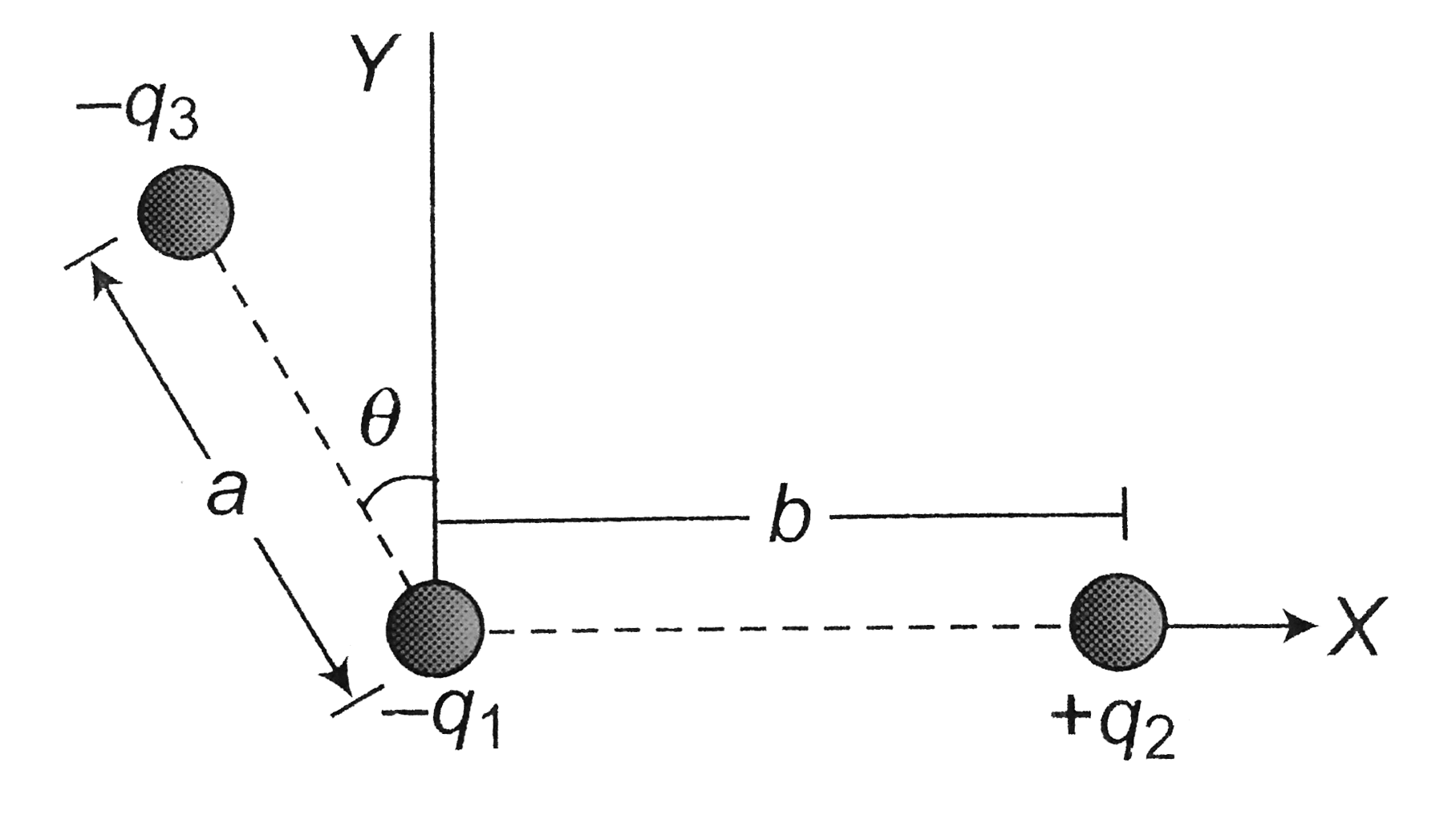
Three charges `-q_(1), +q_(2)` and `-q_(3)` are placed as shown in the figure. The `x`-component of the force on `-q_(1)` is proportional to

A

`(q_(2))/(b^(2))-(q_(3))/(a^(2))cos theta`

B

`(q_(2))/(b^(2))+(q_(3))/(a^(2))sin theta`

C

`(q_(2))/(b_(2))+(q_(3))/(a^(2))cos theta`

D

`(q_(2))/(b^(2))-(q_(3))/(a^(2))sin theta`

Text Solution

Verified by Experts

The correct Answer is:

B
Promotional Banner

Topper's Solved these Questions

  • NEET MOCK TEST 18

    NTA MOCK TESTS|Exercise PHYSICS|45 Videos
  • NEET MOCK TEST 20

    NTA MOCK TESTS|Exercise PHYSICS|45 Videos

Similar Questions

Explore conceptually related problems

Three charges q_(1), q_(2) and q_(3) are shown in figure . Determine the net force acting on charge q_(1) . The charges and separation are given as q_(1) =- 1.0 xx 10^(-6)C, q_(2) =+ 3.0 xx 10^(-6)C , and q_(3) = - 2.0 xx 10^(-6)C, r_(12) = 15 cm, r_(13) = 10 cm and theta = 30^(@) .

Three charges +q, +q, +2q are arranged as shown in figure. What is the field at point P (center of side AC)

Assertion (A): Three point charges Q_(1), Q_(2) and Q_(3) are shown in the figure. The flux over the Gaussian surface depends on only one charge point. Reason (R): Electric flux depends on the all charges nearby.

The value of charge q_1 ,q_2 and q_3 as shown in the figure are

In an isolated parallel plate capacitor of capacitance C the four surfaces have charges Q_(1), Q_(2), Q_(3) and Q_(4) as shown in the figure. The potential difference between the plates is :

Conisder a system of three charges q//3 , q//3 and -2q//3 placed at point A, B and C, respectively, as shown in the figure. Take O to be centre of the circle of radius R and angle CAB=60^@

Assertion: Two charges q_(1) and q_(2) are placed at separation r . Then magnitude of the force on each charge is F . Reason: Now a third charge q_(3) is placed near q_(1) and q_(2) . Then force on q_(1) and q_(2) remains F .

Two points charge q_(1) and q_(2)(=q_(1)//2) are placed at points A(0,1) and B(1,0) as shown in the figure.The electric field vector at point P(1,1) makes an angle q with the x-axis ,then the angle q is

NTA MOCK TESTS-NEET MOCK TEST 2-PHYSICS
  1. If n, e, tau and m are representing electron density, electron charge,...

    Text Solution

    |

  2. At room temperature copper has free electron density of 8.4xx10^(28) p...

    Text Solution

    |

  3. Three charges -q(1), +q(2) and -q(3) are placed as shown in the figure...

    Text Solution

    |

  4. A real inverted image in a concave mirror is represented by (u,v, f ar...

    Text Solution

    |

  5. A table fan rotating at a speed of 2400 rpm is switched off and the r...

    Text Solution

    |

  6. A ball rolls of the top of a stairway with horizontal velocity of magn...

    Text Solution

    |

  7. Consider the situation shown in the figure. The wall is smooth but the...

    Text Solution

    |

  8. The electromagnetic waves travel in free space with the veloci...

    Text Solution

    |

  9. The displacement time graph of a moving particle is shown below T...

    Text Solution

    |

  10. A stone is thrown at 25m//s " at " 53^(@) above the horizontal. At wha...

    Text Solution

    |

  11. The forward biased diode connection among the following is

    Text Solution

    |

  12. The length l , breadth b, and thickness t of a block of wood were meas...

    Text Solution

    |

  13. A 100V, AC source of frequency of 500Hz is connected to an L-C-R circu...

    Text Solution

    |

  14. Assertion (A) : The film which appears bright in reflected system will...

    Text Solution

    |

  15. Two particles A and B execute simple harmonic motions of period T and ...

    Text Solution

    |

  16. A ring shaped tube contain two ideal gases with equal masses and relat...

    Text Solution

    |

  17. A mass M of 100 kg is suspended with the use of strings A, B and C as ...

    Text Solution

    |

  18. An inverted bell lying at the bottom of a lake 47.6 m deep has 50 cm^3...

    Text Solution

    |

  19. In the experiment to determine the focal length of a concave mirror by...

    Text Solution

    |

  20. A polarized light of intensity I(0) is passed through another polarize...

    Text Solution

    |
