Home
Class 12
PHYSICS
Consider the situation shown in the figu...

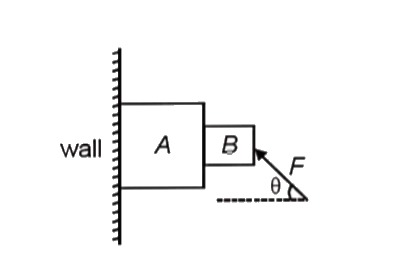
Consider the situation shown in the figure. The wall is smooth but the surface of blocks A and B in contact are rough. The friction of B due to A in equilibrium

A

Is upward

B

Is downward

C

Is zero

D

The system cannot remain in equilibrium for any value of F

Text Solution

Verified by Experts

The correct Answer is:

B
Promotional Banner

Topper's Solved these Questions

  • NEET MOCK TEST 18

    NTA MOCK TESTS|Exercise PHYSICS|45 Videos
  • NEET MOCK TEST 20

    NTA MOCK TESTS|Exercise PHYSICS|45 Videos

Similar Questions

Explore conceptually related problems

Consider the system shown in the figure. The wall is smmoth, but the surfaces of blocks A and B in contact are rough. The friction on B due to A in equilibrium is

Consider the situation shown in the figure. The wall is smooth but the surfaces of A and B in contact are rough. Then,

Consider the situation shown in figure. The wall is smooth but the surfces of A and B in contact are rough. The friction on B due to A in equilibrium. (a) is upward (b) is downward (c) is zero (d) the system cannot remain in equilibrium

Consider the situation shown in figure. The wall and the surface of A and B in contact are rough. The friction on A due to .

Consider the system as shown. The wall is smooth, but the surface of block A & B in contact is rough. The friction force on B due to A equilibrium is :

Consider the situation shown in the figure. Find acceleration of B.

Consider the situation shown in the figure. The surface is smooth and the string and the pulley are light. Find the acceleration of each block and tension in the string.

Consider the situation as shown in figure, frictional force acting between surface and 3 kg block is

Consider the situation shown in figure-l.76 (a) Find the constraint relation for velocities of blocks A and B.

Consider the situation shown in figure. All the surface are smooth. The tension in the string connected to 2m is.

NTA MOCK TESTS-NEET MOCK TEST 2-PHYSICS
  1. A table fan rotating at a speed of 2400 rpm is switched off and the r...

    Text Solution

    |

  2. A ball rolls of the top of a stairway with horizontal velocity of magn...

    Text Solution

    |

  3. Consider the situation shown in the figure. The wall is smooth but the...

    Text Solution

    |

  4. The electromagnetic waves travel in free space with the veloci...

    Text Solution

    |

  5. The displacement time graph of a moving particle is shown below T...

    Text Solution

    |

  6. A stone is thrown at 25m//s " at " 53^(@) above the horizontal. At wha...

    Text Solution

    |

  7. The forward biased diode connection among the following is

    Text Solution

    |

  8. The length l , breadth b, and thickness t of a block of wood were meas...

    Text Solution

    |

  9. A 100V, AC source of frequency of 500Hz is connected to an L-C-R circu...

    Text Solution

    |

  10. Assertion (A) : The film which appears bright in reflected system will...

    Text Solution

    |

  11. Two particles A and B execute simple harmonic motions of period T and ...

    Text Solution

    |

  12. A ring shaped tube contain two ideal gases with equal masses and relat...

    Text Solution

    |

  13. A mass M of 100 kg is suspended with the use of strings A, B and C as ...

    Text Solution

    |

  14. An inverted bell lying at the bottom of a lake 47.6 m deep has 50 cm^3...

    Text Solution

    |

  15. In the experiment to determine the focal length of a concave mirror by...

    Text Solution

    |

  16. A polarized light of intensity I(0) is passed through another polarize...

    Text Solution

    |

  17. Electromagnetic waves propagate in the direction parallel to the vecto...

    Text Solution

    |

  18. A point object O is placed at a distance of 0.3 m from a convex lens o...

    Text Solution

    |

  19. A chain of length l lt (piR)/(2) is placed on a smooth surface whose s...

    Text Solution

    |

  20. The radii of two planets are respectively R(1) and R(2) and their dens...

    Text Solution

    |
