

Home
Class 12
PHYSICS
An inclinded plane making an angle of 30...

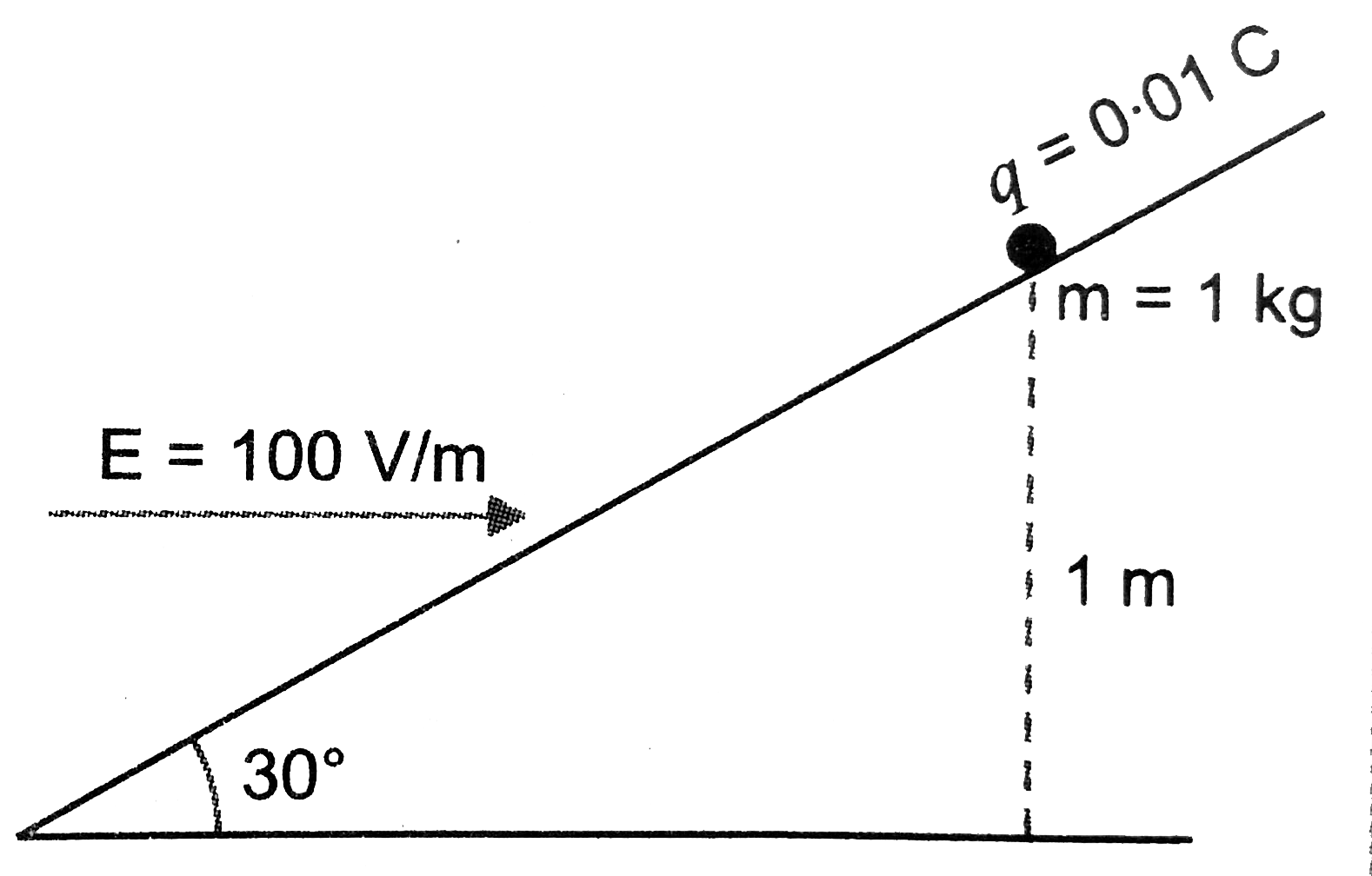
An inclinded plane making an angle of `30^(@)` with the horizontal electric field of `100 Vm^(-1)` as shown in Figure. A particle of mass `1 kg` and charge `0*01 C` is allowed to slide down from rest from a height of `1m`. If the coefficient of friction is `0.2`, find time taken by the particle to reach the bottom.

Promotional Banner

Topper's Solved these Questions

  • ELECTROSTATIC FORCES, CHARGES AND FIELDS

    SL ARORA|Exercise Problems For Self Practice|1 Videos
  • ELECTROSTATIC FORCES, CHARGES AND FIELDS

    SL ARORA|Exercise Problems For Self Practice|1 Videos
  • ELECTRONS AND PHOTONS

    SL ARORA|Exercise TYPE E : Problem For Self Practice|11 Videos
  • HEATING EFFECT OF CURRENT

    SL ARORA|Exercise All Questions|192 Videos

Similar Questions

Explore conceptually related problems

An inclined plane making an angle of 30^(@) with the horizontal is placed in a uniform horizontal electric field 200 (N)/(C ) as shown in the figure. A body of mass 1kg and charge 5 mC is allowed to slide down from rest at a height of 1m. If the coefficient of friction is 0.2, find the time taken by the body to reach the bottom. [g=9.8m//s^(2), sin 30^(@)=(1)/(2), cos30^(@)=(sqrt(3))/(2)]

An inclined plane of length 5.60 m making an angle of 45^(@) with the horizontal is placed in a uniform electric field E=100 Vm^(-1) . A particle of mass 1 kg and charge 10^(-2)C is allowed to slide down from rest position from maximum height of slope. If the coefficient of friction is 0.1, then the time taken by the particle to reach the bottom is

A track has two inclined surface AB and DC each of length 3 m and angle of inclination of 30^@ with the horizontal and a central horizontal part of length 4m shown in figure. A block of mass 0.2 kg slides from rest from point A. The inclined surfaces are frictionless. If the coefficient of friction between the block and the horizontal flat surface is 0.2, where will the block finally come to rest ? [in 10^(-1) m ]

When a body slides down from rest along a smooth inclined plane making an angle of 30^(@) with the horizontal, it takes time 20s. When the same body slides down from rest along a rough inclined plane making the same angle and through the same distance, it takes time 20p is, where p is some number greater than 1. The coefficient of friction between the body and the rough plane is

A partical of mass 1kg rests on rought contact with a plane inclined at 30^(@) to the horizontal and is just about to slip, Find the coefficient of friction between the plane and the particle.

A particle is projected from horizontal making an angle of 53^(@) with initial velocity 100 ms^(-1) . The time taken by the particle to make angle 45^(@) from horizontal is

A body is allowed to slide from the top along a smooth inclined plane of length 5m at an angle of inclination 30^(@) .If g=10ms^(-2) , time taken by the body to reach the bottom of the plane is

A particle slides down a smooth in clined plane of elevation theta fixed in an elevastor going up with an acceleration a_0 . The base of the incline has a length L.Find the time taken by the particle to reach the bottom.

A particle of mass m is projected up from the bottom of an inclined plane with initial velocity v_(0) at angle 45^(@) with an inclined plane of inclineation 30^(@) as shown in figure. At the same time a small block of same mass m is released from rest at a height h . The particle hits the block at some point on inclined plane. If the particle sticks to the block after collision, the velocity of block parallel to the inclined plane just after collision will be (take g=10m//s^(2) )

SL ARORA-ELECTROSTATIC FORCES, CHARGES AND FIELDS-Problems
  1. Five point charges, each of value +q are placed on five vertices of a ...

    Text Solution

    |

  2. Four particles each having a charge q, are placed on the four vertices...

    Text Solution

    |

  3. A charges Q is placed at each of the two opposite corners of a square....

    Text Solution

    |

  4. Two similarly and equally charged identical metal spheres A and B repe...

    Text Solution

    |

  5. A copper ball of density 8.6 g cm^(-3) and 1 cm in diameter is immerse...

    Text Solution

    |

  6. A charged particle of radius 5xx10^(-7)m is located in a horizontal el...

    Text Solution

    |

  7. Two identical charged spheres are suspended by strings of equal length...

    Text Solution

    |

  8. An inclinded plane making an angle of 30^(@) with the horizontal elec...

    Text Solution

    |

  9. Two point charges+ q and-q are placed at distanced apart. What are the...

    Text Solution

    |

  10. Three particles, each of mass m and carrying a charge q each, are susp...

    Text Solution

    |

  11. A ball of mass 10^(-2) kg and having charge + 3 xx 10^(-6)C is tied at...

    Text Solution

    |

  12. A charge + 10^-9 C is located at the origin in free space & another c...

    Text Solution

    |

  13. Consider the classical model of an electron such that a nucleus of cha...

    Text Solution

    |

  14. A uniform electric field of intensity E = 10^(6) V//m exist in vertica...

    Text Solution

    |

  15. A point particle of mass M is attached to one end of a massless rigid ...

    Text Solution

    |

  16. A charge of 4xx10^(-9)C is distributed uniformly over the circumferen...

    Text Solution

    |

  17. A ring of radius 0.1m is made out of thin metallic wire of area of cro...

    Text Solution

    |

  18. Two charges, each equal to q, aer kept at x=-a and x=a on the x-axis. ...

    Text Solution

    |