Home
Class 12
PHYSICS
How much work has to be done in assembli...

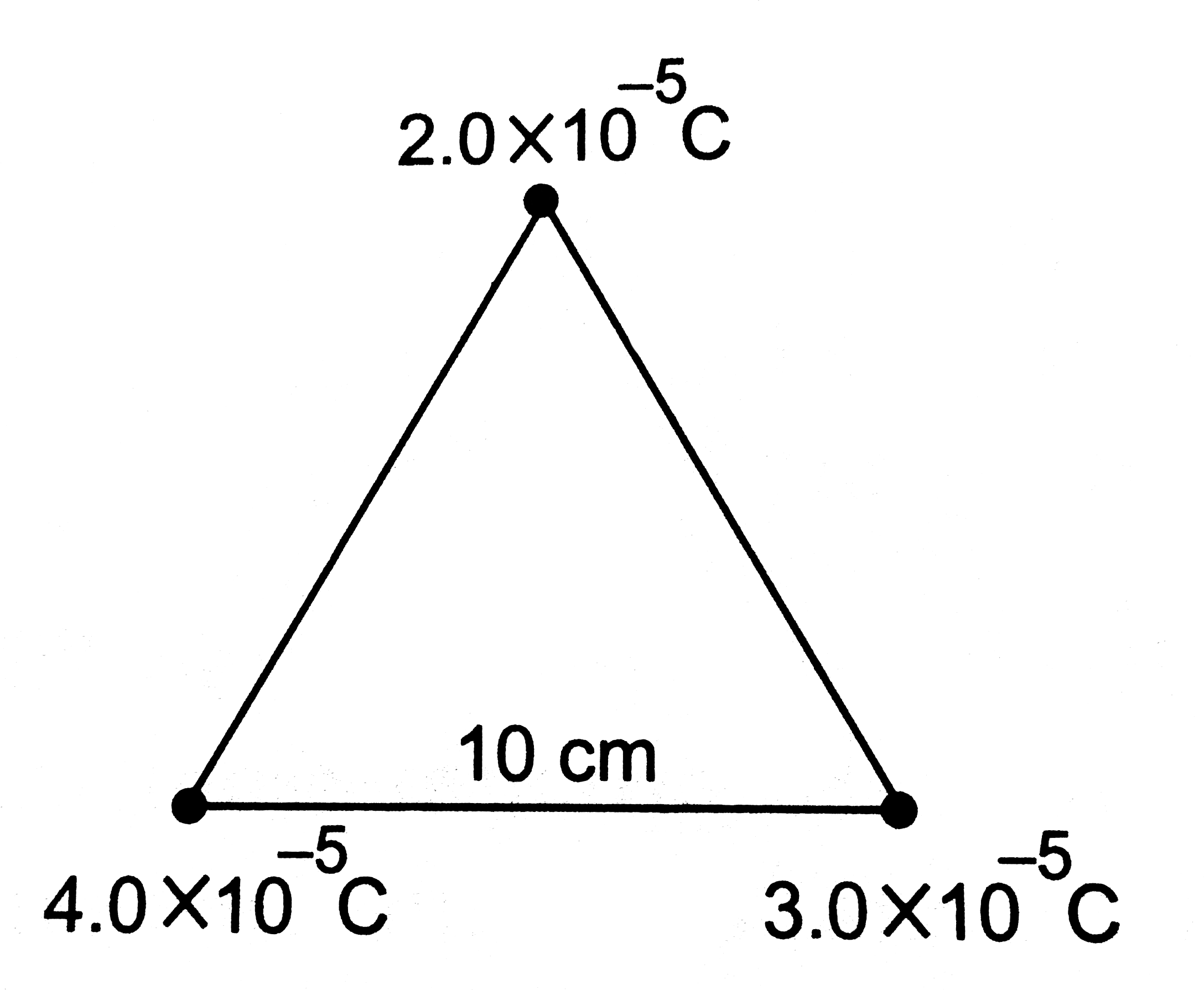
How much work has to be done in assembling three charged particles at the vertices of an equilateral triangle as shown in figure

Text Solution

Verified by Experts

The correct Answer is:

234J
Promotional Banner

Topper's Solved these Questions

  • ELECTRIC POTENTIAL AND ELECTRIC FLUX

    SL ARORA|Exercise Problem|15 Videos
  • CURRENT ELECTRICITY

    SL ARORA|Exercise Problems For Self|101 Videos
  • ELECTRICAL INSTRUMENTS

    SL ARORA|Exercise Problem for self practice|81 Videos

Similar Questions

Explore conceptually related problems

Find the coordinates of the vertices of an equilateral triangle of side 2 a as shown in Figure.

Three points charges are placed at the corners of an equilateral triangle of side L as shown in the figure:

Find centre of mass of a system of three particle kept at the corner equilateral triangle as shown in figure

Determine the electric dipole moment of the syatem of three charges , placed on the verices of an equilateral triangle , as shown in the fogure :

Three identical point charges, q, are placed at the vertices of an equilateral triangle as shown in the figure. The length of each side of the triangle is d. Determine the magnitude and direction of the total electrostatic force on the charge at the top of the triangle.

Three particles of massses 50 g, 100 g and 150 g are placed at the vertices of an equilateral triangle of side 1m ( as shown in the figure ) . The ( x, y) coordinates of the centre of mass will be :

Three masses each of mass m are palced at the vertices of an equilateral triangles ABC of side l as shown in figure. The force acting on a mass 2m placed at the centroid O of the triangle is

Work done by an external agent in bringing three particles each of mass m at the vertices of an equilateral triangle of length l is

Three charges Q, (+q) and (+q) are placed at the vertices of an equilateral triangle of side l as shown in the figure. It the net electrostatic energy of the system is zero, then Q is equal to

SL ARORA-ELECTRIC POTENTIAL AND ELECTRIC FLUX-Problems for self practive
  1. Three charges +q,+q and -q are located at the corners of an equilateri...

    Text Solution

    |

  2. Three particles, each having a charge of 10 muC, are. placed at the ve...

    Text Solution

    |

  3. How much work has to be done in assembling three charged particles at ...

    Text Solution

    |

  4. What is the electrostatic potential energy of the charge configuration...

    Text Solution

    |

  5. Three charges -q, +q and -q are placed along a st. line at equal dista...

    Text Solution

    |

  6. Four charges are arranged at the corners of a square ABCD of side d,...

    Text Solution

    |

  7. Two electrons each moving with a velocity of 10^(6) ms^(-1) are relea...

    Text Solution

    |

  8. Two identical particles of mass m carry a charge Q, each. Initially on...

    Text Solution

    |

  9. An electric dipole consists of two opposite charges of magnitude 2xx10...

    Text Solution

    |

  10. A certain dipole has opposite charges of 2xx10^(-5) separated by a dis...

    Text Solution

    |

  11. Two charges +3.2xx10^(-19) and -3.2xx10^(-19)C placed at 2.4A apart fr...

    Text Solution

    |

  12. A uniform electric field of 200NC^-1 exists in space in the X-directio...

    Text Solution

    |

  13. A circular plane sheet of radius 10 cm is placed in a uniform electr...

    Text Solution

    |

  14. Calculate the total charge enclosed by a closed surface, the number of...

    Text Solution

    |

  15. A spherical Gaussian surface encloses a charge of 8.85xx10^(-8) C (i) ...

    Text Solution

    |

  16. An arbitrary surface encloses a dipole. What is the electric flux thro...

    Text Solution

    |

  17. A point charge of 10^(-7)C is situated at the centre of a cube of side...

    Text Solution

    |

  18. Find the electric flux through each face of a hollow cube of side 10 c...

    Text Solution

    |

  19. Consider a uniform electric field E = 3xx10^(3) hat(i) N//C. (a) What...

    Text Solution

    |

  20. The electric field in a region is given by vecE=3/5 E0veci+4/5E0vecj w...

    Text Solution

    |
