Home
Class 12
CHEMISTRY
Consider the following covalent compound...

Consider the following covalent compounds in their solid state and find the value of expression `(X+Y+Z)`.
`N_(2)O_(5),Cl_(2)O_(6),PC l_(),I_(2)Cl_(6),XeF_(6),PB r_(5)`
Where X=total number of compounds in which central atom of cationic or anionic part is `sp^(3)` hybridized.
Y=Total number of compounds having `90^(@)` bond angle either in cationic or anionic part.
Z=Total number of compounds having `109^(@)28'` bond angle either in cationic or anionic part.

Text Solution

Verified by Experts

The correct Answer is:
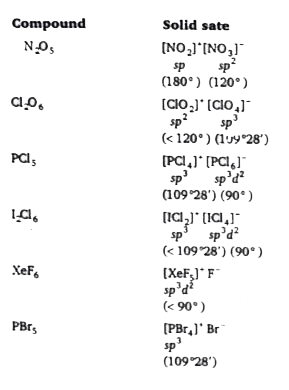
9


x=1+1+1+1=4
y=1+1=2
z=1+1+1=3
x+y+z=4+2+3=9
Promotional Banner

Topper's Solved these Questions

  • p-BLOCK ELEMENTS

    VK JAISWAL|Exercise ASSERTION REASON TYPE QUESTIONS|27 Videos
  • METALLURGY

    VK JAISWAL|Exercise ASSERTION-REASON TYPE QUESTIONS|30 Videos
  • PERIODIC PROPERTIES

    VK JAISWAL|Exercise ASSERTION-REASON TYPE QUESTIONS|35 Videos

Similar Questions

Explore conceptually related problems

Total number of unpaired electrons(s) present in both cationic and anionic part of compound O_(2)[PtF_(6)] .

The difference in the coordination number of the central atom in the anionic and cationic part of Cl_(2)O_(6) is :

Consider the following compounds (1) H_(3)CF (2) H_(2)CF_(2) (3) CH_(4) (4) H_(3)C CF_(3) (5) CH_(3)CH_(3) (6) C_(2)H_(4) and calculate value of Y+X, (where X is the total number of compounds which have H-C-H bond angles equal to 109^(@)28' and Y is the total number of compounds which have H-C-H bond angles greater than 109^(@)28' and less than 120^(@)

Find the total number of compounds or ions having different bond lengths between identical atoms. PF_(2)Cl_(3),PF_(3)Cl_(2),SF_(4),BrF_(5),SbF_(5)^(2-),SF_(6),IF_(7)

Total number of covalent bonds in C_(3)O_(2) is x and y is the number of sp - hybridised atom. Find the sum of x+y ?

VK JAISWAL-p-BLOCK ELEMENTS-SUBJECTIVE PROBLEMS
  1. Sum of oxidation state of nitrogen atom in hyponitrous acid, nitric ac...

    Text Solution

    |

  2. Find the value of x in the tremolite abestos: Ca(2)Mg(x)(Si(4)O(11)...

    Text Solution

    |

  3. Consider the following silicates (a) BaTi(Si(2)O(9)) (b) ZnCa(2)Si...

    Text Solution

    |

  4. Atomicity of white or yellow phosphorus is 4 annd it is represented as...

    Text Solution

    |

  5. Marshall's acid overset(H(2)O) to A+B Aoverset(H(2)O)toB+C If P an...

    Text Solution

    |

  6. Consider following four compounds: (i) C(x) O(y) (ii) C(x)O(y+1) ...

    Text Solution

    |

  7. If following molecules undergo dimerisation then find the value of (YZ...

    Text Solution

    |

  8. Consider Al(2)(OH)(6) compound and caculate the value of (X+Y)+Z Wher ...

    Text Solution

    |

  9. Consider the following covalent compounds in their solid state and fin...

    Text Solution

    |

  10. Consider following compounds A to E : (A) XeF(n) " " (B) XeF((n+1)...

    Text Solution

    |

  11. When B(2)H(6) is allowed to react with following lewis bases, then how...

    Text Solution

    |

  12. What is covalency of chlorine atom in second excited state ?

    Text Solution

    |

  13. Consider the following molecule: Calculate value of q+q, here p a...

    Text Solution

    |

  14. Consider the following structures and calculate value of (P^(2)-Q^(2))...

    Text Solution

    |

  15. Calculate the value of " x+y-z" here x,y and z are total number of non...

    Text Solution

    |

  16. Consider the following species: (i) CH(3)^(+) (ii) (C(3)H(5))(3)Al...

    Text Solution

    |

  17. Consider the following species: CF(4),GeH(4),BCl(3),AlBr(3),H(2)O,PH(3...

    Text Solution

    |

  18. If X,Y and Z are total number of pi-bond(s) in H(2)S(2)O(6),H(2)SO(3) ...

    Text Solution

    |

  19. Calculate value of "x+y" ffor "hypophoshporic acid", where x is total ...

    Text Solution

    |

  20. Atomicity of white or yellow phosphorus is 4 annd it is represented as...

    Text Solution

    |

