A
B
C
D
Text Solution
Verified by Experts
The correct Answer is:
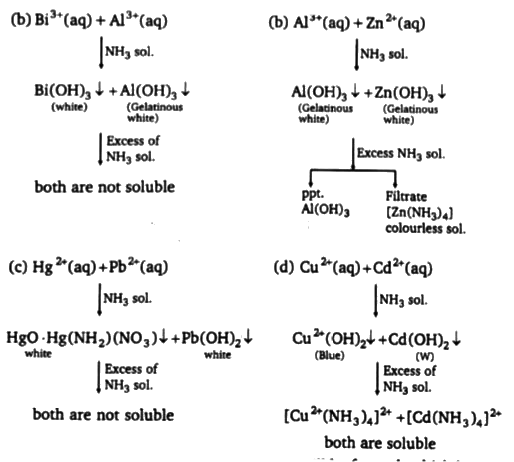



Topper's Solved these Questions
QUALITATIVE INORGANIC ANALYSIS
VK JAISWAL|Exercise LEVEL 3|72 VideosQUALITATIVE INORGANIC ANALYSIS
VK JAISWAL|Exercise ONE OR MORE ANSWER IS/ARE CORRECT|45 VideosQUALITATIVE INORGANIC ANALYSIS
VK JAISWAL|Exercise SUBJECTIVE PROBLEMS|5 VideosPERIODIC PROPERTIES
VK JAISWAL|Exercise ASSERTION-REASON TYPE QUESTIONS|35 Videoss-BLOCK ELEMENTS
VK JAISWAL|Exercise SUBJECTIVE PROBLEMS|2 Videos
Similar Questions
Explore conceptually related problems
VK JAISWAL-QUALITATIVE INORGANIC ANALYSIS-LEVEL 2
- When a reagent (X) reacts with Fe^(3+) salt solution turnsred due to t...
Text Solution
|
- Which of the following mixtures cann be separated by using excess NH(3...
Text Solution
|
- Which of the following salt will not give positive brown ring test?
Text Solution
|
- Consider the following reactions P+Q to R+K(2)SO(4) R to 2CuI +I(2...
Text Solution
|
- A very dilute acidic solution of Cd^(2+) and Ni^(2+) gives only yellow...
Text Solution
|
- Identif salt (A) satisfying above chemical property:
Text Solution
|
- Reddish brown (chocolate) precipitate is formed by mixing solutions co...
Text Solution
|
- Water soluble mixture underset((ii)." dil ."HCl)overset((i)." "BaCl(2)...
Text Solution
|
- Which of the following compounds after mixing can produce blue coloura...
Text Solution
|
- A bromide ion does not intefere with the chromyl chloride test because...
Text Solution
|
- A red solid is insoluble in water. However, it becomes soluble if some...
Text Solution
|
- Which of the following reaction(s) relevat t the microcosmic salt bead...
Text Solution
|
- Solid KCl, when heated with solid K(2)Cr(2)O(7) and concentrated H(2)S...
Text Solution
|
- Choose the correct code by identifying (X), (Y) and (Z) in each case f...
Text Solution
|
- A salt, when warmed with zinc powder and an NaOH solution, gives a gas...
Text Solution
|
- A sulphate of a metal (A) on heating evolves two gases (B) and ( C) an...
Text Solution
|
- X+HNO(3) to Y+NO(2)+H(2)O+S, Y+Ammonium molybdatetoyellow ppt. identif...
Text Solution
|
- underset(("Black"))(X)overset(Dil.H(2)SO(4))tounderset(("gas"))(Y)over...
Text Solution
|
- A mixture of Na(2)CO(3) and Na(2)SO(3) is treated with dilute H(2)SO(4...
Text Solution
|
- An organic compound (A) on heatig produces two gases (B) and (C) and n...
Text Solution
|