Home
Class 12
MATHS
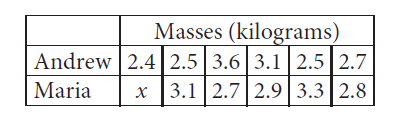
Andrew and Maria each collected six rock...


Andrew and Maria each collected six rocks, and the masses of the rocks are shown in the table above. The mean of the masses of the rocks Maria collected is 0.1 kilogram greater than the mean of the masses of the rocks Andrew collected. What is the value of x ?

Text Solution

Verified by Experts

The correct Answer is:

A, C

Since the mean of a set of numbers can be found by adding the numbers together and dividing by how many numbers there are in the set, the mean mass, in kilograms, of the rocks Andrew collected is `(2.4+2.5+3.6+3.1+2.5+2.7)/6=(16.8)/6`=2.8 . Since the mean mass of the rocks Maria collected is 0.1 kilogram greater than the mean mass of rocks Andrew collected, the mean mass of the rocks Maria collected is 2.8 + 0.1 = 2.9 kilograms. The value of x can be found by using the algorithm for finding the mean: `(x+3.1+2.7+2.9+3.3+2.8)/6=2.9`. Solving this equation gives x = 2.6, which is equivalent to 13 5 . Either 2.6 or `13/5` may be gridded as the correct answer.
Promotional Banner

Similar Questions

Explore conceptually related problems

N molecules each of mass m of gas A and 2 N molecules each of mass 2m of gas B are contained in the same vessel which is maintined at a temperature T. The mean square of the velocity of the molecules of B type is denoted by v^(2) and the mean square of the x-component of the velocity of a tye is denoted by omega^(2) . What is the ratio of omega^(2)//v^(2) = ?

A rock of higher mass resting on a cliff has more energy than the one which has less mass at the same height.

Sydney and Kiana each worked for five days doing chores and each earned a certain amount of money per day. The table above shows the amount that each person earned each day. Kiana's mean earning for the five days was $0.20 less than Sydney's mean earning for the five days. What is the value of y?

A 2kg mass is attached to a spring of force constant 600 N//m and rests on a smooth horizontal surface. A second mass of 1kg slides along the surface toward the first at 6m//s . (a) Find the amplitude of oscillation if the masses make a perfectly inelastic collision and remain together on the spring. what is the period of oscillation ? (b) Find the amplitude and period of oscillation if the collision is perfectly elastic. ( c) For each case , write down the position x as a function of time t for the mass attached to the spring, assuming that the collision occurs at time t = 0 . What is the impulse given to the 2kg mass in each case ?

The roots alpha and beta of a quadratic equation are the square of two consecutive natural numbers. The geometric mean of the two roots is 1 greater than the difference of the roots. If alpha and beta lies between the roots of x^2-cx+ 1 = 0 then find the minimum integral value of c.

Five samples of each of three different rock types were collected on a hiking trip in Colorado. Each sample was analyzed for its gold content. The milligrams of gold found in each sample are presented in the table above. How much larger is the median of the amount of gold in the granite samples than that of the limestone samples?

Five samples of each of three different rock types were collected on a hiking trip in Colorado. Each sample was analyzed for its gold content. The milligrams of gold found in each sample are presented in the table above. What is the percent difference of the average gold content in the granite samples when compared to the average gold content of the gneiss samples?

A small block of ice with mass 0.120 kg is placed against a horizontal compressed spring mounted on a horizonta table top that is 1.90 m above the floor. The spring has a force constant k=2300 M//m and is initially compressed 0.045 m . The mass of the spring is negligible. The spring is releaded and the block slock slides along the table, goes off the edge and travels to the floor. If there is negligible friction between the ice and the table, what is the speed of the block of ice when it reaches the floor. (g=9.8 m//s^(2)) .

Given the setup shown in Fig Block A, B and C have masses m_(A)= M and m_(B) =m_(C) = m . The strings are assumed maseless and unstreichable, and the pulleys frictionless .There is no friction between block B and the support table, but there is friction between blocks B and C , denoted by a given coefficient mu a . In terms the given find (i) the acceleration of block A and B b. Suppose the system is released from rest with block C near the right end of block B as shown in the above figure. If the the length L of block B is given, what is the speed of block C as it reached the left end of block B ? Tear the size of C as small c. If the mass of block A is less then some critical value, the blocks will not accelerate when released from rest. Write down as expression for that critical mass.

A rock of mass m is dropped to the ground from a height h . A second rock, with mass 2m , is dropped from the same height. When the second rock strikes the ground, what is its kinetic energy? (a) Twice that of the first rock, (b) four times that of the first rock, (c) same as that of the first rock, (d) half as much as that of the first rock, (e) impossible to determine.
