Home
Class 11
CHEMISTRY
What is the final product, C, of the fol...

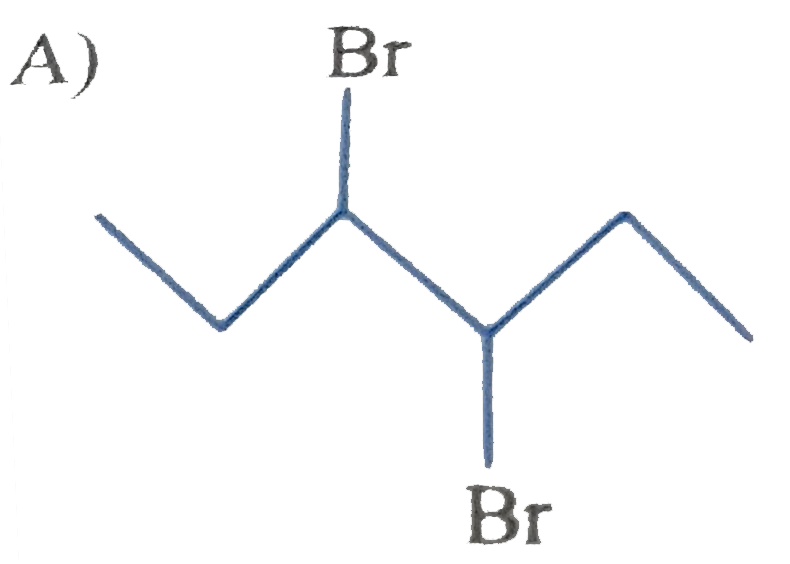
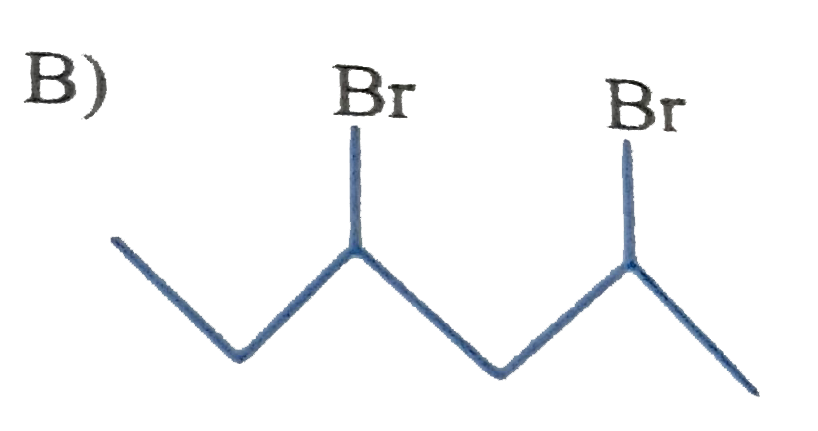
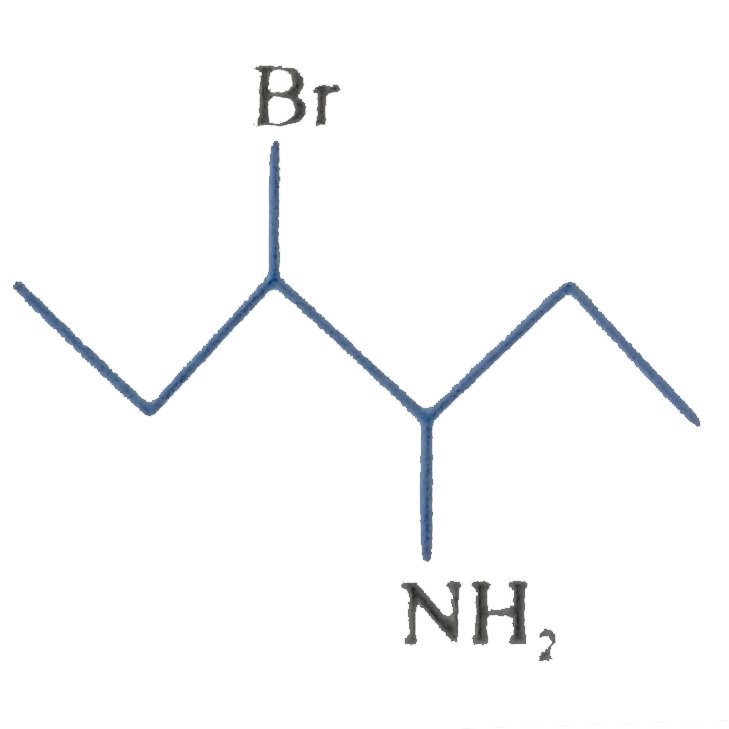
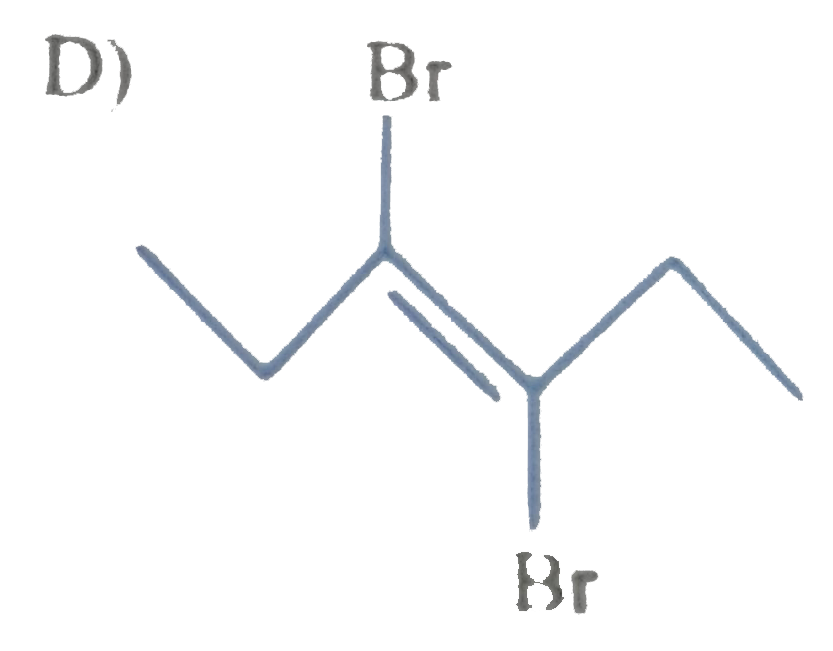
What is the final product, C, of the following reaction sequence?
`CH_(3)-CH_(2)-C-=C-Hunderset((ii).CH_(3)CH_(2)Br)overset((i)NaNH_(2))toA`
`Aoverset(Na,NH_(3)(liq.))toB`
`Bunderset(CH_(2)Cl_(2))overset(Br_(2))toC`

A

B

C

D

Text Solution

AI Generated Solution

The correct Answer is:

To determine the final product C of the given reaction sequence, we will follow the steps outlined in the question. ### Step 1: Reaction with NaNH₂ The starting compound is 1-butyne (CH₃-CH₂-C≡C-H). When it reacts with sodium amide (NaNH₂), the NaNH₂ acts as a strong base and abstracts a proton from the terminal alkyne, forming a sodium acetylide. **Reaction:** \[ \text{CH}_3\text{CH}_2\text{C}\equiv\text{CH} + \text{NaNH}_2 \rightarrow \text{CH}_3\text{CH}_2\text{C}\equiv\text{C}^- \text{Na}^+ \] This gives us the intermediate A: \[ \text{A} = \text{CH}_3\text{CH}_2\text{C}\equiv\text{C}^- \] ### Step 2: Reaction with CH₃CH₂Br The next step involves the reaction of the sodium acetylide (A) with ethyl bromide (CH₃CH₂Br). The nucleophilic acetylide ion attacks the electrophilic carbon in the ethyl bromide, leading to the formation of a new carbon-carbon bond. **Reaction:** \[ \text{CH}_3\text{CH}_2\text{C}\equiv\text{C}^- + \text{CH}_3\text{CH}_2\text{Br} \rightarrow \text{CH}_3\text{CH}_2\text{C}\equiv\text{C}\text{CH}_2\text{CH}_3 \] This gives us the intermediate B: \[ \text{B} = \text{CH}_3\text{CH}_2\text{C}\equiv\text{C}\text{CH}_2\text{CH}_3 \] ### Step 3: Reaction with Na in liquid NH₃ The next step involves the reduction of the alkyne (B) using sodium in liquid ammonia (Na/NH₃). This reaction converts the alkyne into a trans-alkene. **Reaction:** \[ \text{CH}_3\text{CH}_2\text{C}\equiv\text{C}\text{CH}_2\text{CH}_3 \xrightarrow{\text{Na/NH}_3} \text{trans-alkene} \] The product will be: \[ \text{trans-} \text{CH}_3\text{CH}_2\text{C}=\text{C}\text{CH}_2\text{CH}_3 \] ### Step 4: Reaction with Br₂ in CH₂Cl₂ Finally, the trans-alkene reacts with bromine (Br₂) in dichloromethane (CH₂Cl₂). This reaction leads to the formation of a vicinal dibromide. **Reaction:** \[ \text{trans-CH}_3\text{CH}_2\text{C}=\text{C}\text{CH}_2\text{CH}_3 + \text{Br}_2 \rightarrow \text{Br-CH}_3\text{CH}_2\text{C}(\text{Br})\text{C}\text{H}_2\text{CH}_3 \] The final product C will have bromine atoms added to the double bond, resulting in: \[ \text{C} = \text{Br-CH}_3\text{CH}_2\text{C}(\text{Br})\text{H}\text{CH}_2\text{CH}_3 \] ### Final Product Thus, the final product C is: \[ \text{C} = \text{Br-CH}_3\text{CH}_2\text{C}(\text{Br})\text{H}\text{CH}_2\text{CH}_3 \]
Promotional Banner

Topper's Solved these Questions

Similar Questions

Explore conceptually related problems

What is the major product expected from the following reaction CH_(3)-C-=C-Hunderset(NH_(3))overset(NaNH_(2))to

What is the final major product of the following reaction CH_(3) - CH_(2) - C = C - H overset(NaNH_(2)) to overset(CH_(3) CH_(2) CH_(2) - Br) to overset(Hg SO_(4)) underset(H_(2) SO_(4))to ?

CH_(3)CH_(2)C=Choverset(NaNH_(2)//NH_(3)(l))rarr overset(CH_(3)CH_(2)Br)rarr overset(Li,NH_(3)(l)rarr

CH_(3)CH_(2)CH_(2)-overset(O)overset(||)(C)-H+CH_(3)-C-=CH overset(Na,NH_(3)(l))to

The major product of the following reaction is : CH_(3)CH_(2)underset(Br)underset(|)CH-underset(Br)underset(|)CH_(2) underset(II. NaNH_(2) "in liq." NH_(3))overset(I.KOH alc.)to
