Home
Class 11
PHYSICS
Assertion If in a projectile motion, we ...

Assertion If in a projectile motion, we take air friction into consideration, then `t_("ascent") lt t_("descent")`.
Reason During ascent, magnitude of retardation is greater than magnitude of acceleration during descent.

A

If both Asseration and Reason are correct and Reason is the correct explanation of Assertion

B

If both Assertion and Reason are correct but Reason is not the correct explanation of Assertion

C

If Assertion is true but Reason is false

D

If Assertion is false but Reason is true

Text Solution

Verified by Experts

The correct Answer is:
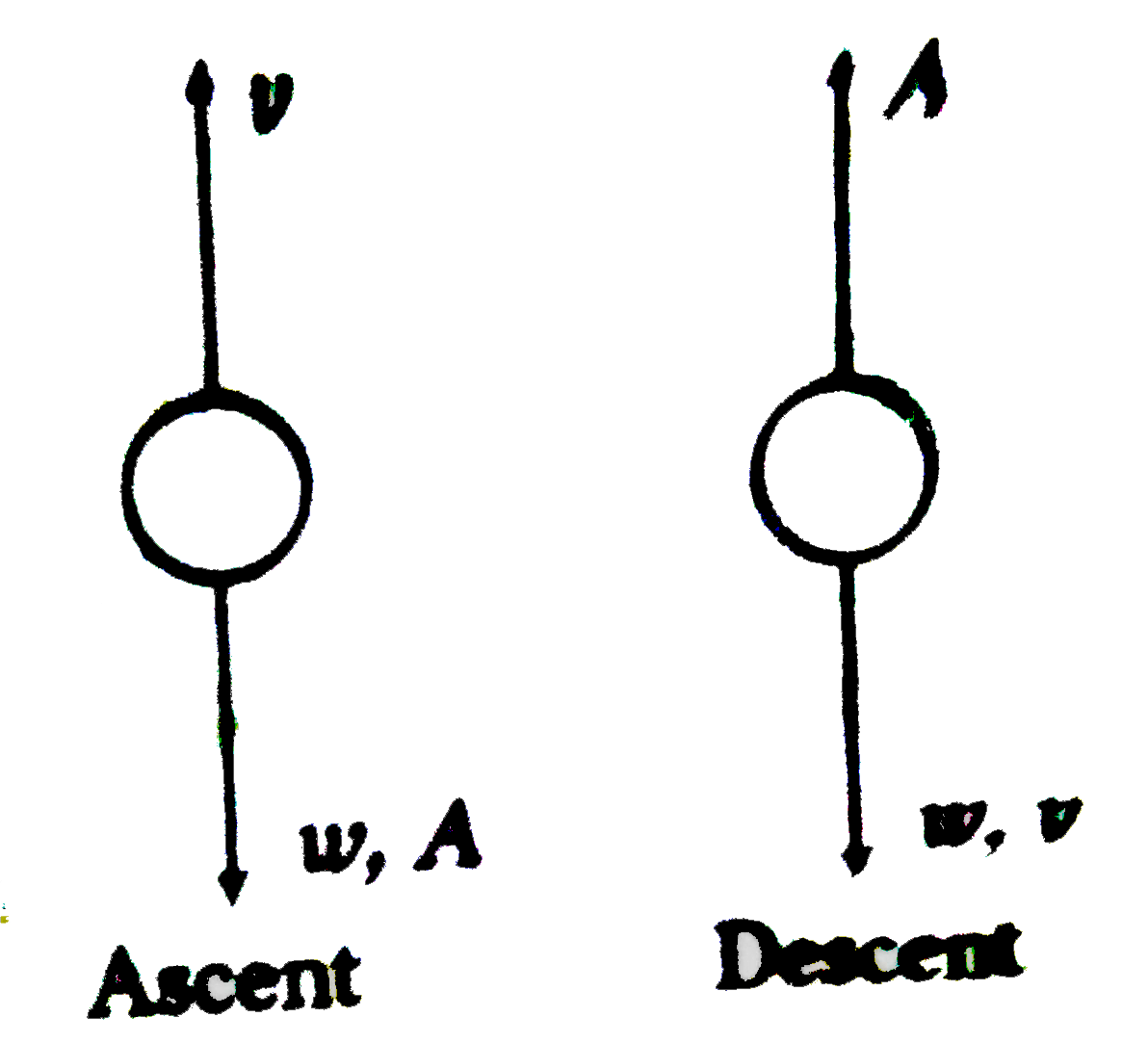
A

`v =` velocity, w = weight and A = air resistance
Promotional Banner

Topper's Solved these Questions

  • MOTION

    DC PANDEY|Exercise Match the Columns|4 Videos
  • MOTION

    DC PANDEY|Exercise C. Medical entrances gallery|1 Videos
  • MOTION

    DC PANDEY|Exercise B. Medical entrance|1 Videos
  • MEASUREMENT AND ERRORS

    DC PANDEY|Exercise Subjective|19 Videos
  • MOTION IN A PLANE

    DC PANDEY|Exercise (C )Medical entrances gallery|32 Videos

Similar Questions

Explore conceptually related problems

Assertion: In projectile motion, the acceleration is constant in both magnitude and direction but the velocity changes in both magnitude and direction. Reason: When a force or accelration is acting in an oblique direction to the direction of velocity then both magnitude and direction of the velocity may be changed.

Assertion : In projectile motion at any two positions (v_2-v_1)/(t_2 -t_1) always remains constant. Reason : The given quantity is average acceleration, which should remain constant as acceleration is constant.

Assertion: In projectile motion, the vertical velocity of the particle is continoulsy decreased during its ascending motion. Reason: In projectile motion downward constant acceleration is present in vertical direction.

Assertion: if air resistance is considerd then time to ascent and time of desent will be different. Reason: Magnitudes of acceleration will be different in upwards and downward motion.

Assertion In case of projectile motion, the magnitude of rate of change of velocity is variable. Reason In projectile motion, magnitude of velocity first decreases and then increases during the motion.

These questions consists of two statements each printed as Assertion and Reason. While answering these question you are required to choose any one of the following five reponses (a) If both Assertion and Reason arecorrect and Reason is the correct explanation of Asserrtion. (b) If both Assertion and Reason are correct but Reason is not the correct explanation of Assertion. (c ) If Assertion is true but Reason is false. (d) If Assertion is false but Reason is true. Assertion In projectile motion, the rate of change in magnitude of potential energy of a particle first decreases and then increases during motion. Reason In projectile motion, the rate of change in linear momentum of a particle remains constant during motion.

Assertion In projectile motion, the angle between instanteneous velocity vector and acceleration vector can be anything between o to pi (excluding the limiting case) Reason In projectile motion, acceleration vector is always pointing vertically downwards. (Neglect air friction.)

Assertion : Kinematic equations are exact and are always correct. Reason : The definitions of instantaneous velocity and acceleration are true only for motion in which the magnitude and direction of acceleration are constant during the course of motion.

A car initially travelling eastwards turns noth by travelling in a quarter circular path of radius R metres at uniform speed as shown in figure. The car completes the turn in T second. (a) What is the acceleration of the car when it is at B located at an angle of 37^(@) . Express your a swers in terms of unit vectors hat(i) and hat(j) . (b) The magnitude of car's average acceleration during T second period.

