Home
Class 11
PHYSICS
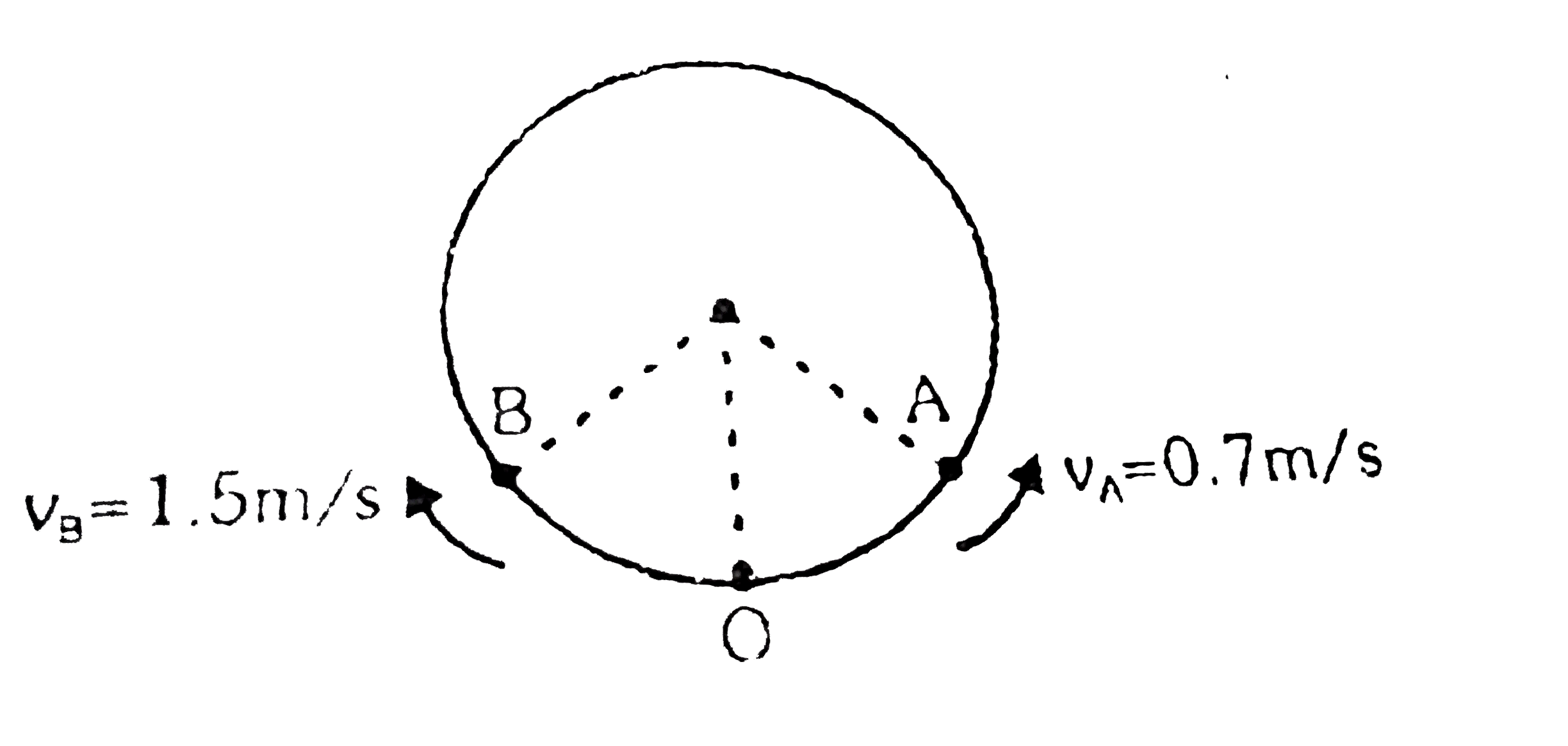
Two particles A and B start at O travel ...

Two particles A and B start at O travel in opposite directions along the circular path at constant speed `v_(A)=0.7 m//s` and `v_(B)=1.5 m//s` respectively. Determine the time when they collide and the magnitude of the acceleration of B just before this happening. `("radius"=5m)`

Text Solution

Verified by Experts

From the condition given in the question, it is clear that total distancen `(=" velocity"xx"time")` will be equal to the circumference of circular path
i.e., `v_(B)t+v_(A)t=` circumference o fcircular path
`1.5t+0.7t=2piR=10pi`
`therefore" Time",t=(10pi)/(2.2)=14.3s`
Acceleration, `a=(v_(B)^(2))/(R)=0.45ms^(-2)`
Promotional Banner

Topper's Solved these Questions

  • CIRCULAR MOTION

    DC PANDEY|Exercise Solved Examples|2 Videos
  • CIRCULAR MOTION

    DC PANDEY|Exercise Miscellaneous Examples|5 Videos
  • CENTRE OF MASS, LINEAR MOMENTUM AND COLLISION

    DC PANDEY|Exercise Level 2 Subjective|21 Videos
  • COMMUNICATION SYSTEM

    DC PANDEY|Exercise Only One Option is Correct|27 Videos

Similar Questions

Explore conceptually related problems

Two particles P and Q start from a point on a circle at time t=0 . They travel in opposite directions along a circular path of radius 10 m at constant speeds of V_(p ) =2.14 m//s and V_(Q ) = 1m//s . After what -time they will collide ?

Two particles A and B are projected simultaneously in the direction shown in the figure with velocities V_(A)=20m//s and V_(B)=10m//s respectively. If they collide in air after 1/2 sec. then

Two particles A and B are projected simultaneously in the directins shown in figure with velocities v_(A) = 20 m//s and v_(B) = 10 m//s respectively. They collide in air after 1/2 s. Find (a) the angle theta (b) the distance x. .

Two points A and B located in diametrically opposite directions of a point charge of +2 muC at distances 2.0 m and 1.0 m respectively from it. Determine the potential difference V_(A)-V_(B)

Two particles A and B are projected simultaneously in horizontal direction with speed 50 m//s and 100m//s respectively . If t_(A) and t_(B) are the time taken by the projectiles to hit the ground by the particles A and B respectively, then

Two particles A and B start moving simultaneously along the line joining them in the same direction with acceleration of 1 m//s^2 and 2 m//s^2 and speeds 3 m//s and 1 m//s respectively. Initially, A is 10 m behind B. What is the minimum distance between them?

Two particle of mass 2 kg and 1 kg are moving along the same straight line with speeds 2m//s and 5m//s respectively. What is the speed of the centre of mass of the system if both the particles are moving (a) in same direction (b) in opposite direction ?

Two identical balls A and B collide head on elastically. If velocities of A and B, before the collision are +0.5 m/s and -0.3 m/s respectively, then their velocities, after the collision, are respectively

two particles A and B are at separation of 100 m . They move towards each other with uniform speed, A with 5 m//s and B with 15 m//s . When and where the two particle meet?

Two perfectly elastic particles A and B of equal masses travelling along a line joining them with velocities 15 m//s and 10m//s respectively collide. Their velocities after the elastic collision will be (in m/s) respectively

DC PANDEY-CIRCULAR MOTION-Medical entrances s gallery
  1. Two particles A and B start at O travel in opposite directions along t...

    Text Solution

    |

  2. In the given figure, a=15m//s^(2) represents the total acceleration o...

    Text Solution

    |

  3. A car is negotiating a curved road of radius R. The road is banked at ...

    Text Solution

    |

  4. A uniform circular disc of radius 50 cm at rest is free to turn about ...

    Text Solution

    |

  5. What is the minimum velocity with which a body of mass m must enter a ...

    Text Solution

    |

  6. A particle of mass 10 g moves along a circle of radius 6.4 cm with a c...

    Text Solution

    |

  7. A fighter plane is pulling out for a dive at a speed of 900 km//h. Ass...

    Text Solution

    |

  8. A particle is moving in a curved path. Which of the following quantiti...

    Text Solution

    |

  9. The ratio of angular speed of a second-had to the hour-hand of a watch...

    Text Solution

    |

  10. If the length of second's hand of a clock is 10 cm, the speed of its d...

    Text Solution

    |

  11. A particle is moving uniformly in a circular path of radius r. When it...

    Text Solution

    |

  12. A rotating wheel changes angular speed from 1800 rpm to 3000 rpm in 20...

    Text Solution

    |

  13. The expression from centripetal force depends upon mass of body, speed...

    Text Solution

    |

  14. Uniform circular motion is an example of

    Text Solution

    |

  15. A stone tied to a rope is rotated in a vertical circle with uniform sp...

    Text Solution

    |

  16. A particle moving in uniform circle makes 18 revolutions in 1 minutes....

    Text Solution

    |

  17. A car of mass 1000kg negotiates a banked curve of radius 90m on a fict...

    Text Solution

    |

  18. On a railway curve, the outside rail is laid higher than the inside on...

    Text Solution

    |

  19. One end of a string of length 1 m is tied to a body of mass 0.5 kg. It...

    Text Solution

    |

  20. A cane filled with water is revolved in a vertical circle of radius 4 ...

    Text Solution

    |
