Home
Class 11
PHYSICS
A particle of mass m is released from th...

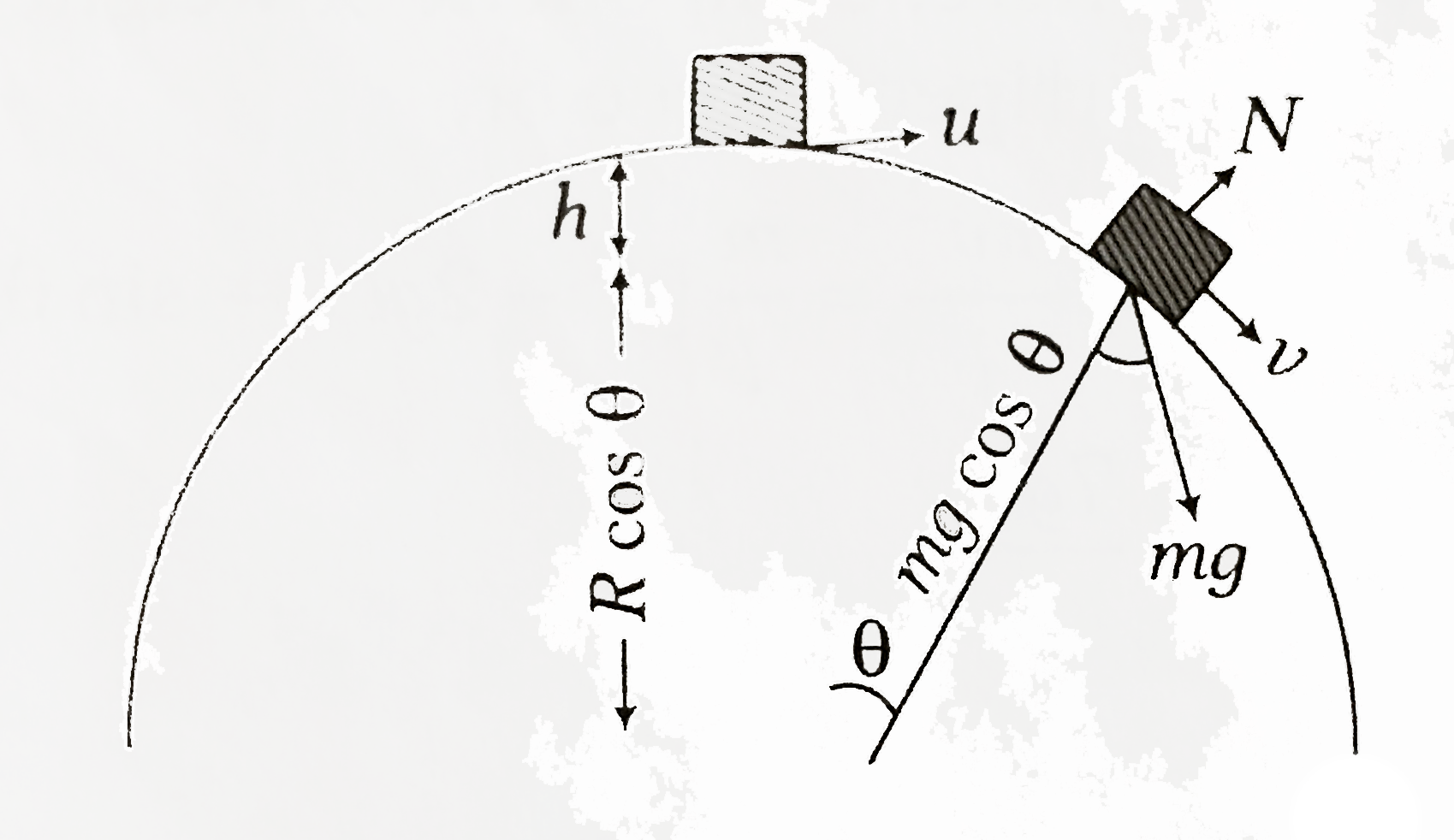
A particle of mass `m` is released from the top of a smooth hemisphere of radius `R` with the horizontal speed `u`. Calculate the angle with verticle where it loses contact with the hemisphere.

A

`sin^(-1)((u^(2))/(3gR)+(2)/(3))`

B

`cos^(-1)((u^(2))/(3gR)+(2)/(3))`

C

`cos^(-1)((u^(2))/(6gR)+(4)/(3))`

D

`sin^(-1)((u^(2))/(6gR)+(2)/(3))`

Text Solution

Verified by Experts

`h=R-Rcostheta`

`v^(2)=u^(2)+2gh=u^(2)+2gR(1-costheta)` ….(i)
`mg costheta-N=(mv^(2))/(R)` ….(ii)
When the particle loses contact
N = 0 ….(iii)
From Eqs. (i), (ii) and (iii), we have
`rArr" "v^(2)=gRcostheta=u^(2)+2gR(1-costheta)`
`rArr" "3gRcostheta=u^(2)+2gR`
`rArr" "costheta=(u^(2))/(3gR)+(2)/(3)`
`rArr" "theta=cos^(-1)((u^(2))/(3gR)+(2)/(3))`
Promotional Banner

Similar Questions

Explore conceptually related problems

A particle of mass m is released from the top of a smooth hemisphere of radius R with the horizontal speed mu . Calculate the angle with verticle where it loses contact with the hemisphere.

A particle is released from the top of a smooth hemisphere.find the angle rotated by the radius through the particle, when it loses contract with the hemisphere. Also sketch variation of normal contact force with cos theta , where theta is an angle rotated by the radius through the particle.

A block of mass as shown is released from rest from top of a fixed smooth hemisphere. Find angle made by this particle with vertical at the instant when it looses contact with hemisphere.

A particle is released from the top of the smooth hemisphere R as shown. the normal contact between the particle and the hemisphere in position theta is

A small body of mass m slides down from the top of a hemisphere of radius r . The surface of block and hemisphere are frictionless. The height at which the body lose contact with the surface of the sphere is

A particle of mass m initially at rest starts moving from point A on the surface of a fixed smooth hemisphere of radius r as shown. The particle looses its contact with hemisphere at point B.C is centre of the hemisphere. The equation relating theta and theta' is .

A particle of mass m is placed in equlibrium at the top of a fixed rough hemisphere of radius R. Now the particle leaves the contact with the surface of the hemisphere at angular position theta with the vertical wheere cos theta""(3)/(5). if the work done against frictiion is (2mgR)/(10x), find x.

A particle rests on the top of a smooth hemisphere of radius r . It is imparted a horizontal velocity of sqrt(etagr) . Find the angle made by the radius vector joining the particle with the vertical at the instant the particle losses contact with the sphere.

A particle of mass m is released on a fixed. Smooth sphere of radius R at a position, where the radius through the particle makes an angle of alpha with the verticle. What is the angle made by radius through the particle when the particle loses contact with sphere? (cos alpha=3//4)

A small block of mass m projected horizontally from the top of the smooth and fixed hemisphere of radius r with speed u as shown. For values of u ge u_(0)(u_(0)=sqrt(gr)) it does not slide on the hemisphere. l i.e., leaves the surface at the top itself. For u=u_(0)//3 , Find the height from the ground at which it leaves the hemisphere