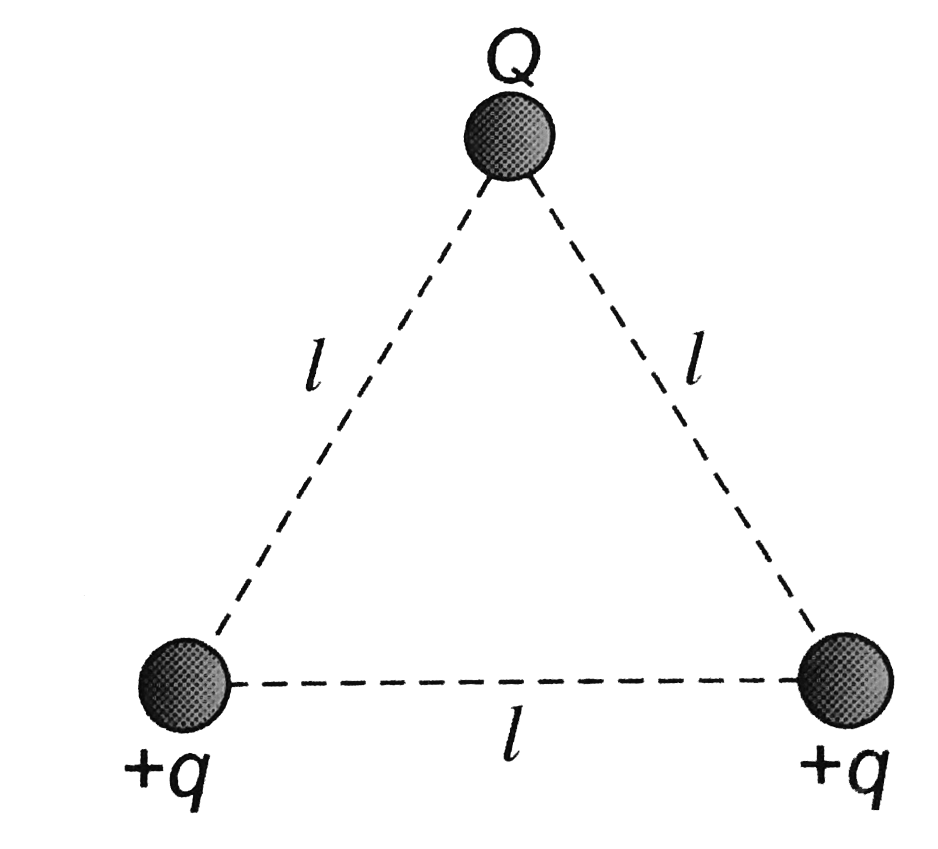
A
B
C
D
Text Solution
Verified by Experts
The correct Answer is:



Topper's Solved these Questions
ELECTROSTATIC POTENTIAL AND CAPACITORS
DC PANDEY|Exercise (B) Chapter exercises|20 VideosELECTROSTATIC POTENTIAL AND CAPACITORS
DC PANDEY|Exercise (C) Chapter exercises|50 VideosELECTROSTATIC POTENTIAL AND CAPACITORS
DC PANDEY|Exercise Check point 2.5|20 VideosELECTROMAGNETIC WAVES
DC PANDEY|Exercise Sec C|22 VideosELECTROSTATICS
DC PANDEY|Exercise Medical entrances gallery|37 Videos
Similar Questions
Explore conceptually related problems
DC PANDEY-ELECTROSTATIC POTENTIAL AND CAPACITORS-(A) Chapter exercises
- Eight small drops, each of radius r and having same charge q are combi...
Text Solution
|
- Eight oil drops of same size are charged to a potential to 50 V each. ...
Text Solution
|
- Three charges Q, (+q) and (+q) are placed at the vertices of an equila...
Text Solution
|
- Consider a system composed of two metallic spheres of radii r(1) and r...
Text Solution
|
- Separation between the plates of a parallel plate capacitor is d and t...
Text Solution
|
- The distance between the circular plates of a parallel plate condenser...
Text Solution
|
- The expression for the capacity of the capacitor formed by compound di...
Text Solution
|
- The equivalent capacitance between A and B will be "A.-|C|-|2C|-|4C|...
Text Solution
|
- Four plates of equal area A are separated by equal distance d and are ...
Text Solution
|
- Four plates of the same area of cross-section are joined as shown in t...
Text Solution
|
- Three equal capacitors, each with capacitance C are connected as shown...
Text Solution
|
- If a slab of insulating material 4 xx 10^(–5) m thick is introduced be...
Text Solution
|
- In this figure the equivalent capacitance between A and B will be
Text Solution
|
- In the connection shown in the adjoining figure, the equivalent capaci...
Text Solution
|
- The resultant capacitance of given circuit between point P and Q is
Text Solution
|
- What is the effective capacitance between point A and B in the given f...
Text Solution
|
- In the figure a capacitor is filled with dielectrics K(1), K(2) and K(...
Text Solution
|
- Four metallic plates each with a surface area A of one side and placed...
Text Solution
|
- The equivalent capacitance between A and B in the circuit will be
Text Solution
|
- The equivalent capacitance between the point A and C is given by
Text Solution
|